
The Great Scroll Divide: Digital Life’s Hidden Cost

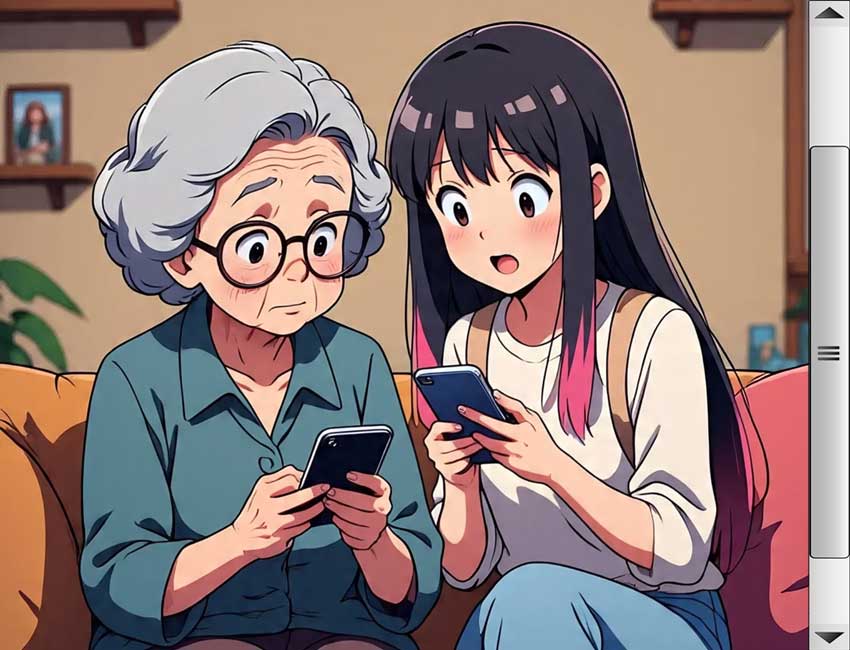

As a proud member of the ‘reply within 2 business days’ Generation X, this is my view of how interconnected tech a.k.a the Great Scroll Divide is affecting each generation and why almost everyone is paying an unseen psychological price for the convenience of interconnectedness. Writes Manjulaa Shirodkar
So here I am, a proud member of the “reply within 2 business days” Generation X, who (not so) recently discovered Instagram. My first message (read post) was a random picture of an airport tarmac with a big, black (or was it red) blob of paint on it that I thought looked particularly imaginative! At the time. Today, I know better, because there were hardly any likes – in the absence of a probable explanation by way of a caption. People must have seen it for what it was. An asphalt surface with a red (or was it black) dot! After all, it was artistic – kind of abstract but artistic nonetheless. And lack of likes did kind of upset me… but I also realised that this was new one-way system of emotional validation.

Bless my little analog heart.
Meanwhile, my 15-year-old granddaughter Sukriti – a nephew’s child, has an anxiety disorder specifically tailored to the algorithmic whims of YouTube Shorts. Her existential dread isn’t rooted in global warming (though she’s concerned) but in the terrifying possibility that her latest dance trend will get only 300 views. “Granny,” she wailed on Facetime last week, “if it doesn’t hit 10K by morning, I might as well delete my entire online identity!”
Welcome to the Great Scroll Divide, folks. It’s not just a gap; it’s a gaping canyon of digital misunderstanding, with each generation paying an entirely different, unseen psychological price for the convenience of interconnected tech.
You’ve heard of the Boomers, I am sure, and their Bewildering Black Box of Online Life.
For me (call me a Digital Immigrant) navigating this new world with a user manual in one hand and balancing a Tablet – of the electronic kind, in the other, the unseen cost is often sheer confusion and a rising sense of irrelevance. Not to mention my rising BSLs. Blood Sugar Levels, you dodo!
I gaze upon their carefully curated feeds and wonder, ‘Why are they posting pictures of their food? Is it going bad? Do they need help?’
“Is it something you wanna talk about?” I call anxiously and ask. “Is there a psychological malady that you are afflicted by?”
They turn and scoff, “We’re the influencers!”
“Influencers? Duh?”
Should I ask them, “Influencing whom? To do what? And why do you get free socks and invitations to the latest new restaurant in town just because you posted a pic of maa ke haath ka khana? Who are you influenced by, btw?”
And the truly scary part for the Boomers vis-à-vis me is that my life suddenly – if temporarily, has been revolving around a random whatsapp message from ‘Prince Mabuza’ who claims there is a real investment opportunity ‘out there in the stocks of a unicorn!’ And my other fintech nephew rushes in to stop me.
“Waittt… you can’t share your OTP and bank details with someone random from Whatsapp who you know only through your insta account!!”
“But he seems a really, nice guy,” I argue back. “He has a website, see, and all his details are up there online. The URL also begins with https:/… He definitely looks like an Eswatini Royal.”
“No, bua,” I am firmly interrupted. “It’s a scam!! Stay away.” Aah, you boomers! You know so little of the real world and your trust in ‘real’ people needs restoration. But the damage is done. A doubt has crept in. I and my millions are saved.
You see, growing up, my privacy concerns revolved around credit card numbers, not the deep-seated fear that Google knows someone searched ‘how to knit a sweater for their cockatoo.’ For the Boomers, the unseen cost is the mental energy expended trying to keep up with an ever-changing tech landscape – that often feels like a secret club they were never invited to.
Back in my time, my friends dragged me to clubs I never wanted to be a part of. Nightlife we called it. Now whether day or night, all life feels like nightlife! There’s no disconnect from the virtual noise and constant scroll through, you see! And occasionally, the actual cost of a phishing scam.
Millennials: The Exhausted Digital Middle Child
Then there’s the Millennials. The “bridge generation,” old enough to remember dial-up agony and blockbuster nights, but young enough to enthusiastically embrace broadband and the birth of social media. Their unseen cost? A profound, chronic exhaustion born from performing all through their lives.
They have watched Facebook go from a fun way to poke friends to a mandatory career networking platform. The possibilities of Linked In have been explored, exploited and super-saturated too. They have perfected the art of the humble-brag. The ones scrolling through endless baby pictures and wedding announcements, simultaneously feeling pressure to achieve more and guilt for not doing enough.

They know the algorithms are manipulating them but can’t quite quit. They are the digital equivalent of my friend who says, “I’m only staying for one drink!” and then wakes up hungover in my other friend’s bathtub! Their emotional well-being is a subtle casualty of trying to maintain a pristine digital facade while their actual lives are, you know, just lives.
But wait, here comes Gen Z: The Algorithms’ Anxious Offspring
And then we reach Sukriti’s generation – the ‘Digital Natives.’ They arrived in a world already sculpted by algorithms, their brains wired for instant gratification and constant external validation. For them, the unseen cost is truly heartbreaking: a pervasive, low-grade anxiety and a distorted sense of reality.
Their self-worth is quantified by likes and followers. Their social lives are inextricably linked to Snapchat streaks and online trends. They’ve never known a world without an online persona, and the idea of ‘unplugging’ is akin to voluntarily severing a limb. You must have seen the Gen Y moms (well, of the few who’ve actually married and had babies on time) in restaurants with the Gen Z baby on the high chair – the little one’s gaze fixed to the cell phone screen, while the mum feeds her in between her own scrolling and taking pictures of food on the table while her husband or the Millennial dad is busy with stock-taking and selling! New Normal, this life.
The algorithms, which meticulously track their preferences and feed them more of the same, don’t just shape their opinions; they shape their anxieties. A missed notification isn’t just a missed message; it’s a potential social catastrophe. Their privacy concerns extend to ‘cancel culture,’ the permanent digital footprint, and the fear that one wrong post can obliterate their future. They are literally having existential crises in 15-second video snippets.
The Unseen Price Tag
So, while I struggle with Why does Mark Zuckerberg know so much about my insta posts of my holidays in faraway little known countryside towns?’ crisis, and Sukriti agonizes over social media virality, the core issue remains: interconnected tech, while offering tremendous convenience, extracts an invisible, psychological toll. For some, it’s the quiet frustration of a rapidly changing world; for others, it’s the crushing weight of constant performance and validation.
Perhaps, the only way to bridge this digital chasm is to acknowledge that beneath the bewildered memes and the viral dances, we’re all just trying to navigate this brave digital world without losing our minds entirely. Now, if you’ll excuse me, I need to go learn how to use a fire emoji. I am the new Cool.
What's Your Reaction?
