
Musicea Saratov State Conservatoire MoU : A Global Crescendo

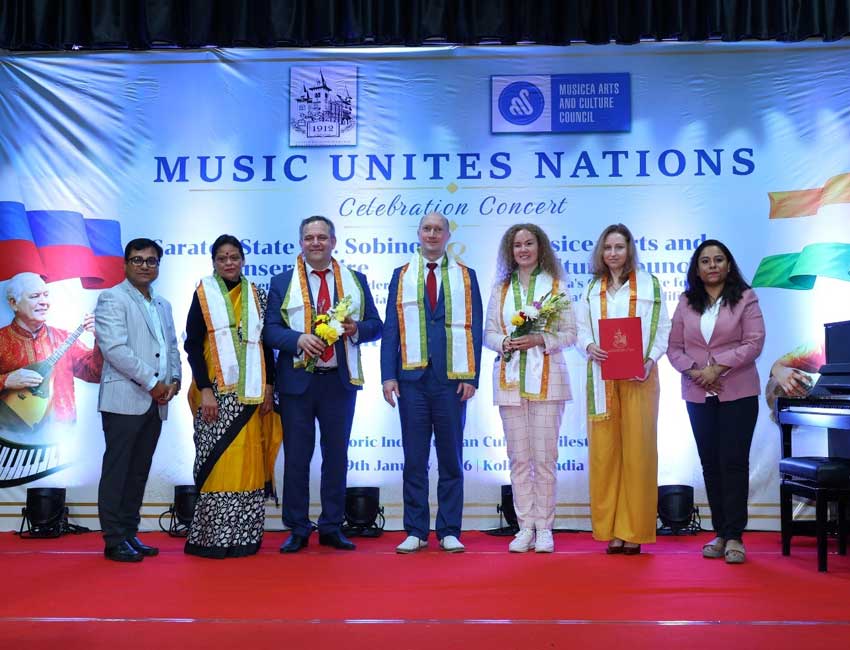

The Musicea Saratov State Conservatoire MoU marks a historic milestone, establishing a premier global academic pathway for Western music education in India through a visionary partnership led by Maestro Surendranath Majumdar.
On a crisp winter morning in Kolkata, the air at the Russian House was thick with more than just the usual January chill; it was charged with the weight of history. On January 19, 2026, the scratching of pens on a Memorandum of Understanding (MoU) signaled a seismic shift in India’s cultural landscape.
The Musicea Arts and Culture Council (India) and the Saratov State L.V. Sobinov Conservatoire—a prestigious Russian Government University—officially joined hands. This isn’t just another corporate handshake; it is the first time a Russian sovereign musical institution has partnered directly with an Indian body to formalize Western music education.
The Visionary Behind the Baton
Every revolution needs a leader, and for India’s Western music students, that leader is Maestro Surendranath Majumdar. As Director of Musicea, Majumdar has long championed a move away from “legacy” examination models—relics of the past that often prioritize certificates over actual pedagogy.
His goal? To build a transparent, outcome-driven framework where an Indian student’s talent is backed by a global academic pathway. Under his guidance, this partnership provides:
-
Direct Access: Indian students now have a bridge to internationally recognized Russian higher education.
-
Faculty Growth: Indian music teachers gain exposure to globally benchmarked standards.
-
Academic Mobility: A structured progression that allows students to move from local classrooms to international conservatories.
A Bridge Between Two Cultures
The ceremony was a masterclass in diplomacy and art, facilitated by Ms. Ekaterina P. Tyurina, Deputy Consul General of the Russian Federation in Kolkata. The presence of high-ranking Russian academics—including Rector Prof. Alexander G. Zanorin and Vice-Rector Prof. Viacheslav Y. Bondarenko—underscored the significance of the deal.
This isn’t merely a business arrangement; it is a “sovereign partnership.” It places India firmly within the global ecosystem of formal Western music, ensuring that the education provided is both future-ready and historically grounded.
From Bach to Burman: A Celebration in Sound
The significance of the day found its voice later that evening at Rotary Sadan. A Celebration Concert served as a live demonstration of what this collaboration aims to achieve.
The performances were a tapestry of global and national pride:

-
Technical Mastery: Musicea’s distinction candidates performed Western classical works on piano and violin with a precision that met international standards.
-
Cultural Roots: The program seamlessly integrated the works of Rabindranath Tagore and R.D. Burman, proving that global education doesn’t mean losing one’s heritage.
-
National Tribute: In a moving segment, the concert honored the 100th birth anniversary of Maestro Salil Chowdhury and celebrated 150 years of “Vande Mataram.”
A New Identity for the Indian Musician
For the teachers who traveled from across India to be felicitated at the event, the message was clear: your contribution is now recognized on a global stage.
Musicea is no longer just an institution; it has become India’s Global Voice for Music Education. By crafting an alternative that is “designed in India, for the world,” Maestro Majumdar and the Saratov Conservatoire have ensured that for Indian musicians, the “middle stretch” of their journey just got a lot more exciting.