
A Review of Mahua Sen’s ‘The Dead Fish’

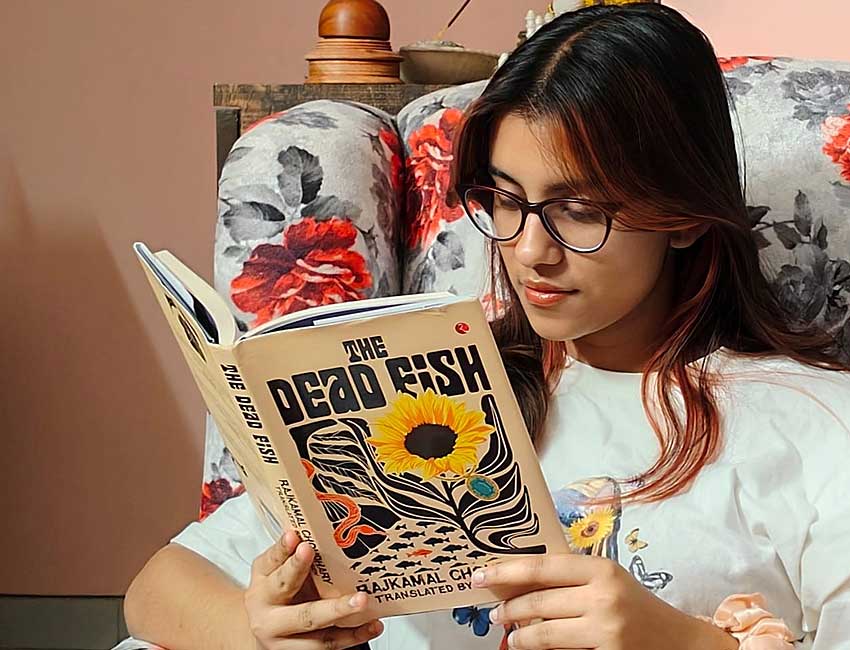

In this sharp review, Nabarni Das explores Mahua Sen’s powerful translation The Dead Fish. Sen brilliantly revives Rajkamal Choudhary’s raw 1966 Hindi masterpiece ‘Machhli Mari Hui‘, bringing its bold, unsettling depiction of urban decay and queer desire to a global audience.
Amidst the 1950s-60s milieu of Hindi literature, Rajkamal Choudhary was an outlier whose three-decade life yielded an eccentric body of work. The publication of his work “Machhli Mari Hui”, translated in English as “The Dead Fish”, in 1966 served as a bold disruption in a period marked by the hegemonic presence of “Nayi Kahani”, or New Story, a literary movement which glorified the alienation of the polite middle classes. Although not the first queer novel in Hindi, Choudhary’s work was an unrefined modernism unparalleled for its unabashed directness. He shattered the masks of the 1960s, replacing sentimentality with a clinical, often brutal depiction of same-sex desire and urban decay. By stripping the romanticism from both the human form and the city of Kolkata, Choudhary forced his readers to inhabit a visceral, suffocating atmosphere that remains startlingly relevant.
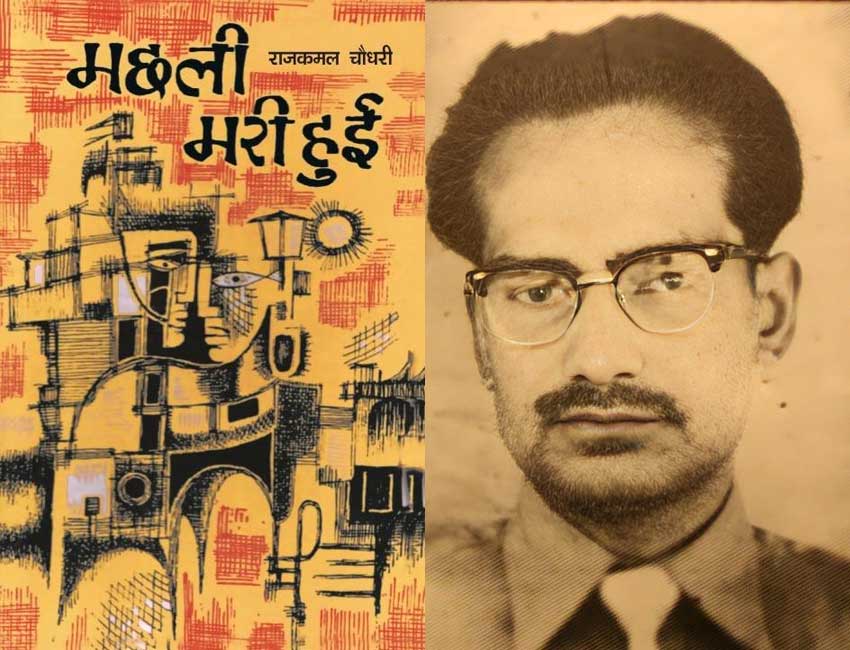
The novel’s psychological resonance is inextricably bound to its setting. Choudhary’s Kolkata is not the sepia hued city of nostalgic trams and flowers; it is a “skeleton of the city” built of steel, profit, and industrial indifference. The “Dead Fish” metaphor serves as a haunting central image for a life half-lived—a creature designed for fluidity but “condemned to dryness” and “rank with decay”. This sense of stagnation defines the lives of Nirmal Padmavat, Shirin, and Kalyani.
Desire as Capital
In this dark cityscape, tenderness is a neglected luxury. Relationships are purely transactional, and lust becomes associated with affluence and ownership. The body becomes an economic entity, just as valuable as the factories and the land that the characters exchange. Nirmal Padmavat, an extremely harsh business tycoon, lives in the “Kalyani Mansion”, a thirty-story tall manifestation of his mental scars. His efficiency is simply a façade of emotional instability, a result of his mother deserting him after his father passed away, taking off with a lorry driver, and his own sexual inadequacy.
The Architecture of Loneliness
The female characters inhabit a world characterized by “sexuality and terror.” For Shirin Salzberg, her attraction towards women represents more than simply an escape from “heteropatriarchy,” but an instinctive move away from “sex which kills.” The ghost which haunts her sexuality is the memory of her dead mother whom she lost during childbirth; Shirin lives in a state of “neurosis” with fear of the “womb that can rupture”.
Mahua Sen’s translation of this bold literary is less a linguistic transfer than a vital historical excavation. By bringing this invisible history into the light of the 21st century, Sen provides accessibility to an audience far beyond the Hindi-speaking world. She preserves Choudhary’s sparse, reportage-like style—a rhythmic kinesis that favors short, sharp sentences over lyrical padding.
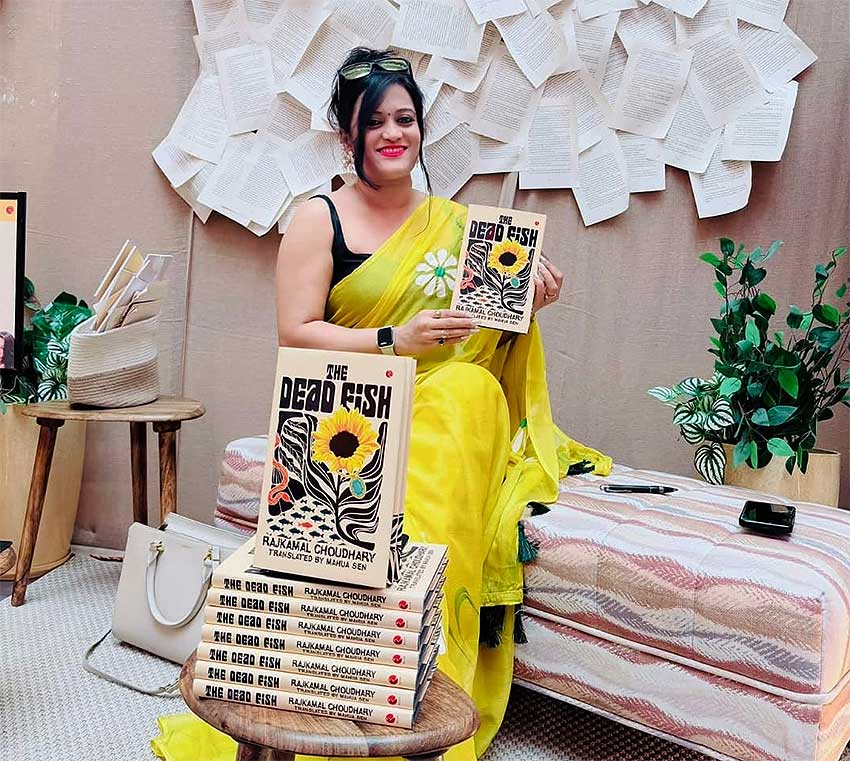
To fully grasp Sen’s “umbilical” link with the source requires an appreciation of Sen’s perspective on the process of translation. In her interview with EKL Review, Sen talks about her “kismet connection” that prompted her to venture into these perilous waters “to retrieve something that was gasping for breath”. Sen considered herself the Sutradhar, a weaver who lived the wounds of the characters to replicate them accurately in a new language. Nonetheless, there are inherent challenges to working in English. Although Sen made sure not to tame the wildness of the writing, according to some critics such as Scroll.in, there have been occasions when Sen has succumbed to providing “clinical labels”. Words like “inferiority complex” could seem a little too concrete for characters that were ambiguous and fragmented. Yet, even this tension reflects the “massive responsibility” that Sen felt; she was not merely a weaver of words but a biological mother to these “startlingly raw” characters, ensuring their rage and yearning were carried across the language gap without betrayal.

In the end, it becomes clear that ‘The Dead Fish’ is merely a reflection on the disintegration of modernity, a harsh reality of neuroses, brutality, and the choking of desires. Its strength is its unwillingness to console the reader. It is through Mahua Sen’s translation that the novel’s eternal truth has been resurrected, and we have come to understand that the Indian modernist past has been neither clean nor genteel. The text concludes as it begins, with a world gasping for moisture; yet, in the novel’s final moments, a brief rain shower offers a flicker of compassion, momentarily reviving the dead fish and providing breath to a narrative that has long survived in the shadows.
Book Details:
- Title: The Dead Fish
- Author: Rajkamal Choudhary (Machhali Mari Hui)
- Translator: Mahua Sen
- Publisher: Rupa Publications India
- Release Date: 5 August 2025
- Format: Hardcover
- Pages: 200 pages
- Price: 251 INR
- Where to buy: https://www.amazon.in/Dead-Fish-Rajkamal-Choudhary
What's Your Reaction?

Very well written review which highlights Mahua Sen’s style and captures Rajkamal Choudhary’s original thought. The review is as much a reflection of the authors as it is revelation Nabarni’s understanding of the subject.