Parachute Bhindeu

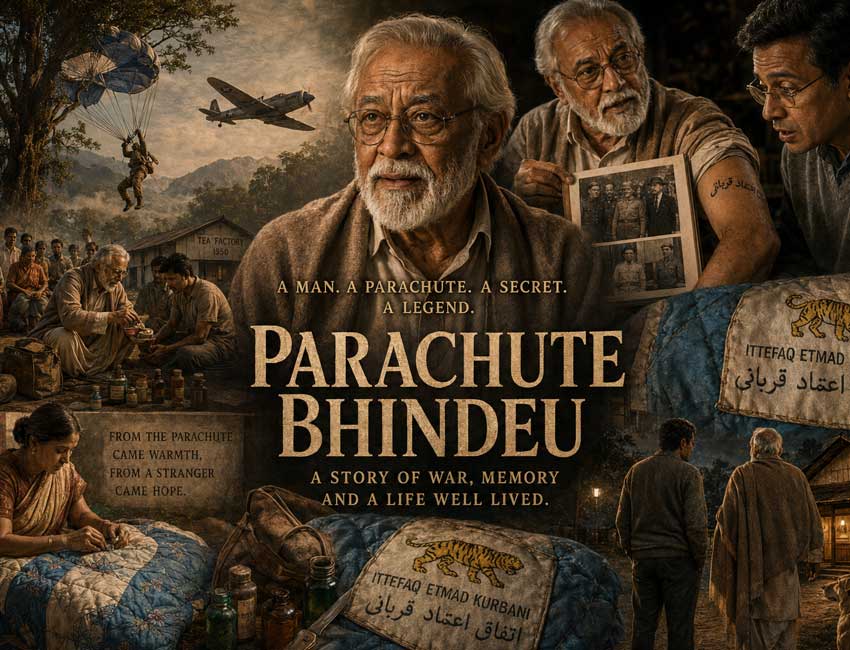

In this captivating historical tale by Dr. Saumya Shankar Choudhury, Parachute Bhindeu ceases to be a mere piece of local folklore. The narrative beautifully uncovers how a tattered relic transforms from a simple village blessing into a profound link to India’s forgotten wartime history.
‘I served in the Army and saw action in the World War’, the octogenarian Dutta cleared his throat and coughed, took a sip of water and continued in a voice not unlike Marlon Brando in ‘Godfather,’ While I was on my last mission, I jumped off the plane and my parachute got entangled in the topmost branch of a tree in the adjoining forest. I was rescued and nursed back to health by this kind village. Since the last great earthquake, I have been here’, he paused dramatically, and delivered the killer punch, ’and so has been the parachute, my saviour’.
A thunderous applause echoed in the village community hall. Sitting on the dais, Partha failed to mask a stifled yawn. He had heard numerous versions of the story in the last fifty years. A then youngish Dutta had arrived in a nondescript village near Dikom in Upper Assam after the great earthquake of 1950, carrying a huge crumpled blue and white mass of material which was apparently the remains of a parachute. He was dressed in ill-fitting khakis and an olive-green beret. Legend had it that he might have emerged from the chasm created by the earthquake in the deep forest.
His arrival in the village coincided with certain events of good fortune which spelt prosperity for the village. A factory for processing tea leaves was started by a Marwari businessman nearby, offering employment opportunities to the locals. One-eyed Dibakar became a father of a healthy boy after twelve years of a barren marriage, while the spinster Ashalata’s wedding was fixed with a barrister in Jorhat. The Namghar structure, in dire need of repairs, suddenly received a generous donation from an unknown benefactor.
In his canvas bag, which emerged from the entangled mass of the remains of the parachute, Dutta had a strange mixture of seemingly useless paraphernalia. Partha felt it might have memorabilia from spoils of a petty thief’s lifetime. Oblivious to Partha’s feelings, Dutta used the potions, concoctions and the few bottles of multi coloured pills in the bag for treatment of sick and needy villagers. He managed to cure the villagers of their fevers, dysentery, headaches, and distressingly itchy skin ailments. These acts of kindness swept away remnants of any doubt surrounding his presence in the village and the goodwill generated firmly put an end to suspicions of any magnitude arising out of the inconsistent details in narrations of his background, the strange accent or that stranger looking tattoo on his left arm.
However, what endeared him most to the villagers was the tattered parachute in all its majesty, a hitherto unknown and unseen item in the sleepy village.
The headman’s wife was so besotted with the material in sky blue, the colour of which didn’t fade till her dying day, that she weaved a quilt out of it, stuffing the sewed pieces with large Ximolu cotton balls and embellishing it with embroidered designs. In harsh winters, it was a blessing to get under the quilt, with the Headman and his wife being the privileged ones to enjoy its endearing warmth. Later, along with clothing and jewellery, the quilt was a bridal gift to their daughter when she got married to Dutta.
The parachute quilt’s fame became part of the local folklore and someone coined the sobriquet ‘Parachute Bhindeu’.
Partha, the headman’s son, who was the first graduate from the village, had his share of reservations on Dutta. When asked about his roots, Dutta gave vague replies about being brought up in rural Bengal by ageing grandparents after his parents died. He spoke of the hardship in the British Indian Army, which he joined after matriculation.
The inconsistencies failed to impress Partha. He noted that Dutta had never expressed any interest in reading any material available in the household and certainly not the weekly newspapers or periodicals which the family subscribed regularly. Neither did he find Dutta a willing participant in any discussion relating to the successive wars which India fought after independence.
It was debatable whether Dutta was literate, for he would illegibly scribble a signature if required but then signatures were meant to be illegible. He rarely used English words and was the laziest person in the house refusing to be on time for any occasion. He couldn’t dress very well. His chubby appearance was a study in contrast to that of a disciplined soldier.
Dutta rarely ventured out of the village and was oblivious to the current affairs of the outside world and always came up with an excuse to avoid travels.
Yet Dutta’s behaviour at times puzzled and intrigued Partha.
‘I have travelled the world and I have seen many lands’, he would often regale the elders on the village mel or keep mischievous kids rooted to one place for hours with his vivid descriptions of huge ships in the port of Burma, the aborigines of Andaman and the yellow people near Malaya. He would speak about the Japanese with respect and awe. He would narrate the efficiency of the Chinese craftsman who in his opinion were the best carpenters and masons in the whole world.
Partha, having graduated in History from the prestigious Cotton College in far off Gauhati, raised questions on the chronology of the events narrated by Dutta but his quest for truth would perpetually suffer at the hands of his parents and elder sister, who were clearly in awe of Dutta’s charisma. The last nail in the coffin was his parents’ positive response to his sister’s expression of interest to marry Dutta.
To be fair to Dutta, the marriage was a success and the family business amassed great wealth. Even the stubborn Partha couldn’t deny Dutta’s contribution in this aspect.
The session in the community hall that evening had come to an end. Partha was feted for his contributions as an author and a researcher. Dutta, the senior most member in the dais had chaired the session. He gathered the folds of his dhoti and draped the shawl around his shoulders and with the help of Akon, his youngest son, who himself was a small tea planter, climbed down the dais. Partha who and had settled in Bhubaneshwar, was a bachelor and was on a visit to his ancestral village.
‘You have fooled us all but we don’t mind’, Partha playfully told his Bhindeu or brother in law. They walked slowly towards their house in the village, now occupied by Dutta, furnished tastefully with all the modern amenities.
Dutta smiled the same disarming smile which had won over the village half a century ago and said,’ Yes brother. I am not the person I claim to be.’
‘Hey Bhindeu! I was joking. We owe you our success…our opulence. You took care of everything when I was away’, Partha suddenly felt ashamed at himself.
‘Well, then I must tell you something, as it is of no significance in 2007’, Dutta paused near the Namghar, a couple of dogs wagging their tails in anticipation of Parachute Koka giving their moth-eaten furs a gentle pat. Dutta didn’t disappoint them. He stroked their chins and rubbed his cold hands together.
‘You are a History Professor. A writer par excellence. Your work on INA is really commendable’, Dutta paused much to the look of genuine surprise in Partha’s eyes.
’The INA was disbanded following the alleged death of our leader, Netaji Subhas Chandra Bose. Some were jailed, some were hanged while a few disappeared’, Dutta stopped and asked Akon to go ahead.

‘But a handful few stayed back in the Andamans. The Japanese had kept supplies at various strategic locations in the islands. The war ended, but we were afraid to enter the mainland.’ Partha listened in stunned silence. All along he had considered Dutta to be an imposter, a petty thief or even a murderer. Under the smokescreen of his scepticism he had perhaps misjudged Dutta all these years.
‘I had left my village in the North Bank, a few kilometres from Lakhimpur, in 1938 to study Medicine in Calcutta. There I came into contact with Netaji and in a few months, I was in Singapore.’, By then both had resumed their walk to the house. A gentle breeze was blowing and the distant whistle of a goods train pierced the tranquil atmosphere. It was getting colder. They entered the house through the wicker gate.
’By 1949 things had settled. We learnt that India was free but divided’, Dutta continued, his eyes seemingly moist, ’Your book on INA has photographs of INA pilots, exercising in their vests’.
Partha nodded with a gaping mouth and narrowed his eyes.
‘Did you not notice that scrawny boy in the photograph with Bose on the third page. Next to that famous photograph with Hitler. He appears in three of them and this tattoo is visible clearly in the picture taken from behind,’ Dutta had almost stormed into the living room and opened the bookshelf.
’This is the photograph’, he showed a folded page inside the book which Partha had authored and which had become a collector’s item. He then flung the shawl aside, rolled his shirt sleeve and flexed his left arm to reveal a tattoo, exactly similar to the one in the photograph. It was in Urdu.
Dutta rushed inside the bedroom and hurled the folded quilt on the bed. He made a small incision in the bottom left corner of the quilt with a katari meant to slice betel nuts. Strands of cotton peeped out. He carefully folded back the cloth over near the incised area of the quilt made from the parachute.
The same words in Urdu as in the tattoo stared back at them. A faded insignia of a yellow tiger was visible. The inscription of Ittefaq Etmad Kurbani printed both in English and Urdu, the letters in Urdu resembling the ones in the tattoo, stood out proudly, even if a shade paler.
‘The Indian Government had been flying old INA planes to its various airfields in a programme to incorporate its handful pilots in the Air Force. We were trained in Tokyo in ‘42. Your book has a chapter on the Tokyo Boys. On us! I was flying to Chabua with another INA pilot but the engine died and we crashed. Perhaps I was lucky to have been bailed out by the parachute. Perhaps the wreckage of the plane is deep under the mighty Brahmaputra. I had lost my memory then when I came to the village, but over the years it has come back in patches. But it surely came back after reading your book!’
A perspiring Partha remained transfixed like the statue of his late father in the village square. His history lesson was complete. Perhaps he could finally give the benefit of doubt to his Parachute Bhindeu, after all these years.
What's Your Reaction?