
BECOMING: Richa Jha’s Journey in Indian Children’s Books

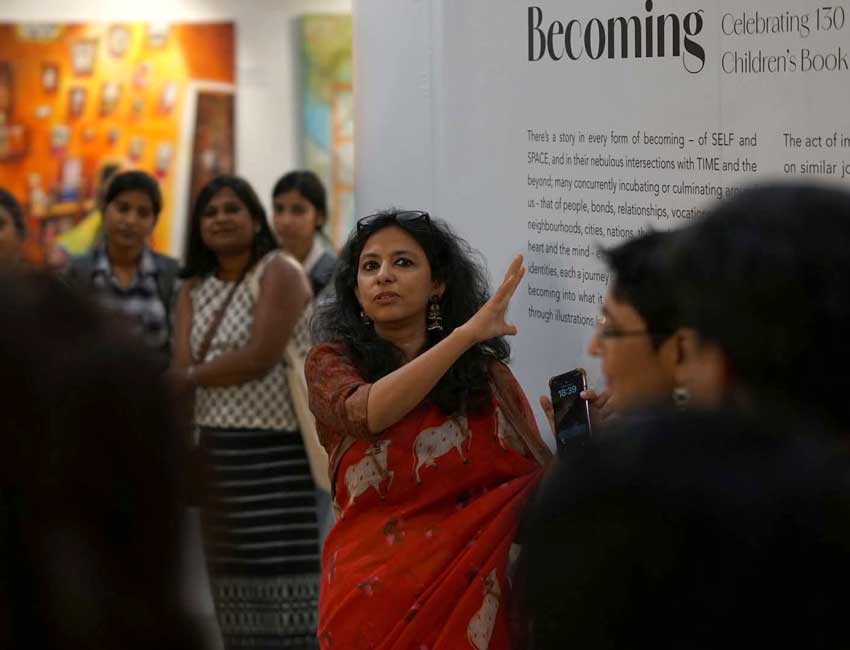

In this inspiring feature, writer Nabarni Das takes us inside “BECOMING“—a groundbreaking exhibition celebrating Indian children’s picture books. Discover how author and publisher Richa Jha reshaped visual storytelling, honoring the timeless power of art and imagination.
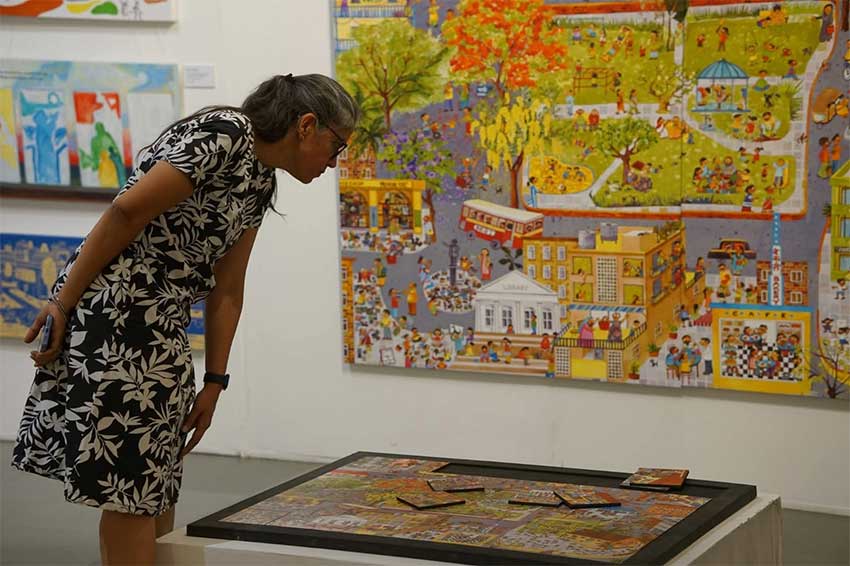
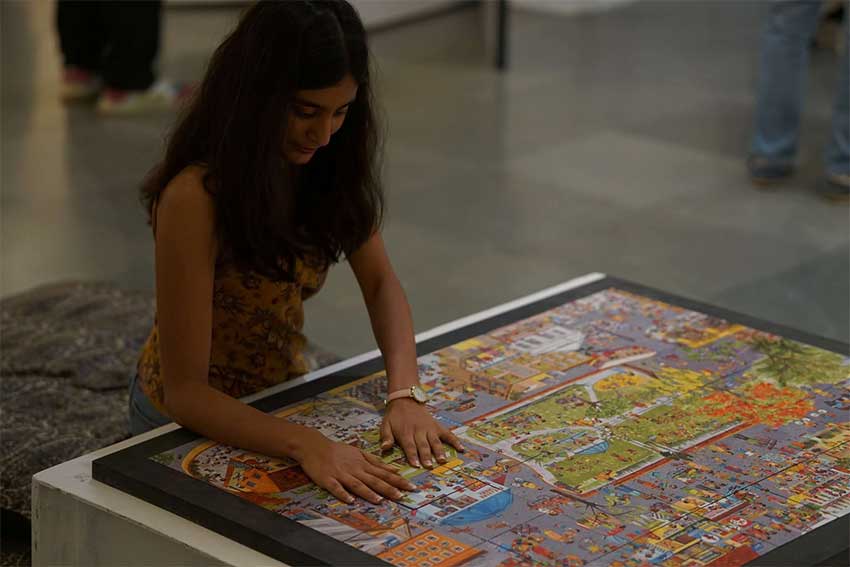
A little girl and her father are on their knees on the floor of the children’s gallery, their heads bent over a giant puzzle map. She turns a bright yellow piece in her hand, trying to fit it to the coastline of a familiar state. He smiles, lets her struggle for a few seconds, then gives her the gentlest nudge. Their laughter rises softly in the quiet of the museum, floating past framed illustrations, early sketches, and the bold colours of picture books lining the walls. It is precisely the kind of moment Richa Jha had hoped for when she put this exhibition together. “A picture book isn’t just for a child”, she says, “it slows everyone down. It lets adults reconnect with wonder.”
And in that moment, child and parent piecing together a map, her belief becomes visible. Richa Jha, author, publisher, traveller, and now curator, has spent the last decade reshaping how Indian children’s literature is created, read, and remembered. BECOMING, her latest undertaking, is not simply an exhibition; it is a declaration of love for picture books and a tribute to the long, often invisible history of Indian children’s illustration. At its heart lies a deceptively simple idea: that stories meant for children are not necessarily limited by childhood, and that the images we encounter when we are young can remain with us long after we have stopped calling ourselves children.
Before she was a publisher or curator, Richa was simply a writer, the kind of person who lingered over sentences and instinctively felt the emotional possibility of picture books. She remembers the early days vividly: the long hours, the self-doubt, and the unexpected joy when her first award came. “It wasn’t about winning”, she remembers in the interview, laughing softly. “It was about feeling seen. And that was something.” There is something revealing in this idea of being seen, particularly within children’s literature, a space that is often treated as secondary to literature written for adults. To be recognised was not merely to receive an award; it was to have her work acknowledged as something worthy of attention.
Her stories resonated not just with children but also with adults who recognised themselves in her gentle narratives. She attributes this to something very simple: honesty. “If the story is authentic”, she says, “it will reach anyone, no matter their age.” But writing, she realised, was not enough. To bring the books she dreamed of into the world, she needed to become something more. Thus, Pickle Yolk Books was born—named spontaneously and lovingly. “I didn’t want to make ten books a year”, Richa says matter-of-factly. “I wanted to make two beautiful ones.”
Quality over quantity was not a business strategy; it was a philosophy. She handpicked stories that moved her, stories that asked difficult questions gently, and stories that treated young readers with respect. The result was a catalogue that was small, but piercingly thoughtful: Machher Jhol, Akela, The Unboy Boy, Dance of the Wild—each title quietly reshaping the landscape of Indian picture books. The significance of this approach lies not simply in the books themselves, but in the belief behind them: that children are capable of complexity, that difficult subjects do not have to be softened into meaninglessness, and that beauty and seriousness can coexist within the same page.
But running a one-woman press had its own storms. “You are everything”, she says, “The editor, accountant, marketer, designer, worrier.” She laughs, but it is the laugh of one who has fought through real fatigue. Publishing demanded that she occupy every role at once, often carrying responsibilities that remained invisible to the reader who eventually encountered the finished book. And yet, the awards, across India and abroad, made it clear that her insistence on craftsmanship mattered. Still, publishing was only one chapter. Something bigger had begun to take shape in her mind.
The idea for BECOMING arrived slowly, through questions, through memories, through a desire to look back as much as forward. “I kept thinking”, she explains, “‘Where is our visual history? Where are the illustrators who shaped us?’” BECOMING became her answer. The question is larger than an exhibition. It asks us to consider what happens to the visual history of childhood when the people who created it, and the images they created, are not remembered. It asks where the illustrators are who taught generations of Indian children how to imagine, long before illustration was given the cultural attention it receives today.
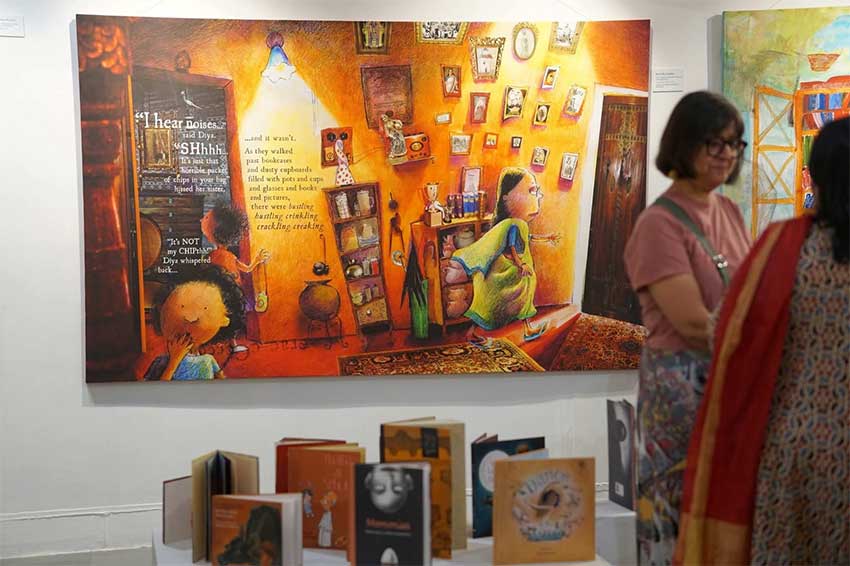
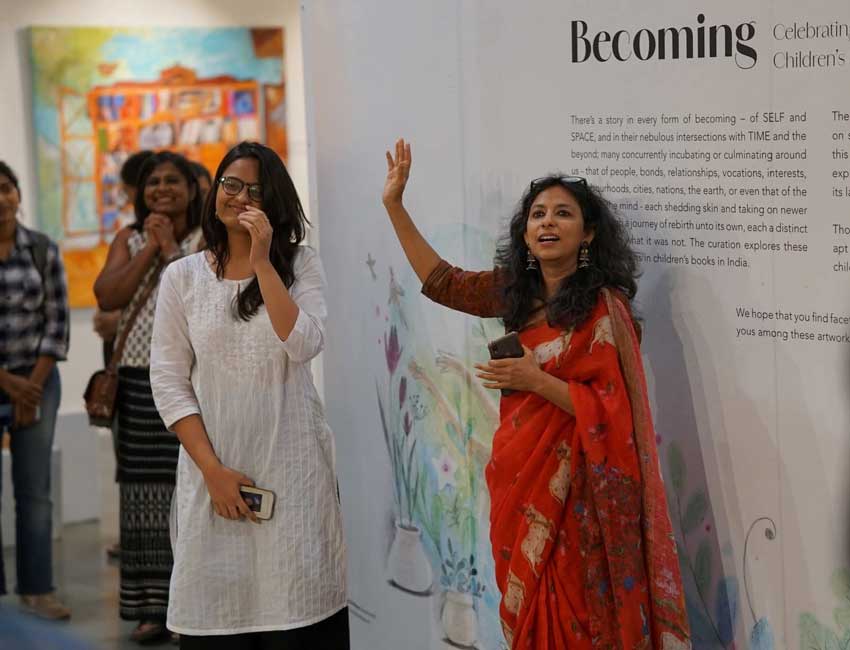
The title itself reflects both the evolution of Indian children’s illustration and Richa’s own journey. “We’re all constantly BECOMING”, she says, “all of us: artists, readers, picture books themselves.” The word suggests movement rather than completion. To become is to exist somewhere between what has already happened and what might still happen. Instead of placing the art chronologically, she chose to arrange it emotionally. The exhibition flows like a story: fear, joy, belonging, wonder—each section revealing how artists across a century have interpreted the inner worlds of children. In doing so, the exhibition moves beyond a simple history of illustration and becomes an exploration of childhood itself: its fears, its joys, its desire to belong, and its capacity for wonder.
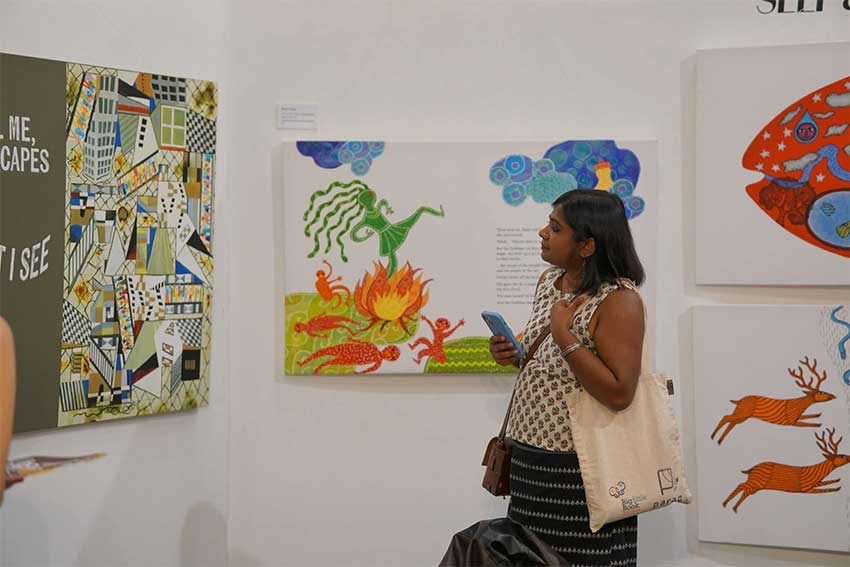
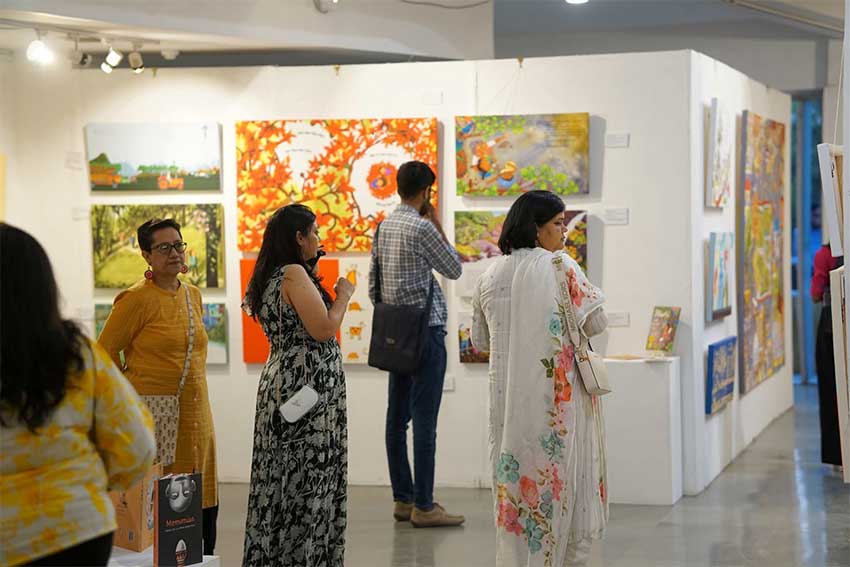
Along the walls hang the works of giants: Abanindranath Tagore, Satyajit Ray, Pulak Biswas; beside them are the bright colours and bold lines of contemporary illustrators: Gautam Benegal, Sumanta Dey, Ruchi Shah, Priya Kuriyan, Atanu Roy. The result is a visual dialogue between eras, rather than a separation of the past from the present. “You can see a lineage”, Richa says, almost in awe. “You can see how we carry each other forward.” There is an important recognition within this lineage. Artistic traditions do not simply disappear and reappear in isolation; they are inherited, challenged, transformed, and carried forward. The contemporary illustrator exists partly because of the artists who came before, just as future artists will inevitably inherit something from those working today.
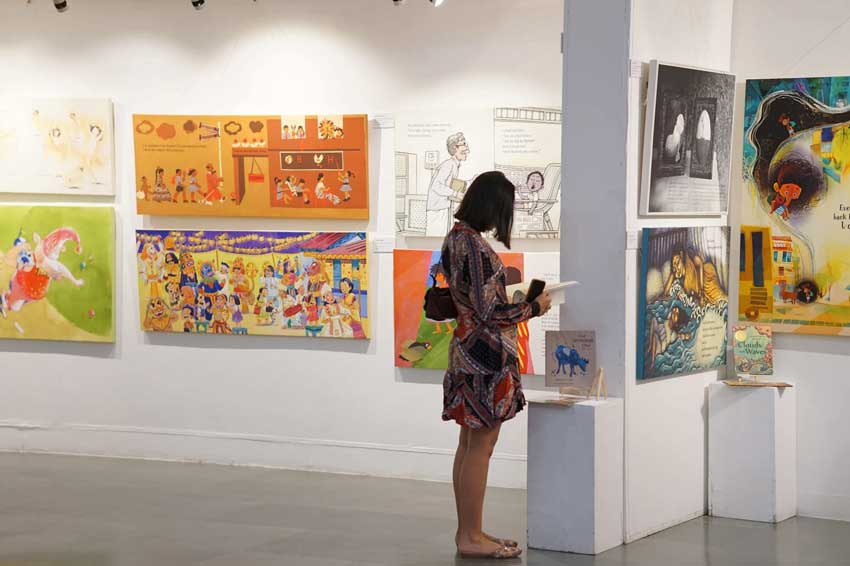
What sets the exhibition apart, however, is its interactivity. A walk-in book. A puzzle map. Reading corners inviting parents and children to sit down together. “I wanted people to play”, she says. “Art should be experienced in the body, not just looked at.” This becomes particularly meaningful in an exhibition about children’s literature. The visitor is not asked merely to stand at a distance and observe. Instead, the exhibition creates opportunities for participation, for touch, movement, reading, and play. A child placing a puzzle piece beside a parent is therefore not simply interacting with an object; they are inhabiting the very philosophy of the exhibition.
Collaboration with artists, publishers, designers and educators became both the heart and backbone of the show. “It’s a community effort”, she insists. “One person can hold the vision, but many hands make it breathe.” The statement reflects the nature of children’s literature itself, which is rarely the work of a single person. Writers, illustrators, editors, publishers, designers, educators, parents, and readers all contribute to the life of a book. Richa’s curatorial work extends that same collaborative principle into the museum space. And yes, she hopes BECOMING will travel. “Why not?” she says. If the exhibition is concerned with the ways stories and images move across generations, then perhaps it should also be allowed to move across places.

Richa has said often and with conviction that picture books are for everyone, not just for children: “They ask you to feel without rushing. And we all need that.” In a digital world that enshrines speed, she considers picture books a counter-movement—an invitation to pause, reflect, breathe. They create a space in which the reader is not required to move quickly from one piece of information to the next. Instead, the page can be inhabited. An image can be looked at twice. A sentence can be carried for a while. She talks about grief, kindness, loneliness, imagination, and how picture books can hold these weighted things with gentleness. “They can talk about anything: grief, fear, love, social issues, if they do it with care”, she says. “Children understand more than we think.”
Perhaps that is one of the most important ideas underlying her work: that children do not need to be protected from complexity so much as they need complexity to be offered to them with care. Grief can exist in a picture book. So can fear, love, loneliness, imagination, and social issues. What matters is not whether the subject is difficult, but whether it is treated honestly. A picture book can therefore become more than a form of entertainment. It can become a language through which a child encounters emotions that they may not yet have the vocabulary to articulate.

When asked to describe in a single word what she wants her work to do, she paused for a long moment. “Self-discovery”, she finally said. A word as soft as a blanket, as powerful as an embrace. It is also perhaps the word that most clearly connects the different parts of her career. The writer searches for the right story; the publisher creates the conditions for that story to exist; the curator places stories and images into conversation with one another. Across each role, the underlying impulse remains the same: to create spaces in which people can recognise something of themselves.
In the gallery, a little girl finishes her puzzle. She claps her hands, proud. Her father takes a picture. The gallery lights gleam back in their eyes—two visitors, two readers, BECOMING something together in the quiet company of art. Richa watches scenes like this with a kind of quiet fullness. Writer, publisher, curator—every role she has held seems to converge here, in this celebration of story, memory, and imagination.
“I think all of us are just trying to become who we were meant to be,” she says. “And picture books… they help us get there.” The statement gives the exhibition its final meaning. BECOMING is not only about the transformation of Indian children’s illustration; it is also about the transformation of the people who encounter it. The child who walks into the gallery is not quite the same child who walks out. The parent who sits beside them is not merely watching. They are remembering, perhaps, a version of themselves that existed before adulthood taught them to move quickly, to stop looking, to stop wondering.
In the museum, in her books, in her publishing house, and now in BECOMING, Richa Jha creates spaces where people, young and old, can pause, feel, imagine, and grow. Her contribution is therefore not limited to the books she has written or published, nor to the exhibition she has curated. It lies in the spaces she creates around stories—in giving them somewhere to live, somewhere to be encountered, and somewhere to be remembered.
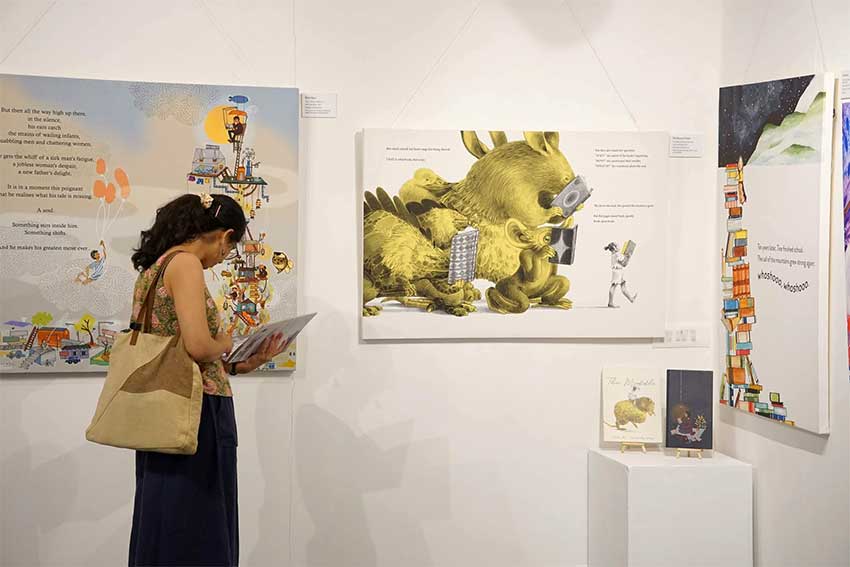
And perhaps that is what it means to become. Not to arrive at a finished version of ourselves, but to continue changing through the stories we read, the images we remember, the people we encounter, and the questions we are brave enough to ask. Richa Jha’s work reminds us that picture books can hold all of these things. They can hold childhood and adulthood, memory and imagination, fear and wonder. They can hold us for a moment when the world insists that we keep moving.
And perhaps that is her most important contribution: not just building stories, but building places where stories can live and breathe in, and hold us as we, too, become.
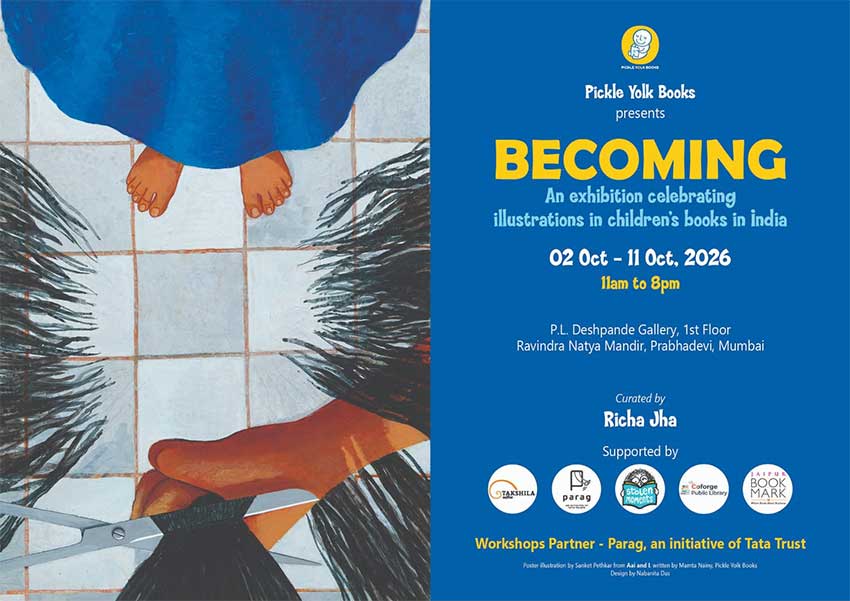
After a successful run in Delhi, BECOMING is now coming to Mumbai, celebrating 130 years of illustration in children’s books in India. The exhibition opens on 2 October 2026 at 12 noon and runs until 11 October, from 11 am to 8 pm, with free entry and open access for all, at the P. L. Deshpande Gallery, 1st Floor, Ravindra Natya Mandir, Prabhadevi. Curated by Richa Jha, BECOMING is not just for children; it invites people of Mumbai, of all ages into the fascinating world of picture-book art.
What's Your Reaction?
