Translating Freedom: Wani Nazir on Mahua Sen’s The Politics of Liberation

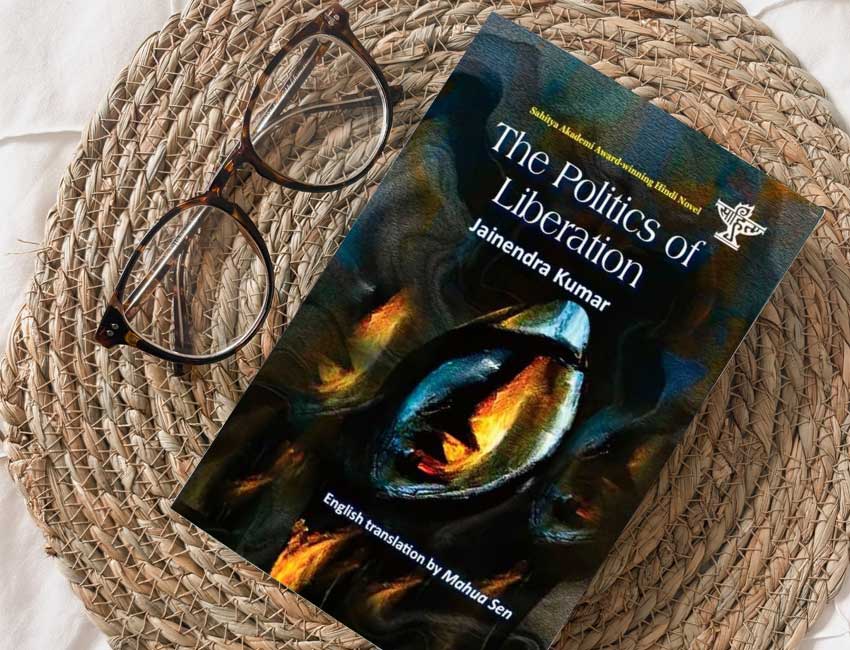

Reviewing Mahua Sen’s English translation, The Politics of Liberation, Wani Nazir explores how language, psyche, and the ethics of freedom intertwine. Mahua Sen masterfully bridges cultural divides, capturing the profound interiority and political dilemmas of Jainendra Kumar’s original work.
There are books that wade into politics through the door of history. Jainendra Kumar’s Muktibodh enters through a smaller door: a door of a room at night, a sleeping man, the mind refusing to sleep. “My sleep has been erratic these past few nights.” The private opening is like a wound under the clothing: “I’m gripped with a profound sense of dilemma.” The political dwelling of the novel begins here, at the distance between the life you have been given, and the life you can still call your own.
Mahua Sen’s English translation, The Politics of Liberation, crosses that same distance, but between languages. Translation is a different kind of leaving. In one house, something leaves and enters with the dust of this other house. Muktibodh’s translation, says Sen, is “a privilege yet arduous a process.” She identifies the difficulty with Kumar’s “idiomatic expressions and metaphors intrinsic to Hindi”, many of which “have no direct equivalent in English”. The original words are not coins to be exchanged. It is to convey an atmosphere across. She desires to maintain the “original spirit, richness and beauty” of Kumar’s prose, its “tone and spirit”, its “depth, lucidity and subtlety”.
Kumar’s Sahay is a man shaped by action. He does not believe the internal self is valid. “Thinking and writing have become necessities for me”, he admits, but thought creates a problem. “Thinking is a form of retreat.” Outside is the real world, the world of administration, decision-making, consequences. “The real challenge lies beyond walls.” His creed is almost brutally simple: “Thoughts are for idlers. Real men confront the world outside and solve its problems.”
However, the walls start to shift. What Sahay thought was outside gradually reveals itself to be within. The novel is imbued with the quiet violence of a cultural politics. The outer world comes to act as a mirror, and the mirror is not going to remain still.
The title Muktibodh is liberation which, however, must be understood not as an event but as awakening, a state of consciousness to be constantly reclaimed. The politics of a country do not free the individual living in it. Thus, the eye-catching curve ball, “The country longed for freedom, but looking back, I wonder if it was I who needed to be free.” History enters the body. Independence becomes personal.
Sahay must therefore fight against more than political structures. Every borrowed identity that seeks to become permanent is problematic. “Every word that comes from outside only builds resistance within me. I don’t want to hear anything—not even a single word—about duty.” ‘Duty’ here seems to be like a stone. Virtue is what others insert into the self and then call it that.
Love seems, momentarily, an option. “Others may want me to change, to grow, to become someone ‘better.’ But love doesn’t ‘demand’. It simply accepts as it is.” With Neelima, Sahay feels he can exist without performance: “With you, Neelima, I don’t have to wear a mask.” But the mask has many faces – morality, religion, ideals, even goodness itself. “I cannot accept any kind of mask—not of ideals, or principles, or even religion.”
What is left when the masks are taken off? It’s not necessarily good. No purity. The truth, perhaps, may be ugly or unpleasant. “Let whatever arises in me come from my own self, whether it’s good or bad, selfish or selfless. That, to me, is truth.”
Neelima is aware of the threat. They expressed a desire to become other people’s conscience. The same is true of Scorpio. I wanted to become your conscience. But now I see, that was a self-deception.” “Not even love can govern what lies in the heart.” And beneath love, morality, politics, this novel finds something more ancient and less obedient: “In every heart, there is only one force, that’s desire. That alone drives us, and that alone is the end point of all our journeys.”
Translators find this the most difficult part. Kumar’s sentences have a lot of emotion because of conviction. Through a philosophical proposal, a confession is born; through intimacy, we touch the metaphysical. A literal translation of this prose will let the skeleton fly, but the soul be grounded. Sen has to select rhythm, register, metaphor, and silence. As a result, she does not just remain true to words. She imparts with accuracy the novel’s unsurety.
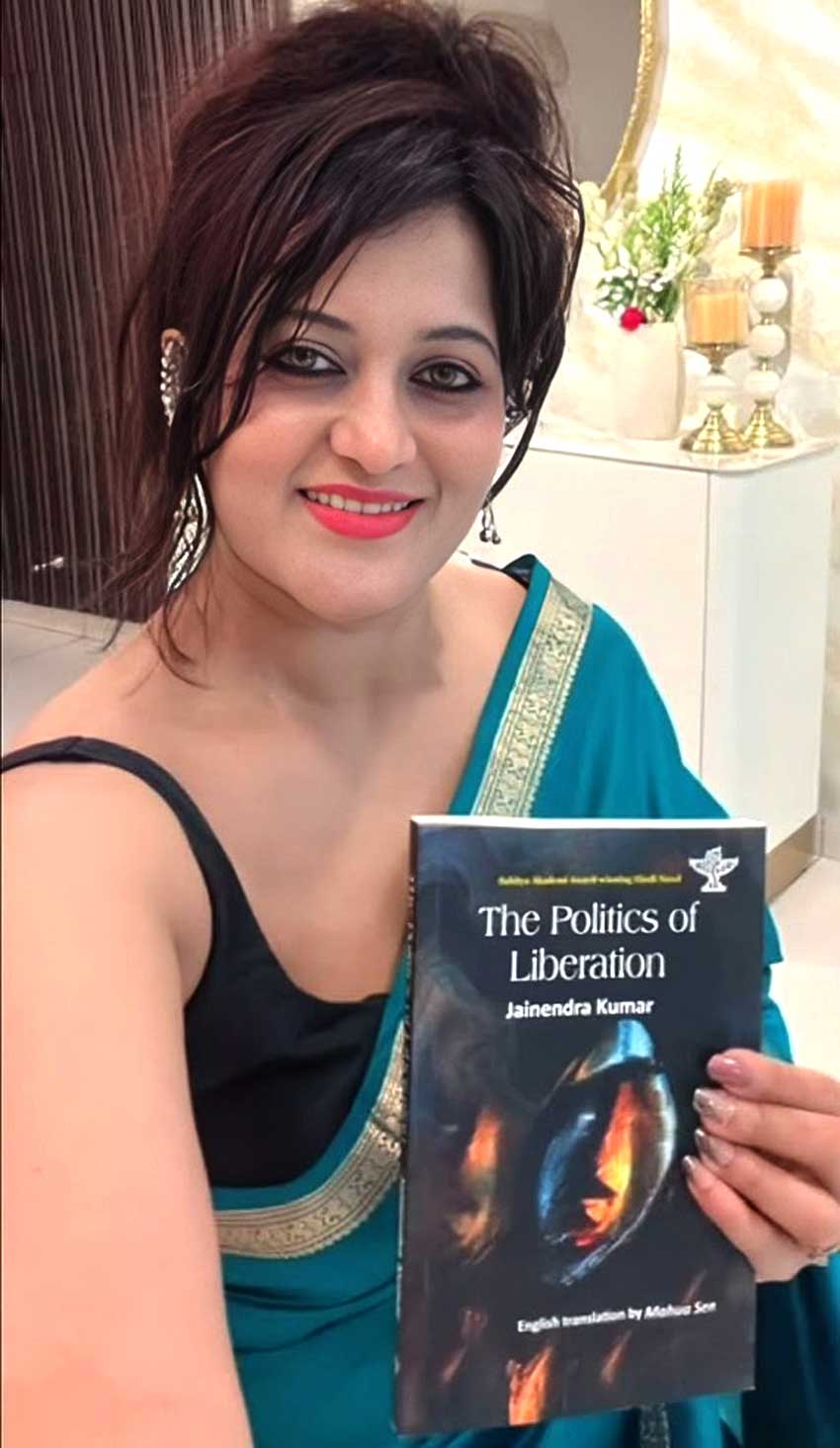
“Duty may bind a man, but dreams, they set him free.” It seems almost aphoristic, but Kumar will not let it settle into wisdom. Waking dreams might liberate you, but they can become a chore. Hopelessness may confine duty but can still create another duty attached to life. Freedom is always messy.
The conflict between father and son tells us this. He wished his mother could forget that he was her son. Viressar wishes to be acclaimed an orphan when they come in search of a refuge as an inheritance.” On the contrary, it weighs heavily on him: “I’m not his son; I’m his burden.” He is burdened by his father’s reputation. “He has a name, a reputation, I’m considered his son. Outside, everyone measures me by his name, and I shrink.” Even renunciation is suspected when it conceals ambition: “His pretense is that he doesn’t want any position. But this entire renunciation, this so-called austerity, is only for that position.”
Likewise, power, too, is emptied of its apparent solidity: “The power to rule… it is an illusion. It’s not real.” This statement does not make politics irrelevant. It makes politics more personal. Power persists because people either want it, submit to it, resist it, or mistake it for themselves.
The book is also conscious of the gender distribution of that power. Neelima states that “a woman is deemed unfortunate the moment she steps into politics or even entertains the thought. Such a path, for her, is seen not as an expression of her womanhood, but as a betrayal of it.” Then comes the sentence which reveals the whole architecture: “A man lives for a dream; a woman lives for the man of that dream.” Here, love itself turns political because the desire of the woman is allowed only as long as it is tethered to the man’s destiny.
Spirituality cannot provide an easy way out. At Gandhi’s Samadhi, the well-known invocation ‘Hey Ram’ becomes a question ‘Raghupati, Raghava, Raja but who is this Ram? Where does he dwell? What meaning does he hold for me?” The holy word has travelled through history but still must be discovered privately. Translation accomplishes a comparable action. One Word investigates how a word with a history can live again, in a different language.

The concept of surrender present within the novel is also unstable. “Life is a struggle, right up to the very end.” But “that peace… it doesn’t come from effort. It comes from surrender.” And even surrender has a big question mark at the end. “It is just a defense mechanism. A retreat.” Kumar rejects comfort whenever it becomes excessive.
This denial wins the finale. Sahay announces, “I’ve become the Minister.” The journey of politics seems to have reached its end. But arriving doesn’t lead to freedom. In its place, solitude: “I was left alone in the room—alone, to manage the weight of my own sternness, and to endure in solitude, whatever fate had in store for me.” The chair has been acquired. The self stays.
Maybe this explains why the novel does not allow freedom to have a last act. “It would have been beautiful if the story of liberation had ended there, in that stillness. But the world doesn’t grant us such clean closures.” Our liberation continues unabated, because the self is always changing, resisting, desiring, and creating. “The pattern continues to unfold—layer upon layer—because perhaps everyone must arrive at liberation in their own time.”The deepest paradox of the novel follows: “Liberation and creation are not separate things. Maybe liberation is found through creation. And if we look closely, we will see that every act of creation is also the making of a bond.”
Translation forms mutual bonds. It does not remove the gap between Hindi and English; it generates to produce something meaningful across. Sen’s The Politics of Liberation is not thus just a mere linguistic transfer. It is an interpretive act. The book investigates how politics can manifest itself in the everyday lives of even minor characters. It is also about the claims that we make on one another the various claims of family, love, morality, nation and language.
Thus, the highest faithfulness of the translation does not consist in making Kumar’s universe entirely at home. Letting go of some of its strangeness, it can survive. A translated novel must continue to trouble the reader as much as it troubles Sahay. Being liberated in Muktibodh is never getting possession of an answer. One must have the courage to exist within the query.
Translation, when taken seriously, can do the same thing. It transmits a voice across a boundary while fully acknowledging the border’s existence. It fosters closeness while maintaining distinction. Sen’s translation unsettles English by Kumar not simply translates Kumar into English. The answers given in the novel are not just transposed. It takes forward the queries which do not allow and refuse even in the end to complete liberation.
Book Details:
- Title: The Politics of Liberation
- Author: Jainendra Kumar (Muktibodh)
- Translator: Mahua Sen
- Publisher: IBP Books
- Release Date: 9th September 2026
- Format: Paperback
- Pages: viii+143pp.
- Price: 336 INR
- Where to buy: https://www.ibpbooks.in/the-politics-of-liberation/p/64302
What's Your Reaction?