
Chittaranjan Giri on Craft, Character & Complex Roles


In an interview with Manjulaa Shirodkar, Chittaranjan Giri talks about his role in Kaisi Ye Paheli, a film that’s currently on the festival circuit of Jagran Film Festival 2026 – the world’s largest travelling film festival. Giri also talks extensively about his work spanning over two and half decades, his kind of cinema and the medium he loves the most – theatre.
The 14th edition of Jagran Film Festival (JFF 2026) which was inaugurated in Delhi on 20th August has a lineup of nearly 200 films – including international and national features, shorts, documentaries, retrospectives and tributes. It also includes a special section titled JFF Junior with films specially for younger audiences. Amidst the line up are hidden gems such as ‘Kakori’ which won the National Award for Best Non-Feature (2025) for Kamlesh Mishra and Ananyabrata Chakraborty’s debut ‘Kaisi Ye Paheli’ starring Sukant Goel, Sadhana Singh, Rajit Kapur and Chittaranjan Giri in key roles.
Set against the verdant and serene hills of Kalimpong, the film is a murder mystery which features Goel and Giri as police officers handling the investigation of a young girl’s mysterious death. Giri plays Tamang Sir — a cop tasked with figuring out the not just ‘who dunnit’ but ‘why dunnit’!! Giri as Tamang endears his character to the audience not via theatrical bravado but through deadpan humour and a series of witty oneliners. He brings a distinct quiet authority to the role, balancing tension with sharp, unexpected lightheartedness.
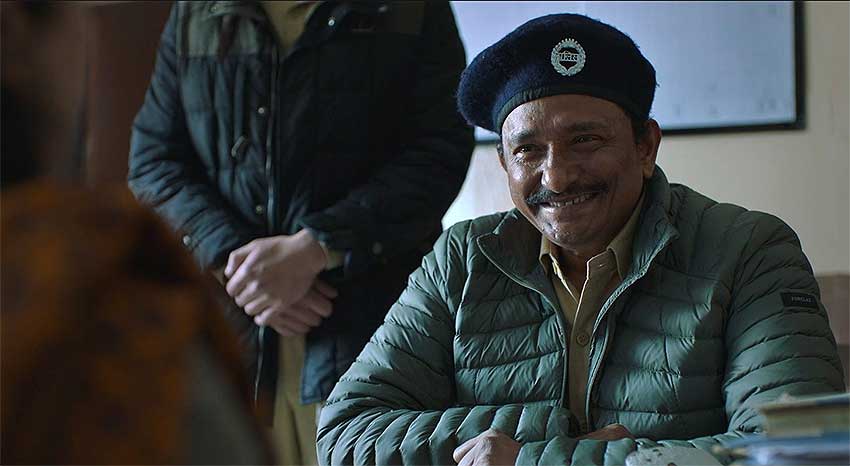
It is a trademark performance from an actor whose career across Indian cinema has been defined by quiet versatility. From regional art-house cinema to politically charged drama, Giri’s filmography reflects a constant refusal to stay in a comfort zone. In the Konkani film ‘Paltadacho Munis’ (Man Beyond the Bridge), he delivered a performance of profound vulnerability. In Bhushan Patiyal’s ‘Aakhir Palayan Kab Tak’, he steps into the shoes of a journalist assisting the cops in a murder investigation set against the backdrop of passive aggression and communal displacement. His filmography is vast as it is varied. It spans Hindi films like ‘Gulaal’, ‘1971’, ‘Matrubhoomi’, ‘Super 30’, ‘Thackeray’; Marathi cinema like ‘Lathe Joshi’, Jabbar Patel’s ‘Dr Babasaheb Ambedkar’, Vishal Bharadwaj’s debut film ‘Makdee’ and a significant stint in Bhojpuri films alongside actors like Ravi Kishan, demonstrating seamless moves across linguistic and cultural boundaries.
Despite tackling politically charged narrative terrains or ethically complex roles, Giri maintains a clear distinction between an actor’s personal worldview and the character at hand. For Giri, the character’s internal reality takes complete precedence over the political leanings or ideology of the project. “As an actor, the ideology of the film does not matter to me,” Giri explains. “What matters is what I bring to the table for that character. The journalist in ‘Palayan…’ is at a point where he wants to be neutral. The truth lies somewhere in between, so I don’t have to give my opinion. As an actor, I have to safeguard that character.”
This commitment to safeguarding the truth of a character extends even to playing morally ambiguous or dark roles. Giri approaches dark characters not with judgment but as an exercise in human nuance and audience awareness. “Modern acting has a lot of layers within,” says Giri. “As an actor I am socially aware but I shouldn’t become so biased that if I find a role challenging I refuse to do it. I will play a dark role in a manner that the audience too will see it as wrong.”
This drive to continually challenge his craft eventually led him to one of his most prominent mainstream roles — playing Yasir – a key lead role in Raj & DK’s hit web series ‘Farzi’ where he shares screen space with Shahid Kapoor, Vijay Sethupati, Amol Palekar, Kay Kay Menon and Bhuvan Arora. Though Giri had never originally intended to move into films, shifting to cinema was a deliberate choice to step outside his comfort zone. The commercial success of ‘Farzi’ marked a major turning point, bringing widespread visibility to an actor who had spent decades honing his craft in quieter arenas.
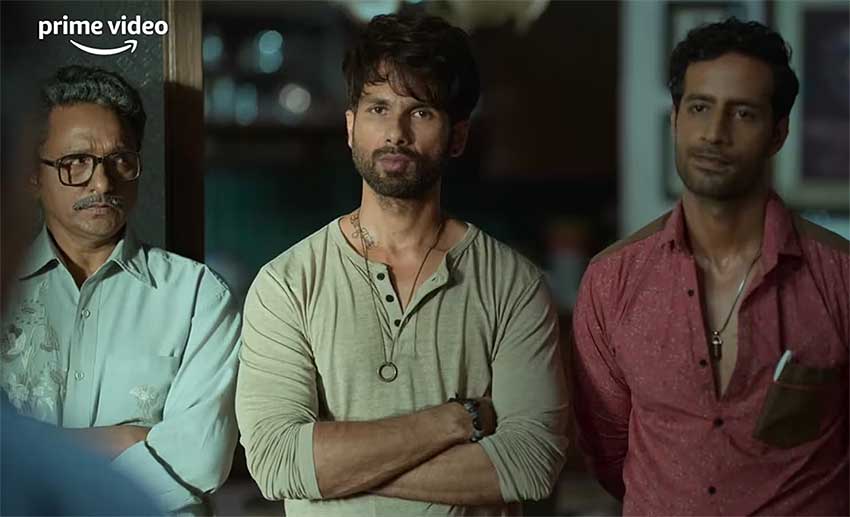
Despite the newfound commercial recognition, Giri’s foundation rests on critical acclaim. ‘Man Beyond the Bridge’ directed by Laxmikant Shetgaonkar was awarded the National Film Award for Best Feature Film in Konkani and the FIPRESCI at Toronto IFF, while ‘Lathe Joshi’ garnered multiple festival nominations. Amrit Sagar’s ‘1971’ is based on a true story of a bunch of POWs plotting an escape from a Pakistani camp. It features Giri as Subedar Ahmed and won for Sagar the National Film Award in 2007-2008. ‘Kaisi Ye Paheli’ has also won the Best Director for Chakraborty at Yellowstone International Film Festival in Mumbai last year.
Giri’s understanding of performance also informs his work behind the camera. When directing his debut film ‘Awakash’ (a film that he has also scripted) — a story following a woman Sujata (played by Giri’s wife Ashwini) who returns to her parental home after a failed marriage only to find herself displaced by her younger sister—he approaches storytelling entirely through a performer’s perspective.
“My universe is that of an actor only,” Giri says. “I direct a film like an actor. When we see a character, we first imagine how they would dress, how they would walk, talk, behave overall. The power of your imagination takes the character forward. If you’re directing what you have written, you are visualizing every character through an actor’s eye.”
This deep visualization stems from a lifetime built on the stage, followed by an intentional effort to resist artistic complacency. Born in Jaunpur, UP, near Banaras, Giri was a restless youngster keen to forge a path away from his family business. Encouraged by his mother, a play he watched at age 15 sparked an epiphany. His early journey took him through the vibrant theatre circuit of Banaras and Mumbai, co-founding the group Vyakhya in the late 1980s. Recognizing the need for formal rigor, he enrolled in the prestigious National School of Drama (NSD), graduating in the early 1990s alongside contemporaries such as Zakir Hussain, Adil Hussain, Rajesh Tailang, Anup Soni and Milind Inamdar.

He spent subsequent years at the NSD Repertory (1993–1996), directing landmark plays like Mahesh Elkunchwar’s ‘Pratibimb’ and ‘Parineeti’ (featuring Mukesh Tiwari and Vijay Raaz), before making his screen debut in Jabbar Patel’s ‘Dr. Babasaheb Ambedkar’ (1996) as Ramdas Gandhi. In the interim, he also acted in several television serials. “But I was getting complacent and the routine got to me,” states Giri explaining why he left TV for teaching.
Thus, despite his success in the Repertory and on television, Giri made deliberate exits whenever he felt his growth stagnating. He left the Repertory and later, in 2003, made a conscious decision to stop doing TV serials entirely because he felt he was losing himself as an actor. “Acting was beginning to feel like a routine 9-to-5 job where daily rehearsals and evening shows left no room to research, study characters, or explore the craft deeply. I was veering towards mere gimmickry to hold the audience’s attention.” Choosing the uncertainty of freelance film work defines Giri to date.
For him, whether directing, performing in small-town theatre, or headlining a streaming blockbuster, the ultimate purpose of acting remains intrinsically linked to human empathy and societal awareness. “We are all living in difficult times and I’m very clear that I never want to hurt anyone… We live in the hope that we live in a good world and that is what will inspire me to become a good actor. If the world is not good, then how can I possibly hope to become a great actor? I don’t look at society from behind the veil. I remain aware and therefore I am the actor I am.”
Like his characters, Giri saved his best punchline for the last. His best is yet to come. Like most of his work hitherto, it will arrive silently but leave with aplomb. Keep an eye out for it.
What's Your Reaction?
