A Journey of Learning Indian Mythology Through Audiobooks

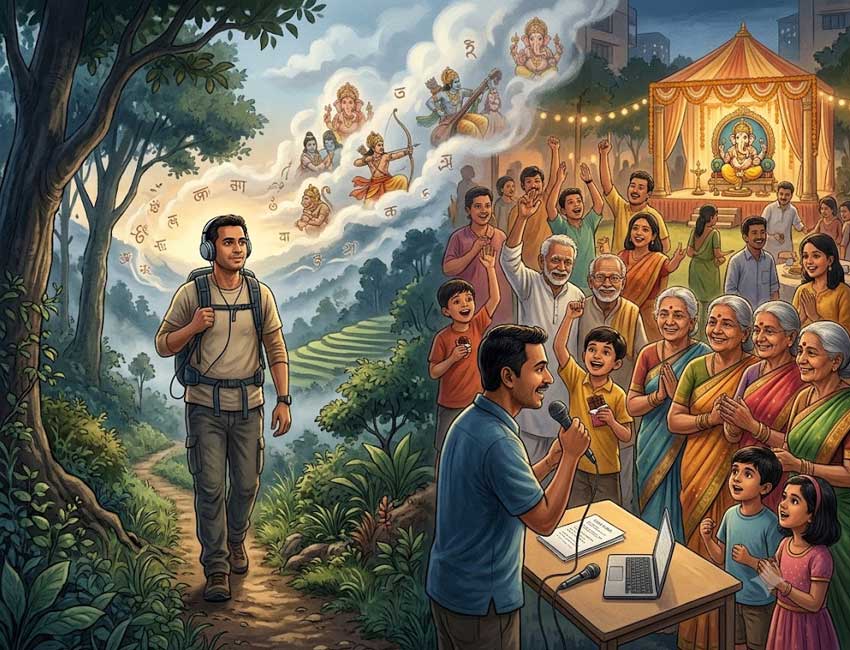

In this inspiring article, Kamdi Hemant Bhaskar shares his personal journey of learning Indian mythology through audiobooks during solitary treks in Nagaland, showing how a quiet passion for stories unexpectedly blossomed into a meaningful connection with his community.
Being alone in Nagaland, away from my family, gave me considerable free time before and after office hours. I tried to use it productively, combining long-distance walks, running and trekking with audiobooks.
I initially used earbuds, but they caused ear pain and headaches after a while. I then switched to lightweight, over-the-ear, noise-cancelling headphones, which made long listening sessions far more comfortable. The noise cancellation also allowed me to listen at the lowest possible volume with good clarity, without being disturbed by surrounding sounds.
I remember doing hundreds of rounds around the guest house where I also lived, before and after dinner, while listening to audiobooks. On solo treks, I sometimes listened for eight to ten hours continuously. Over time, these walks and treks became not just physical activity but a regular space for learning.
Around 2023–24, that learning developed into a particular interest in Indian mythology. I explored books and commentaries on the Vedas, Ramayana, Mahabharata and Bhagavad Gita, and particularly enjoyed listening to and re-listening to several works by Devdutt Pattanaik.
I liked Pattanaik’s approach because he presented mythology without unnecessarily hurting the sentiments of believers under the name of being factually correct, while offering his own perspective in a rational manner. His familiarity with a wide range of scriptures and texts also enabled him to compare traditions, identify similarities and differences, and critically examine several sources together.
Some of the books introduced me to fascinating and lesser-known stories from the Vedas and the epics. I read and listened to them mainly for knowledge, understanding and the joy of discovery, but also with another purpose in mind: to have stories to narrate to my children.
To be honest, I am not a very spiritual person. People around me may hardly have ever seen me going to a temple. Perhaps that makes it even more surprising that so much mythology could eventually come out of my mouth. My interest was more in learning, understanding, interpreting and enjoying the stories than in presenting myself as a spiritual person.
I still remember my children sometimes looking at me with astonishment and asking, “Baba, how do you know so many things?”
Somewhere inside me, I had always craved that expression from my children. After all, narrating stories to them was one of the important reasons I was reading mythology in the first place. I wanted not only to give them moral lessons, but also to show them that behind many familiar stories there are lesser-known versions, unusual characters, different interpretations and fascinating details.
Something that appears very familiar can have many layers hidden underneath.
Occasionally, I also used these learnings in my public speaking. Alongside my reading, in 2025, I developed the habit of meticulously listing whatever I read and re-read—the book name, title, author’s name and date of reading. I did not record the facts themselves; I simply maintained a record of what I had read. One such record is available here as an image for reference.
I also discussed mythology from time to time with friends and people around me. But I was careful because such conversations can easily turn into debates that continue without reaching any logical conclusion and, instead of enriching the discussion, can sometimes create unnecessary differences or even strain relationships.
I had never imagined that this vast amount of reading would one day have any particular utility.
Then came the Ganesh Festival of September 2026.
I received a call from Rajashri Didi, one of the main organisers of the festivals and cultural activities for which our Rachana Sayantara society is known and appreciated. She asked me if I could jointly conduct a quiz for the residents as part of a week-long series of evening cultural and entertainment programmes.
During our discussion, she suggested sports and current affairs as possible themes.
I almost cleared my throat before telling her, “Didi, I hardly know anything about sports. In fact, I have not watched even a single cricket match on television so far. And my general knowledge is also not particularly good.”
Instead, I suggested that we use a subject I knew somewhat better. I told her that I knew a little about mythology and understood how to structure a quiz. I felt the subject would suit both the occasion and the audience.
She immediately welcomed the idea and felt it was even more relevant to the event.
I also told her that a quiz would naturally be more serious than songs and dances and could be skipped if the audience was not in the mood. It was not meant to occupy the main stage. It could simply fill a gap between programmes or help manage delays.
The moment I hung up, I started preparing.
I used artificial intelligence to generate initial clues, questions and options in both English and Hindi, and then curated and refined them repeatedly. Finally, I developed four themes in sequence: Vedas, Ramayana, Mahabharata and Ganesha, with six questions under each.
I was particularly careful that nothing in the questions should hurt anyone’s religious sentiments. The intention was to create curiosity, not controversy.
I also deliberately kept different levels of difficulty. A few questions were very easy so that children could participate and win a chocolate. Some were moderate, while a few were meant for those with a deeper familiarity with mythology.
What gave me confidence was that I knew the background of every question. They were not facts collected overnight. Many had emerged from books and commentaries that I had been reading and listening to for years.
I was also conscious of how I wanted to present myself. I did not want to appear as a spiritual preacher. I tried to come across more as an academician and an enthusiast who had developed a genuine curiosity about mythology.
When the quiz began, the children’s round immediately brought energy into the programme. The questions were simple enough for them to attempt, and the chocolate added to the excitement.
The adults, especially during the ladies’ round, connected easily with familiar stories and participated enthusiastically. Many answered correctly, while others came very close. When someone gave an almost-correct answer, I preferred to encourage them by saying, “You are very close. Try again,” rather than simply declaring it wrong.
The senior citizens seemed particularly intrigued by stories and interpretations that differed from the versions they had commonly heard. Some came from original texts, while others belonged to popular traditions and lok kathas passed down through generations.
Whenever an opportunity arose, I tried to connect the stories with broader messages—love, peace, rationality, absence of ego, women’s empowerment, change and continuity in mythology, difficult times as opportunities, comedy and humour within serious traditions, the wisdom of mythology, goodness within what may appear to be badness, and the regional differences as well as harmonies found across the epics in contrast to absolutism.
Because the quiz was only a filler activity, we could conduct only two rounds on the first evening. The remaining two were completed on another day when another gap arose in the programme.
The activity was appreciated by many, both young and old. Children enjoyed participating, adults connected with the familiar themes, and elders found the lesser-known details and perspectives particularly interesting.

After one of the sessions, while having dinner, I noticed a group of senior ladies standing together in a circle, eating and chatting with one another. I approached them and asked whether they had enjoyed the quiz.
Perhaps I was asking for more than feedback. The human inside me was craving validation and appreciation.
Their response was overwhelming.
They blessed me generously and appreciated the effort, particularly the fact that someone from the younger generation had taken such an interest in mythology, explored it in detail and tried to present it in a positive and constructive manner. Some even expressed the wish that more youngsters would develop such curiosity.
My family members also appreciated the effort immensely, which made the experience even more satisfying.
I did not know it at the time, but my naughty younger sister had quietly taken a photograph of this interaction.
That photograph now has a special emotional significance for me. It does not simply capture a few elderly ladies appreciating a quiz. It captures a moment when years of private learning—accumulated through solitary walks, long treks, audiobooks, repeated listening and reading—were suddenly recognised by people who actually live around me and know me closely.
That matters to me.
Appreciation from people with whom you live and interact throughout the year can have a very different meaning from appreciation from people who are only remotely connected. The photograph reminds me of that moment of warmth, validation and connection.
For years, I had considered this reading a completely personal pursuit—for knowledge, entertainment, curiosity, and especially for the stories I could share with my children. I never imagined that it would eventually become a way of connecting with my own community.
The journey from those solitary walks in Nagaland to that evening during the Ganesh festival felt unexpectedly complete.
We keep learning without knowing where that learning will take us.
The happiness we get out of learning itself is often sufficient to fulfil the purpose.
And sometimes, quite unexpectedly, that learning finds its own moment to come alive—in a child’s astonishment, a conversation with friends, a public speaking opportunity, a community gathering, or a photograph that quietly preserves a meaningful moment.
Perhaps that is enough.
What's Your Reaction?