When Did We Stop Seeing Each Other as Human?


As headlines reduce Manipur violence and peace to grim statistics, community development professional K. Richard Luihing, from Maram Ramlung in Senapati district, reflects on a deeper tragedy: how prolonged conflict and online hatred are slowly eroding our shared humanity.
Manipur is burning, and somewhere along the way, we are learning to hate.
Every morning, I check the news. And every morning, I am afraid of what I might find. Another firing.
Another killing.
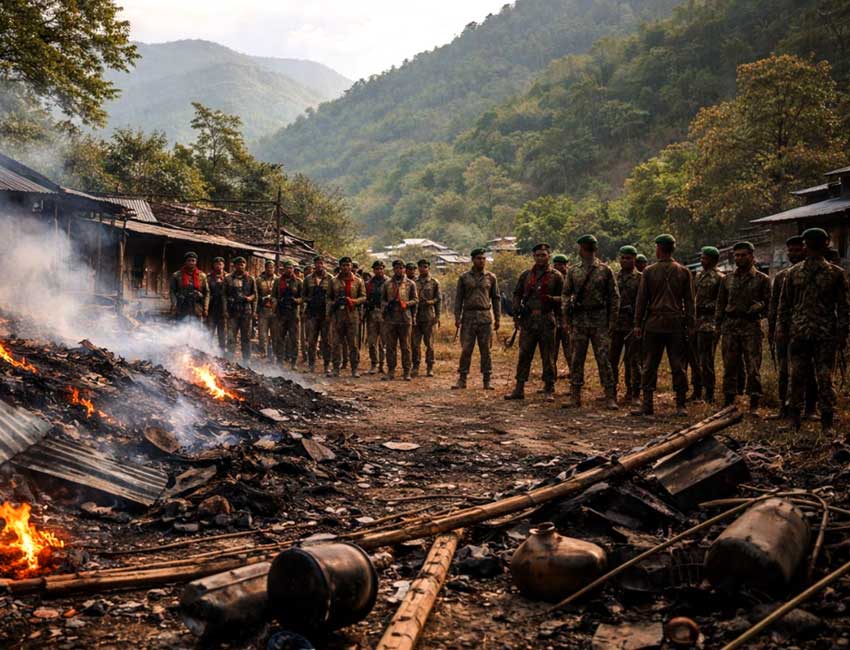
Another village attacked. Another house reduced to ashes.
Another family forced to leave behind everything they have known as home.
Sometimes, there is a photograph. A lifeless body. A face that was once someone’s entire world. And beneath it, hundreds of comments. Some expressing grief, others expressing anger, and some, disturbingly, explaining why that person deserved to die. I often wonder when we became so comfortable with this. When did someone’s death become something we could debate? When did we start looking for reasons to justify a killing instead of simply mourning a human life?
Manipur has been living through a terrible chapter since May 2023. Hundreds of lives have been lost, thousands of families displaced, homes destroyed and livelihoods shattered. Many are still living in relief camps, waiting for a normalcy that seems to move further away with every passing day. But statistics have a strange way of making suffering distant. We read about hundreds of deaths and thousands of displaced families. The numbers are horrifying, but after a while, they become just numbers on a screen.
We scroll past them.
Except that somewhere, a mother is still waiting for her son to return. Somewhere, a father is trying to explain to his child why they cannot go home. Someone is sleeping in a relief camp, wondering how much longer this temporary life will last. Someone is afraid to take a road they once travelled every day. And somewhere, a child is growing up learning that people from another community are not to be trusted.
Perhaps that is the tragedy we are not paying enough attention to.
We speak about the lives lost, the homes destroyed, the displacement and the political failures. We must. These things cannot be brushed aside. But I wonder if we are also paying attention to what this prolonged violence is doing to us as people.
Something has changed in the way we see one another.
Three years ago, many of us were asking when the violence between two communities would end. Today, another community has been drawn into another cycle of violence. And instead of stopping to ask how we arrived here, we seem to be finding newer reasons to deepen the divisions.
How many more communities must become enemies before we realise where this is taking us?
I understand anger. I understand grief. I understand that for someone who has lost a family member, a home or an entire lifetime of memories, being asked to forgive can sound almost cruel. Nobody should be expected to forget what has happened to them. Nobody should be asked to pretend that their suffering is over. But does our suffering give us the right to celebrate someone else’s? I think that is a question we have become increasingly uncomfortable answering.
When someone from our own community dies, we mourn. We demand justice. We want answers, and rightly so. But when the person accused belongs to another community, our grief often takes a different direction. We begin searching for explanations. What did they do to us? What happened to our people before this? Who attacked first? What happened to our village last year?
Before we realise it, we are no longer talking about a person who has died. We are talking about the community they belonged to. The individual disappears. Their identity takes over. And somehow, their death becomes less worthy of compassion. This is perhaps how hatred sustains itself. Not always through violence, but through the quiet acceptance of someone else’s suffering. Through the belief that our pain is greater, our losses matter more and the other side deserves whatever comes their way.
Social media has only made this easier. A video from years ago is circulated as though it happened yesterday. An unverified message travels through hundreds of WhatsApp groups. A photograph is shared without context. A rumour becomes a fact simply because enough people have repeated it. And when we are angry, we rarely look for the truth. We look for something that confirms what we already believe. We want evidence that we are right, that the other community is wrong, that our anger is justified. We forward things without checking them, react without understanding them and sometimes celebrate things we would once have found deeply disturbing.
I wonder how many of us have stopped to think about the consequences of a message we forward in anger. Somewhere, that message could become someone’s reason to pick up a weapon, attack a neighbour or refuse help to a person in need.
Words have consequences. Especially in a place already struggling to hold itself together. I do not know when Manipur will find its way out of this. I do not know whether another agreement, another ceasefire, another security deployment or another political arrangement will finally bring lasting peace.
I hope they do. We desperately need them.

But I am beginning to feel that something else needs to change alongside all of this. We cannot keep waiting for peace while teaching ourselves to hate. We cannot expect children to grow up together when the adults around them are busy explaining why they should stay apart. Think about the children who have spent a significant part of their childhood in this atmosphere. What are they learning about people? What memories are they making? What will they think when they grow up and look back at these years?
Will they remember a neighbour who helped their family, or only the community that neighbour belonged to? Will they remember friendships, or the stories of hatred they heard at home? Will they ever know what it feels like to live in a place where a person’s name, language or identity does not determine whether they are safe?
We owe them something better.
None of this means that crimes should go unpunished. Those responsible must be investigated. The guilty must be held accountable. Justice is not optional, and asking for it is not an act against peace. But justice and revenge are not the same thing. Holding individuals accountable is not the same as blaming an entire community. And the death of an innocent person cannot become acceptable simply because another innocent person died yesterday. We have already lost too many people. Too many homes. Too many years that could have been spent living, working, studying and growing together. I don’t have a solution to offer. I cannot tell a family that has lost everything how to rebuild its life. I cannot ask someone who has lived through unimaginable fear to simply trust again. And I certainly cannot pretend that peace is just a matter of changing our attitudes. There are difficult questions of justice, security, governance and accountability that demand honest answers. But there is one question each of us must answer for ourselves.
What are we becoming?
One day, the guns may fall silent. Roads may reopen. Schools may fill up again. Markets may return to life. People may begin travelling between places they have avoided for years. But will we be able to look at one another without suspicion? Will we be able to sit across a table, share a meal, work together or simply greet a neighbour without first remembering which community they belong to? Or will the violence have ended only on the surface, leaving behind a hatred that continues to be passed down, quietly, from one generation to another?
I don’t know what Manipur will look like when all of this is over. But I hope we do not reach that day only to realise that, in trying so hard to protect our own people, we have forgotten how to see the humanity in others.
Perhaps the first step towards peace is not forgetting what happened. It is not pretending that everyone is equally responsible, or that every wound can be healed with an apology. Perhaps it is much simpler, and much harder. It is refusing to celebrate a death. Refusing to turn another person’s suffering into a victory. Refusing to teach our children that hatred is something they must inherit. Because when the guns finally fall silent, we will still have to live with one another.
And I hope, by then, we haven’t forgotten how.
What's Your Reaction?