Are Planchettes in Seances Macabre but Real?

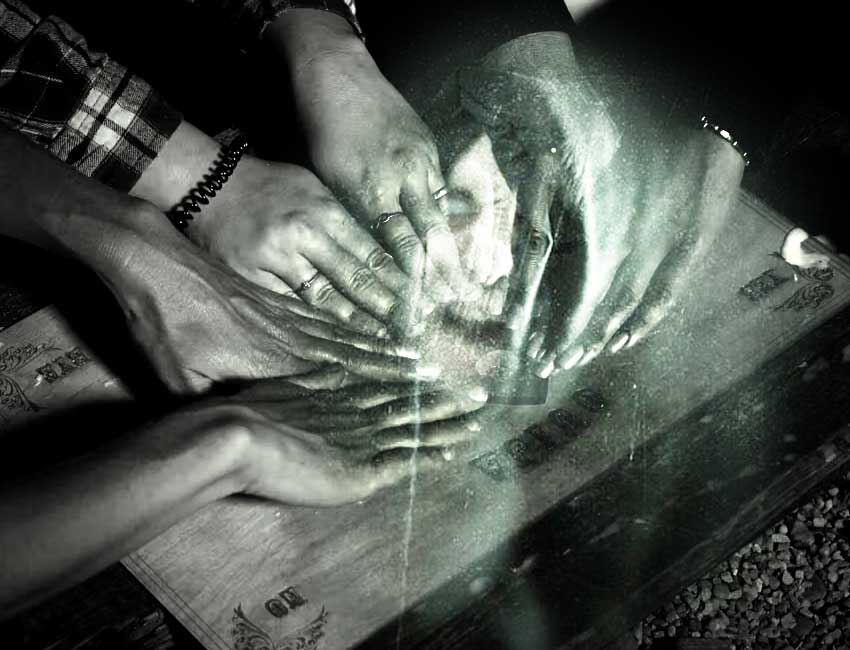

Planchettes, tools to commune with spirits, hold a fascinating history. The Theosophical Society of India famously hosted sessions with Rabindranath Tagore, bridging the earthly and paranormal. Prasanta Paul investigates this intriguing, out-of-this-world practice.
Do you desire to enter into the macabre world of paranormal and speak to your departed dear and near ones through planchettes in séances? It’s a strict ‘No’ ‘No’ for non-believers though.
Fed up with a plethora of requests for planchettes, the Kolkata branch of the Theosophical Society of India (TSI) is almost ready to hang up a “No Planchette” signboard at the College Square office here.
Because, the slew of pleas almost every week for conducting planchettes, an umbrella term in Bengali for séance, is fast turning out to be a big headache for the society office bearers, leaving them hard pressed to devote to other engaging matters of concern.
A host of family members keen to establish ‘contacts’ with their close but dead relatives, have kept on thronging the society premises for a hearing and subsequent solution through the world of paranormal.
Theosophical Society- A Brief History
The Society which once shot into fame for its Hindu occult practices, has been finding it quite difficult to shake off its much-touted mantle that it has been ‘wearing’ for more than one and a half century.
A relevant question may crop up here and quite reasonably so—why is TSI being chosen by the people for the purpose of planchettes?
Let us go a little deeper. Theosophy has originated from the Greek word ‘Theos’ which means wisdom while ‘Sophy’ stands for God; Theosophy is the result of the amalgamated two.
Way back in 1875, a Russian lady, Mrs. H.P. Blavatsky and Col. H.S. Olcott, an ex-British army officer, founded Theosophical Society. In less than a decade, they were inspired by the tenets of the Vedanta and Upanishad and moved over to Madras in India to establish the Theosophical Society of India in 1886.
And the beliefs that powered TSI were an odd mix of religion, philosophy and occultism.
Delving deeper into ancient esoteric philosophies of India, they were soaked into the search of the existence of an ‘Unseen Universe’; the nature of its inhabitants, if any, and the laws that govern them and their interactions with mankind and other investigators fascinated them.
Mrs Annie Besant who popularised TSI in India, found in the Upanishads a storehouse of wisdom for the realisation of the Absolute (Truth) and divinity. The dire need of India, she felt, is the development of a national spirit, an education founded on Indian ideals, enriched but not dominated by a flurry of Western thought and culture.
Hence, by resurrecting and strengthening the ancient Hindu doctrines and philosophies, the organisation sought to investigate unexplained laws of nature and the psychic and spiritual faculties and powers latent in mankind.
Planchettes: Trend of Fostering Communication with Spirits
Gradually, fostering communication with spirits gained momentum in India, especially Bengal; for Bengalis have an eternal fascination for anything that has a remote connection with the paranormal. And this preoccupation has found a tantalising reflection in Bengali literature, films and some traditional customs down the ages.
Equipped with a two-wheeled caster and a pencil-holding aperture pointing downwards, a planchette, technically speaking, is supposed to facilitate automatic writing.
Once the mind assumes the right composure through a sort of divine meditation-cum-concentration on the departed soul either through a medium or by one’s own self, the medium or the self is possessed by the spirit thus invoked.
Then, the device starts communication with the spirit, producing written messages on paper to as many questions thrown by the medium as possible; the session lasts as long as the medium or the self is strong enough to withstand the myriad and cryptic process.
The Tagore Connection & Tradition of Planchettes
A number of leading Bengali litterateurs including Nobel laureate Rabindranath Tagore have been ‘blamed’ for popularising planchettes in the Victorian era.
And more importantly, several of them including Tagore were drawn by the TSI’s disquisition of the whole gamut of the laws governing the cosmic and anthropic origins, evolution and human destiny.
Now, all this leads us to a very simple yet important question – what is the connection between TSI and Tagore or other contemporary literary figures?
Tagore suffered a series of personal tragedies since he was 14; within a span of barely 25 or 30 years, he lost his mother, his soul inspirer Kadambari Devi, his wife Mrinalini Devi, daughter Renuka, his father Maharshi Debendranath Tagore and his youngest son Samindranath.
The procession of demises turned Tagore more introspective, prompting him to be drawn to Hindu Puran, occults and the theory of life after death. As he immersed himself in the study of soul which is transcendental and indestructible, he was increasingly drawn to TSI and its esoteric philosophy.
Moreover, he drew inspiration from his elder brother Dwijendranath Tagore and elder sister Swarnakumari Devi, both of whom were in the governing body of TSI. Dwijendranath was, of course, a very familiar name in the parlour of contemporary paranormal research and activities.
So much so, a room in the Theosophical office in erstwhile Calcutta had been earmarked for Tagore to host planchette sessions to communicate with his family members and close friends. And surprisingly, he did so with customary elan.
In that room at TSI, Tagore, it was widely believed, had a fruitful conversation with Samindranath. Then, the spirit of Manilal Ganguly, the son-in-law of painter and Tagore’s nephew Abanindranath, was made to draw a picture with the assistance of one lady Bula and the legendary painter Nandalal Bose during such a session at Shantiniketan which was conducted by Gurudev.
In order to send a clear and categorical message to the world about the existence of the paranormal, Tagore carefully jotted down all the details of his conversations with the deceased during umpteen such sessions; this, in fact, stunned his contemporaries and readers later, about their accuracy and veracity.
And the written accounts of his plethora of conversations have been recovered from eight notebooks presently preserved at Shantiniketan.
Evolution of TSI in the 21st Century
The present generation, argues one of the TSI members, is not at all loathe to draft themselves with the organisation; but they have realised one pervasive truth –“Invoking a demised soul through planchette is not a child’s play; you need a pure heart and soul to be able to communicate as the invoked spirit too faces severe strain and stress.”
The Society which is due to hold its International Congress in Canada later this year, would see 71 members from India participating in it. “Planchette won’t get a priority there; the Congress, I suppose, will be more keen to address universal brotherhood in the present global context,” explains Jayashri Das.
“An inquiry into the myriad and unexplained laws of nature doesn’t always necessarily mean exploration of the paranormal; it can also mean a deeper quest for transcendentalism and the great void beyond the universe,” she concludes.
What's Your Reaction?