
Womb vs Society: The Stigma of Infertility

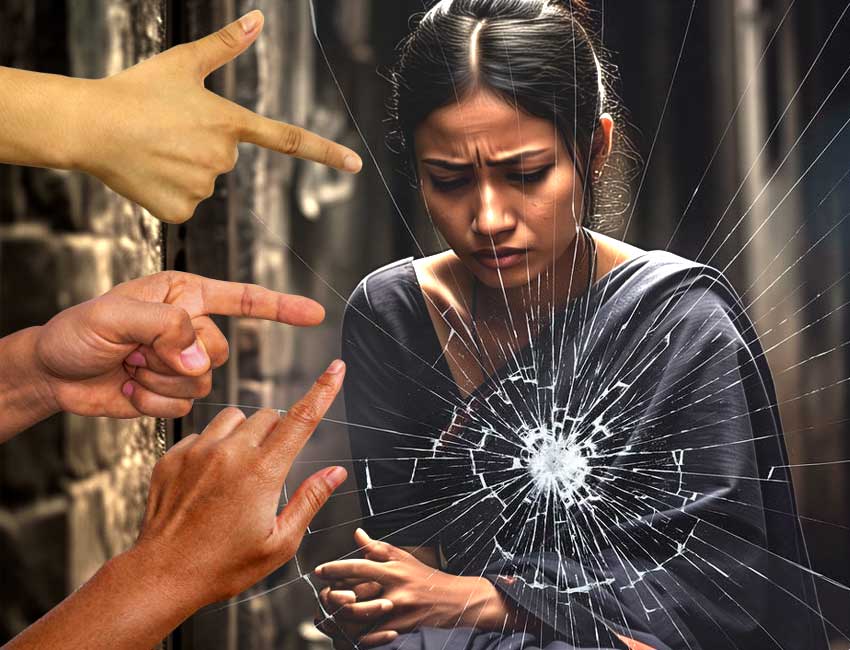

“Womb vs Society” explores Kusum’s devastating journey. Her infertility becomes a public battle, eroding her marriage and identity. This powerful piece by Dr. Denim Deka, reveals the profound societal pressures faced by women.
The humor that once naturally flowed in their conversation is now fading. Both realized that their union once cemented by love, friendship, joy, and respect also plunged. It was also somewhat shocking to them how a question around one’s abilities could reach such a heightened stage of judgment. Today, discussions and interactions between the two only resulted in disagreements, clash of ideologies, and by degrees it has been straining their marital relation. However, if compared between the two, it was particularly challenging for Kusum than Bhaskor to deal with. Kusum vividly remembers how her in-laws questioned her morale when she took a principled stand of ‘adopting’ an unknown child. Abuses were hurled at her for willing to embrace a different blood.
It has been five years since Kusum and Bhaskor tied the nuptial knot in a small village in Kamrup (rural) in 2010. But the pressure to start a family emerged from the second year of marriage. But when their respective families were made aware of the infertility issue detected in Kusum, the blame game did not stop ever since. Her fertility, menstruation and womanhood became questionable. The indirect mocking would sustain on an everyday basis. With Bhaskor’s family putting a high value on motherhood and his support gradually being negligible, it became highly distressing for Kusum to express what she was experiencing. She was unable to deal with the ‘stigma of barren woman’ alone. She mostly remained tensed, anxious, frightened, and worried. Her psychosocial well-being and self-esteem began to be threatened. There came a time when none of her defensive response mechanism worked. Kusum realized how a private matter became a series of public conversation in the family and at the village. At this point, she desperately wanted to run away to Guwahati. Thinking that the city would be busy and no one would notice her infertility, Kusum even proposed the idea to Bhaskor but it was pointless.
Poignantly, she realized that ability to choose is not an option for rural woman like her. The fact that she could not conceive have totally robbed Kusum of her agency to speak anything. She felt like questioning why her husband, family, and the village was becoming so indignant towards her. Kusum wanted to scream out loud, say that infertility was a medical condition, and was trying her best even through herbal remedies as suggested by her maternal grandmother. At the same time, she felt like asking why motherhood through the natural process was so necessary, and why it has become a sort of universal decision to comply with. It made her awkward to think how the society gazed at her body, her reproductive ability, and getting constantly monitored by the ones who visit her home. Her body became the site of society’s social construction of meanings, opinions, and several dichotomies of fertility/infertility, pure/impure, ability/inability, etc. The stigma around her infertility swelled discussions about Kusum being unequal to other mothers, pregnant women, and prospective mothers.
Once Bhaskor even said that Kusum could not be the flower (as the meaning of her name suggests) that blooms. It was shocking to find how Bhaskor shaded her. She wondered if he was taking pride in his fertility and masculinity. Or was he trying to make her feel incompetent and signaling that she is not worthy to be a woman. She recalled the Hindi serials where the woman protagonist would run her business venture single-handedly without male support. She aspired to be one but knew she could never be. Her everyday life was now burdened with expectations of giving birth to a child in order to meet the intergenerational social security and lineage. Going by Durkheim words, it is the social fact, i.e. cultural norms or social structure, that exist outside of any individual but is capable of exerting pressure and control. Kusum’s identity today is defined and shaped by the familial and societal expectations, thoughts, and decisions.

Both her body and identity has now been marginalized and excluded from social events and gatherings. She overheard people saying about her to be a carrier of negative energy. Power and discrimination has been mapped on her body while nullifying her subjectivity completely. Bhaskor grew more insensitive to her insecurities and sadness. She realized her primary relation with him is hanging and would continue to be the same or perhaps become worse. Kusum tried hard to find an answer as to why people never understood a need for accordance of respect, and support to her. Kusum got ready to withstand her upcoming journey till the time she could endure. She knew about having to navigate life and its ongoing turbulence in isolation. The message was clear- she lost the right to her own body and she was not in a position to shelter her body from criticisms.
(The piece is a work of fiction inspired by the social scenario around infertility of women)
What's Your Reaction?
