
ASI Uncovers 4 Undocumented Rocks In Mizoram


A devoted foodie with keen interest in wild life, music,…
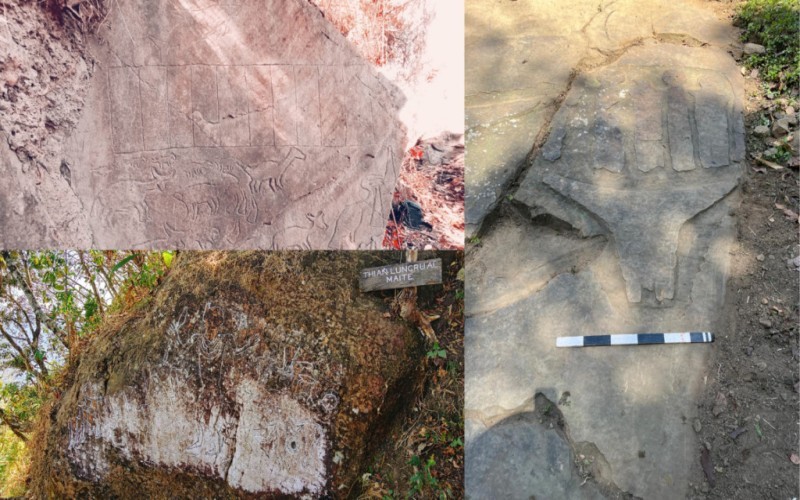
In a stunning archaeological breakthrough, the ASI has discovered four undocumented rock art sites across Mizoram’s rugged landscape, revealing intricate carvings of humans, animals, and ancient symbols.
Well, hold onto your pith helmets and dust off your trowels — the hills of Mizoram have just whispered a few secrets to the Archaeological Survey of India (ASI), and let’s just say, they’re rather old, rather arty, and rather marvellous.
In what can only be described as a cracking bit of luck and legwork, the ASI team, led by the indefatigable Assistant Superintending Archaeologist Salam Shyam Singh, uncovered not one, not two, but four previously undocumented rock art sites dotted across Saitual, Champhai, Khawzawl, and Serchhip districts. Yes, four — like a prehistoric Greatest Hits compilation, minus the vinyl.
The discovery was the result of a meticulous village-to-village survey in February. It seems someone finally read the manual on ‘leaving no stone unturned’ — quite literally.
Scribbles from the Stone Age (or thereabouts)
Let’s start in Maite village, nestled in the Saitual district. Picture this: a towering rock cliff adorned with a human figure bang in the middle (clearly the diva of the lot), flanked by other human forms, animals, gongs, a neat little row of mithun heads, and some mysterious symbols thrown in for good measure. It’s a bit like an ancient group photo, except no one’s blinking and the photographer was a dab hand with a chisel.
Meanwhile, over in Lianpui village in Champhai, the rock face is practically bursting with prehistoric pizzazz — a large human figure lording it over smaller ones, fish swimming about (possibly unaware they’re part of history), hornbills strutting their stuff, and enough geometric designs to give a maths teacher palpitations. There are even spears and daos depicted, suggesting someone back then was either very brave or very worried.
The district of Khawzawl really rolled out the red carpet with two rock art sites. At Tualte village, researchers found mithun heads, stylised human forms, and rectangular shapes gouged into an expansive rock face — possibly the ancient equivalent of graffiti tags, but with more cultural cachet. Nearby Chhawrtui village offered up rows of human and mithun heads, a curious circular design with what can only be described as leafy tendrils, and a lone fish, perhaps contemplating its singular fame.
A Tale Etched in Stone (and Local Lore)
Now, before you start imagining Indiana Jones swinging into Mizoram, let’s bring it back to Singh and his scholarly squad, who’ve been rather level-headed about the whole affair. “Surveys typically precede excavations,” Singh told reporters with the calm confidence of someone who’s seen a fair few rocks in his day. He estimates the carvings to date somewhere between the 16th and 19th centuries — not quite the Stone Age, but certainly old enough to warrant a respectful “Cor blimey!”
Dating, of course, will require the usual scientific song and dance — carbon dating, stratigraphy, perhaps even a séance or two if things get tricky.
Interestingly, local villagers were far from gobsmacked. They’ve known about these carvings for generations, handing down stories like treasured recipes. It’s the outsiders who’ve finally caught up — better late than never, eh?
A Cultural Goldmine in the Hills

The ASI isn’t new to this rock art lark. A few years back, they uncovered five sites at Vangchhia in Champhai, near the Myanmar border, featuring everything from ceremonial scenes to abstract art that could rival your local gallery’s ‘modern’ section. This new batch of discoveries adds another feather in Mizoram’s cultural cap — or perhaps a mithun horn in its heritage hat.
If all goes well (and we sincerely hope it does), the ASI may soon slap a ‘Do Not Disturb’ sign on these sites, offering them official protection and a well-earned place in India’s archaeological annals.
So, next time you’re trekking through Mizoram and fancy a bit of prehistoric pondering, keep your eyes peeled. You never know when a friendly cliff might show you a bit of ancient gossip, lovingly etched into stone.
And remember, while modern artists have Instagram, the ancients had granite — and arguably a better sense of permanence.
Cheerio and carry on exploring.
What's Your Reaction?

A devoted foodie with keen interest in wild life, music, cinema and travel Somashis has evolved over time . Being an enthusiastic reader he has recently started making occasional contribution to write-ups.