A devoted foodie with keen interest in wild life, music,…
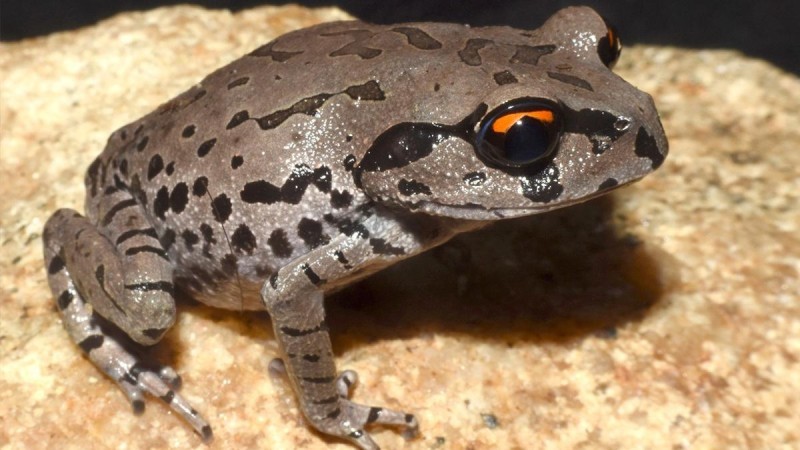
A new frog species, Leptobrachium aryatium, has been discovered in Assam and Meghalaya by Dr. Dipankar Dutta and his team. Named after Arya Vidyapeeth College, this remarkable find highlights Northeast India’s rich biodiversity and the importance of conservation.
In what can only be described as a right royal ribbit of a discovery, a brand-new species of frog has hopped onto the global scientific stage—straight out of the misty greens of Assam’s Garbhanga Reserve Forest and the adjoining Ri-Bhoi District in Meghalaya. And no, this isn’t a late April Fool’s joke or the plot of a David Attenborough documentary (although it certainly has all the makings of one).
The rather dashing amphibian—now officially christened Leptobrachium aryatium—has been described by a crack team of frog-fancying boffins: Dr. Dipankar Dutta from the University of Science & Technology Meghalaya (USTM), in cahoots with herpetological heavyweights Dr. Jayaditya Purkayastha, Dr. Jayanta Gogoi, and Dr. Saibal Sengupta. The big reveal came splashing into the scientific world via the journal Zootaxa on the 14th of April, just in time for a celebratory cuppa.
Now, this isn’t your average garden-variety croaker. Leptobrachium aryatium is as unique as a hippo in Hyde Park. Morphologically distinct and evolutionarily intriguing, the little blighter is helping scientists piece together the age-old jigsaw puzzle of amphibian diversity in India’s lush Northeastern hills. According to a press release from USTM, this find also serves as a polite yet firm nudge to remind us of the region’s rich ecological tapestry—one that, frankly, could do with a bit more love and a lot less litter.
But here’s the part that’ll tug at your academic heartstrings—if you’ve got one. The frog’s name is no accident. The team has chosen to honour their alma mater, Arya Vidyapeeth College in Guwahati, by bestowing its name upon the species. Hence, Leptobrachium aryatium—a rather elegant way of tipping the hat to the place where their scientific journey began. Arya Vidyapeeth’s Herpetology Lab, by the by, isn’t just any old research nook—it’s a nationally and internationally respected hub of amphibian antics, churning out experts like a well-oiled frog-finding machine.
Dr. Dipankar Dutta, looking suitably chuffed, had this to say: “This species was first reported in 2001 by my mentor and guide as Leptobrachium smithi. At the time, it was the first record of this genus in India. After my Master’s, my guide Dr. Saibal Sengupta nudged me towards researching this species for my PhD, as practically nothing was known about it. We’ve since studied everything from its breeding habits to its home range and even its acoustic quirks—which, I must say, are surprisingly sophisticated for something that spends its evenings croaking in the undergrowth.”
The research kicked off properly around 2004 and has been plodding along ever since with the patience of a British queue. The frog was originally lumped in with the Leptobrachium smithi group—most of which reside in Southeast Asia—until the team’s meticulous work revealed it to be an entirely new character altogether.
In the end, it’s a story of dedication, nostalgia, and science done the good old-fashioned way—with boots on the ground, notebooks in hand, and, presumably, the occasional leech or two. So next time someone tells you frogs are boring, do feel free to remind them that in the forests of Assam and Meghalaya, they’re rewriting the rulebook—and making quite a splash doing it.
As the Brits would say—here’s to the frog, and may it leap into many more scientific hearts. Long may it ribbit.
A devoted foodie with keen interest in wild life, music, cinema and travel Somashis has evolved over time . Being an enthusiastic reader he has recently started making occasional contribution to write-ups.