
Padmasambhava: A Journey Through Sikkimese Mysticism – Part 2

In the first part of this series, we shared the ancient origins of the Chogyal dynasty, in this part we share the teachings of Guru Padmasambhava, as documented by his chief consort Yeshey Tsogyal. Delve into the intricate connections between Vajrayana Buddhism and Sanatan Dharma.
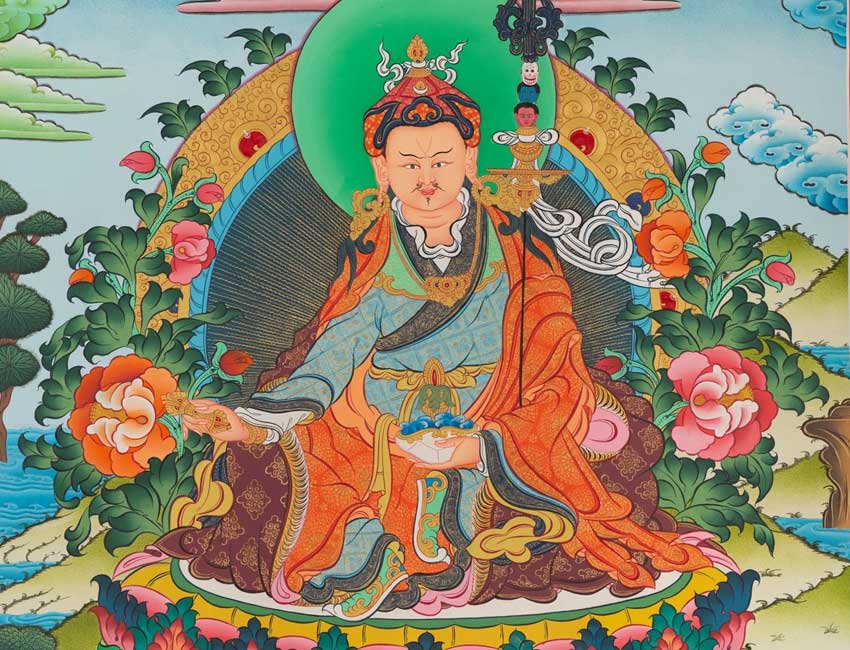
Guru Padmasambhava’s chief consort, Yeshey Tsogyal wrote: “At the Hum Cave, he (Padmakara) trained in the deities of Śrī Heruka, slaying the male demons and joining with the females.
“Perfecting yogic conduct, he spent five years there, turning the wheel of Dharma amongst the ḍākinīs. He had visions of the deities of Śrī Heruka.”
Later, at another charnel house (place where human bones are stored for tantric practices), at the ‘Terrifying Grove’… “donning the eight ornaments of the charnel ground, and magnetising the ḍākinīs, he presided as the great gaṇacakra chief”.
“Perfecting union and liberation, he attained the supreme siddhi, gazing upon the face of Mañjuśrī-Yamāntaka.”
He then practiced the magnetising deities of Mighty Padma-Hayagrīva, another form of Heruka.
Even later, “he practiced at the ‘Zombie Grove’, where he practiced the deities of Kīla’s Activity. He magnetised every mātṛkā and ḍākinī there.”
Note the terms repeated every now and then: mātṛkā and ḍākinī. The concept of ḍākinī is unique in Vajrayaan: they are evil spirits who the Guru vanquished and changed them into positive spirits called Bhumipalas and Dharmapalas, protectors of the sacred land and the deities of Dharma.
Then came the “practice of the Mātryāvahanavisarjana, the Calling and Dispatching Mātṛkās,” clearly a female deity, a form of Kali, though we are not clear which form it is.
Notably, it is then that “he ate human flesh and wore human hides”. This is perhaps the most arduous of tantrism, of losing all sense of human existence, of fear, or “ghreena”, which even Paramhans Ramakrishna was inducted into by an unnamed ‘Bhairavi’.
This unornamented description by the Guru’s closest consort does not mention Sanatan Dharma, for she was not concerned with it. She wrote that as the Guru had narrated the stories to her. And the Guru diid not fabricate his own life story, just as Lord Ram had not.
Tara and Shunyataa
“Tārā is a meditation deity revered by practitioners of the Tibetan branch of Vajrayaan Buddhism to develop certain inner qualities and to understand outer, inner and secret teachings such as karuṇā (compassion), mettā (loving-kindness), and shunyataa (emptiness).”
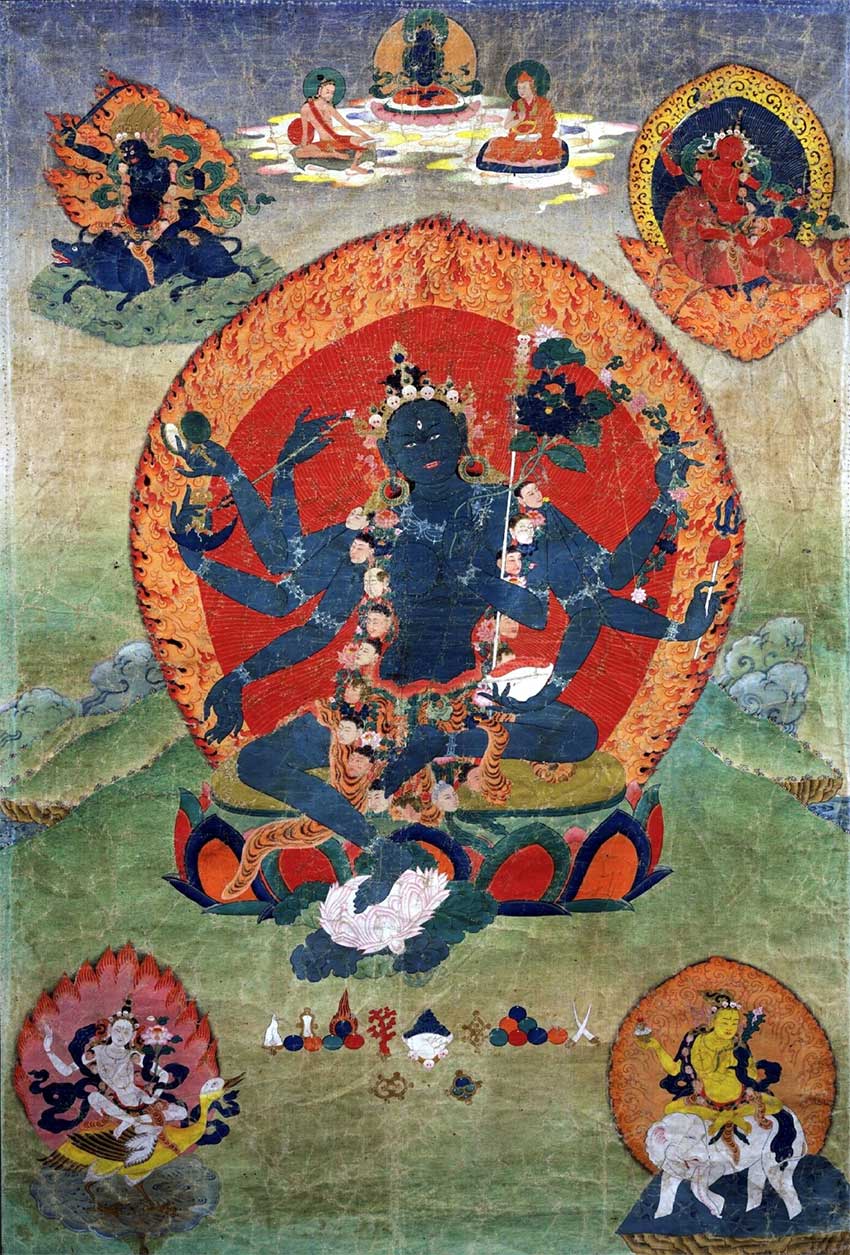
In Sanatan Dharma, this shunyataa is that phase of cosmology when Brahma – for Leela’s sake – manifested as Parampurush and Paramaaprakriti.
As the scholar Mrityunjoy Mookerji told me, this is the Matrika Shakti, the driving forces behind all creation, the creative aspect of Nirakar Bramha.
According to Tibetologist SV Beyer, “it would seem that the feminine principle makes its first appearance in Buddhism as the goddess who personified prajnaparamita”.
Avalokiteshwara’s Tears
One interesting thing is that Goddess Tara emanated as compassion from the tear drop of Avalokiteshwara, for which we have the following description below:
“Then at last Avalokiteshvara arrived at the summit of Marpori, the ‘Red Hill’, in Lhasa. Gazing out, he perceived that the lake on Otang, the ‘Plain of Milk’, resembled the Hell of Ceaseless Torment.
“Myriad beings were undergoing the agonies of boiling, burning, hunger, thirst, (and) yet they never perished, sending forth hideous cries of anguish all the while.
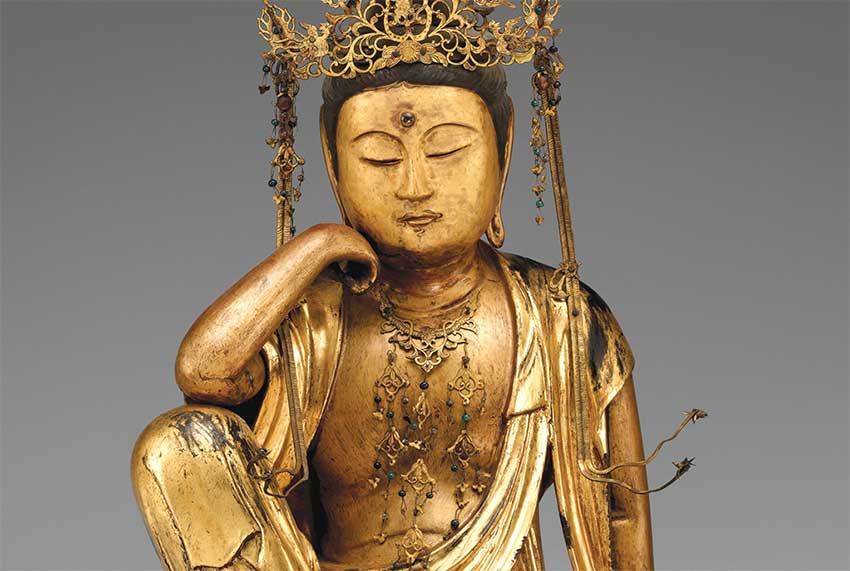
“When Avalokiteshvara saw this, tears sprang to his eyes. A teardrop from his right eye fell to the plain and became the reverend Bhrikuti, who declared: ‘Child of your lineage! As you are striving for the sake of sentient beings in the Land of Snows, intercede in their suffering, and I shall be your companion in this endeavour!”
“Bhrikuti was then reabsorbed into Avalokiteshvara’s right eye, and was reborn in a later life as the Nepalese princess Tritsun.”
Chhinnamastaa and Chamundaa
I am not aware where this came from in Lhasa, but this seems to indicate that the Indian tantra by then had become fully merged with Vajrayaan Buddhism.
Chamundaa is also there in Tibetan, rather, Vajrayaan Buddhism as seen in a Nepal idol, which is described as Chamunda Devi, with eight-arms. The right hands hold the sword, damaru, victory banner and skull cup respectively. The left hands hold the shield, khatavanga and the noose.
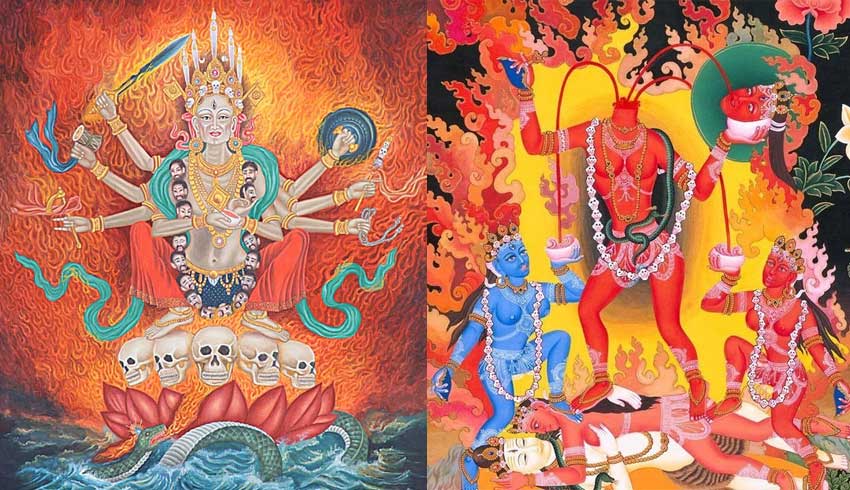
Chhinnamastaa is popular in Tantric and Tibetan Buddhism, where she is called Chinnamundaa (“she with a severed head”) – the severed-head form of goddess Vajrayogini or Vajravarahi – a ferocious form of the latter, who is depicted similar to Chhinnamastaa. Buddhist texts recount the birth of the Buddhist Chinnamundaa.
The “Tibetan Buddhist Encyclopedia” writes:
“One tale tells of Krishnacharya’s disciples, two Mahasiddha sisters, Mekhala and Kankhala, who cut their heads, offered them to their guru and then danced.
“The goddess Vajrayogini (Chinnamastaa) also appeared in this form and danced with them.”
Another story recalls princess Lakshminkara, who was a previous incarnation of a devotee of Padmasambhava, who cut off her head as a punishment from the king and roamed with it in the city, where citizens extolled her as Chinnamunda-Vajravarahi.
Guru’s Gurus
But how did all this happen? How did these goddesses rise up the Himalaya and reach Tibet?
Yeshey Tsogyal says in “Garland of Vajra Gems,” which was a hagiography of Padmasambhava written under his directions and later hidden by his consort, that there was a reason that the guru had to find a guru.
Having practiced what to me seems 40 years (by Yeshey Tsogyal’s account) of roughly five years each in eight charnel grounds, or crematoria, Padmakara declared that he would be spreading his learnings across the land.
But he faced a tough resistance in that, for the people he targeted to teach challenged his credentials: “Who is your guru? Where have uo come from?”
And though Padmakara initially declared that he was a buddha and self-taught, for all practical purposes, he realised he needed a guru.
That is when he reached Nalanda. There, he trained under three fabled teachers: Manjushrimitra, Sri Simha and Vimalamitra, though he had a total of eight gurus there.
And who were they? Let us see what history says:
Manjushrimitra was one of the early masters of the Dzogchen lineage of Chinese Buddhism. He was a disciple of Garab Dorje and the main teacher of Shri Singha, who was a teacher of Padmakara.
Hence, it is clear that Buddhism went from India to China and Nepal first and then through Padmakara, it reached Tibet.
Sri Singha was a disciple of Manjushrimitra, and both were Dzogchen masters who were already active in the Tantric milieu in India independently.
So by the time Padmasambhava reached Nalanda, a heady mix of Buddhism and tantrism was already brewing in the fabled Buddhist University.
Then amongst Padmakaara’s tutors, there was Vimalamitra: His teachers were Buddhaguhya, Jñānasūtra and Śrī Siṃha. All three were tantric practitioners in their own rights.
Naturally, Padmasambhav found the resonance of his own practices in these teachers and must have evolved the Tantrayana with its myriad Kali forms.
Much respected scholars like PT Gyamtso and Jamyang Dorjee seem to suggest that being unable to fully vanquish the powerful lobby of Bonist ministers, Guru Padmasambhava struck a compromise by merging some aspects of Bonist ritualism in his Buddhism.
But this seems open to scrutiny, for under normal circumstances, shamanism is animism and does not have deities in human form, such as Kali or Chamunda.
According to the renowned scholar, Geoffrey Samuel, an emeritus professor of religious studies at Cardiff University, while Bon is “essentially a variant of Tibetan Buddhism” with many resemblances to Nyingma, it also preserves some genuinely ancient pre-Buddhist elements.
So, given the personal praxis of Padmakara and his tutelage under Tantrik Buddhist gurus, it seems quite logical to say that the powerful female deities were Sanatan Dharma exports to Tibet.
The Tantra War
I recall that during my lengthy interview of PC Sorcar Jr for my then magazine, ‘Debonair’, he had told me something very interesting.
In a nutshell, this relates to the constant feud between Buddhism and Sanatan Dharma in India.
The legendary magician had told me how Buddhism at one point was sweeping India, as people protested against Brahmanical despotism, especially the caste system.
To counter Buddhism, Sorcar Jr told me, the Brahmanical order brought out the female deities for the first time. Feminine, alcohol, sex and magic were a heady mix, and large sections of Indians started returning to the fold.
It is possibly to resist this revivalist sway of Sanatan Dharma that Buddhist scholars at Nalanda were studying tantra and merging its most attractive aspects of femininity, the use of alcohol in rituals and magic into original Buddhism, and that is how Kali in her various forms, even as Chhinnamastaa, found her way into Vajrayaan Buddhism.
What's Your Reaction?
