
Excerpts from ‘Walking, Wandering, Wayfaring’

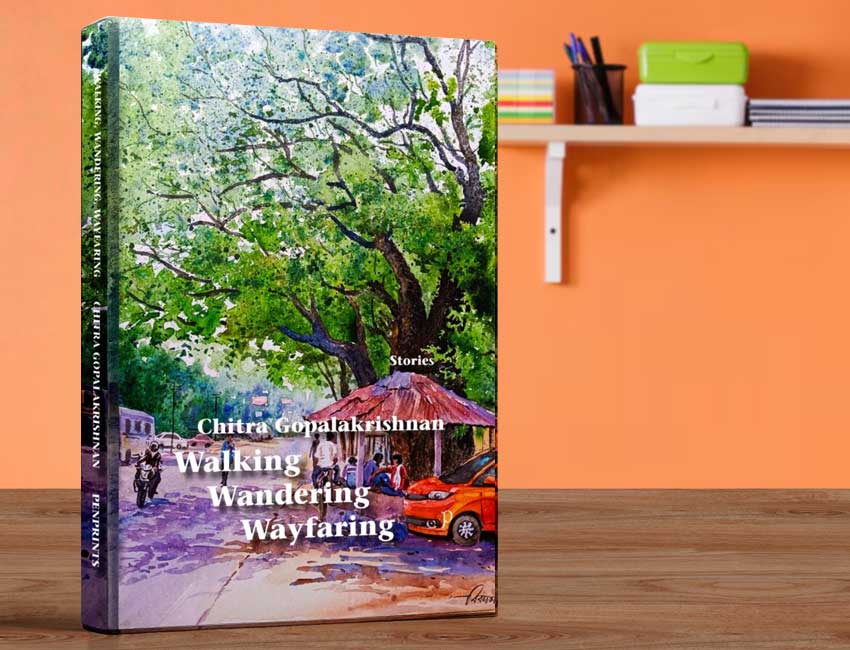

Walking, Wandering, Wayfaring is a profoundly reflective collection of 32 short stories by New Delhi-based journalist, social development consultant, and creative writer Chitra Gopalakrishnan. Here we present the excerpts from the newly released book by Penprints Publication
My collection, through its thirty-two stories, invites readers to be wayfarers on the journeys of the body, mind and spirit, and to look at life differently, to recognise the wonder of an alternative philosophy of existence that acknowledges the limits of accepted truths and easy categorisation.
The hope is that, as the stories gather momentum and navigate a variety of voyages, through its three sections, ‘Soul to Soul’, ‘People to People’ and ‘Women to Women’, oftentimes blurring the boundaries between the self and the universe, and between the personal and the political, readers will view difference openly and without judgment, with attentiveness, deep listening, and patience.
The wayfarer’s journeys within the book deliberately move away from the explosive and the obvious to veer into the margins to examine what exists at the periphery of attention, often the everyday lives of ordinary people. Dealing with grief, loss, memory, identity, exclusion, climate and environmental anxieties, the burdens of patriarchal structures and many more uncomfortable realities, these journeys of men and women often reflect a shared condition of precariousness. Yet, in the same breath, these voyages, whether straightforward or circuitous, reversed or those of former or afterlives, unequivocally celebrate the transformative and liberating potential that each person holds within. It is an affirmation of each one’s ability to reclaim oneself.
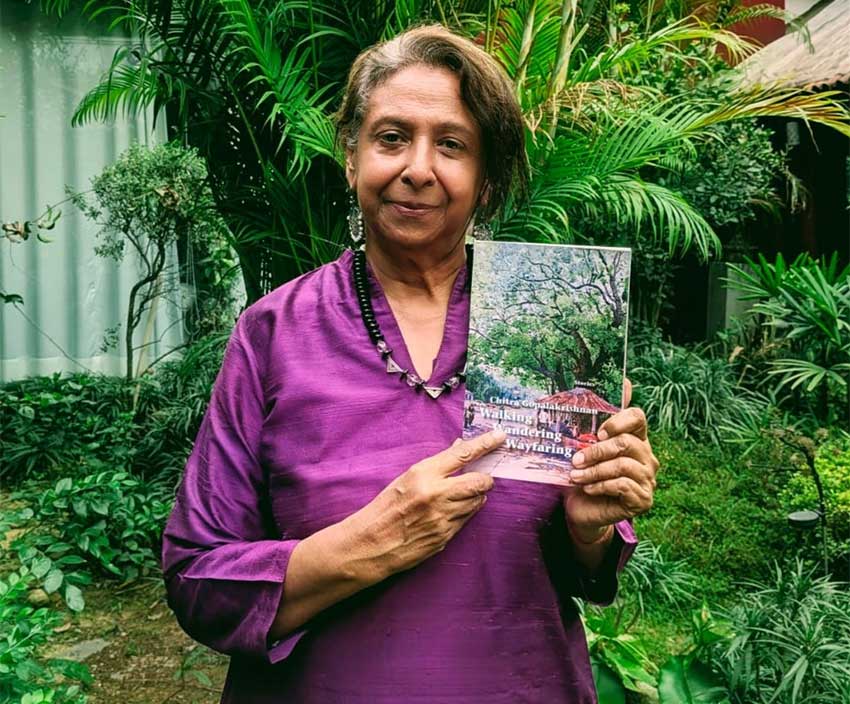
Excerpts from the book
Soul to Soul
I feel the forest size me up. To see if I am up to waldeinsamkeit. Roughly translated from German, it means the feeling of being alone in the woods. It is a feeling that comes over you when you are at peace with the forest, or say, in your environment, or with yourself.
Will I be able to reach my waldeinsamkeit, the wonderful state of equipoise? Will I be able to slip into a state of calm, peaceable, intuitive functionality even as the forest’s disasters fall on me, sometimes in spite and malice, other times by accident and whim? I wonder about this even as I hear the receding sounds of the ghorals’ barks.
I have come here to test precisely this. I need to know whether I will hold up not only to the treacheries of the forest but to the extremities of life, its contradictions, be they conditions, circumstances or emotions. As a person, as a woman, if I do, the jigsaw puzzle of my life could come together. Perhaps. Waldeinsamkeit
***
The theeyam’s thirayattam, the dance of gods, gathers a kinetic, irregular, beyond-the-bones tempo with a quality of bare rawness to it. The theeyam’s eyes blaze with energy. There is an otherness, a primal, animistic energy within her. There is a palpable life-form, possibly conscious and perceptibly powerful, within her. It is as if she is having a furious encounter with a living substance that is besieging her all at once, too enormous and violent to hold on to, yet immensely beautiful to let go of. She dances for hours, lost in an electric, ecstatic trance where she is one with the dance, oblivious to her tightened muscles, bruised feet, or fatigue.
Though we don’t dance, we seem to be in some motion, in the flow of the life force, as if we are her chorus, and in a different kind of consciousness through some sort of hypnotic energy. While we are in touch with the elements—earth, water, fire, air, and ether—and with the landscape of human existence, we are at the same time animated by the vastness beyond, its nothingness, which is not a void but an everything-ness, filled with matters of essence. I cannot explain this any better. Invisible Lines
People to People
Dr Vinod Sharma walks a little more, re-living Mehrauli’s history, and its continuum in his mind. He thinks back to Lal Kot, built by the Tomar chief Anangpal in 731 A.D., and its expansion by Prithviraj Chauhan, the ruler who overtook the Tomar reign. He then lets his mind wander to Qutub Minar, the tall victory tower, whose construction was initiated by Qutub-ud-din Aibak of the Mamluk dynasty, and completed by his successor, Iltutmish, before being further refurbished by Feroz Shah Tughlak of the Khilji dynasty. His thoughts then rest on the Jain temple of Yogmaya, constructed in the 12th century, and believed to have been built by the Pandavas.
“It’s time to rediscover all of my city anew, its past, present and future, not just its geography as a cartographer, or its history as historiographer, or its future as a futurologist, but more as an anthropologist who seeks to understand what it is to be human, to be a person, today, yesterday, long ago, always, and more so as a humanist who has concern for human welfare, values, freedom and dignity,” he says to himself.” Destined for a Different Path
***
“Carry the good weather with you always,” is what my wily maternal grandmother would often tell me. With an unruly mass of coarse white hair and many, many curly tendrils with lives of their own, she had piercing eyes, and an even more piercing tongue, both of which she unreservedly used with knife-keen precision.
As a thirteen-year-old girl, I lacked the flair or the chutzpah to do what she asked.
Otherwise, I would have carried to New Delhi in December of 1975 the summery joviality of Hyderabad, the fiery flavours of its mirapakayas, the tangy gongura sambhar trails along with the endless orange-gold stretches of sky all within the throbbing inner ducts of my still-forming being. A Journey, A Homecoming

Women to Women
An aching void settles within her as the motorcycle ride back to her quarters deepens her sense of dejection. In the evening, a deep, brooding silence fills the gardeners’ room. The men are at a loss for words to say to her. As she sits with them in the stillness of the night, the fragrant scent of satparni invades her nostrils.
After a long silence, she finds her voice. With an indrawn breath, she says, “I am aware that my life has changed, and that I no longer have the means to maintain my familiar world. However, I will not let my current burden break me. I will learn to carry it better. I know we are all paying a steep price for my husband’s infidelity, but I believe with all my heart that he is not capable of rape. We seem to be battling systems and institutions that are failing us, just as much as we are confronting individuals, and our remedies feel small and insufficient. Maybe there is no such thing as justice. But I have to hope that justice can at least mean an absence of injustice. I am uncertain how many years, resources, or adjournments it will take, or how I will endure the testing of time. If you will allow me, I will stay here; my children, my home, and my fields can wait. I am willing for my family to survive on just rotis and salt during this time.”
In the dimly lit room, Sonu silently hands her a plate of food and offers her a blanket. She smiles at him in gratitude, places the food on the ground, wraps the blanket around herself, and walks defiantly toward the satparni tree, even though it is pitch dark. Despite the bad news, she feels alive. With a newfound surge of energy, she is ready to shed her misery and embrace the tempting possibility of hope. She is prepared to step outside of herself and take the risk of changing her relationship with the world, facing the challenges and drudgeries it throws at her. She will be ready for their lawyer’s call in the morning, she tells herself. Bail Denied
***
Reba was born in 1971 in Bangladesh, the same year as the Muktijuddho, or Liberation War, during which Bangladesh gained independence from Pakistan. This significant year changed the history and geopolitical landscape of South Asia. As an infant, she and her family were among the ten million refugees who fled their homes, foot-slogging their way to India, the land of her ancestors, amid brutal shelling. This violence was a consequence of the retaliatory actions taken by the Indian government against Pakistan. Reba often wrestles with the narrative of her infant life, one steeped in the politics and mistrust of three countries. When she recounts it to me, she shares fragments—bits from one place, pieces from another. It seems as though she resists telling a straightforward narrative, choosing instead to convey it in disjointed snippets. She always conceals certain elements, as if protecting the essence of the story. Perhaps this is because she herself stitches together her memories from various strands of hearsay. Or maybe she believes that sharing the entire story would somehow oversimplify her and her family’s struggles, reducing it to a weak plot. For A Home, For a Port in the Storm.
Book Details:
- Title: Walking, Wandering, Wayfaring
- Author: Chitra Gopalakrishnan
- Publisher: Penprints
- Release Date: June, 2026
- Genre: Short Stories
- Price: 499 INR
- Where to buy: https://penprints.in/shop/product/walking-wandering-wayfaring/
What's Your Reaction?
