
Echoes of the Raj: A Ghost Story Set in Writers Building


Uncover a chilling ghost story set in Writers Building by Subhadeep Banerjee. This historical thriller follows an ICS officer haunted by a forgotten file from the British Raj era.
It was a dark, moonless Calcutta evening, save for the yellow halogen lamps on Central Avenue. Mihir Das was riding home from Writers Building in his government-issued Hindustan 10. The bottle-green hatchback was meant for use by top government officials like Deputy Secretary Das, who loved every bit of the luxury. Now was his time to sit back, relax, and enjoy the ride home. With power came the perks of luxury travel. Today, his driver, Laxman, was taking a detour. As the car proceeded towards the Girish Park area en route to his Cossipore residence, Das checked his West End Mido pocket watch. It was nearly seven in the evening. In the busy traffic that lay ahead, he knew that home was at least half an hour away.
Das decided to scrutinise something he was carrying home. Soon enough, though, he started sweating profusely—something his driver noticed through the rear-view mirror.
Laxman: “Sir, are you feeling unwell? You are sweating heavily.”
There was no answer from Das, who had started gazing out the window with the file in his hands, eyes fixed in one direction. Laxman persisted and called him out twice.
Laxman: “Das Sahib? Das Sahib?”
It was then he realised that Das was lost in his thoughts and not listening. Laxman pulled over to the kerbside and hit the brakes, which jolted Mihir Das out of his frozen state of mind.
Laxman: “Sir, are you unwell? Is anything the matter?”
Das, alerted by Laxman glancing backwards from his seat, managed to gather himself.
Das: “No, I am fine; just a bit tired. I need to relax. I remember, there used to be a good kebab shop named Hussain’s Khana two blocks away from here. Isn’t it so? I would like to get something good for dinner tonight. Take me there.”
Laxman: “Hussain’s Khana, Sir?”
Das: “Yes.”
Laxman: “There is no such kebab shop here, or nearby.”
Das could not believe what he was told.
Das: “How can that be? I came with a friend a few months ago, you drove us there, remember?”
Laxman: “No, Sir, I am unable to remember. Yes, there is a Chinese restaurant named Ming’s Place nearby where I had taken you and your son last month, but not a kebab shop.”
Das: “How can that be? You are mistaken! Those kebabs were so good! And I even offered you one piece! And now you tell me you did not take us there?”
Laxman: “Sir, you have never offered me kebabs. The only time you offered me anything was after I completed one year in your service, when you paid for my nimbu-paani.”
Das: “Are you sure there is no such place here?”
Laxman: “Yes, Sir.”
Confused, Das pondered for a while and finally conceded.
Das: “Hmm! Maybe I am confusing it with some other place? But this area looks very similar to where Hussain’s Khana was located. Oh, I see! That was in Sealdah, was it? But I think I definitely got the name right. The kebabs were delicious back then.”
Laxman: “When was that, Sir?”
Das: “Hmm, I think you are right. That was a long time ago and no, you were not there. I went with somebody else. Oh well, never mind! Take me to Ming’s Place.”
Laxman: “Yes, Sir.”
Did Mihir Das’s mind create a fleeting false memory out of some past experience? Why?
As a senior bureaucrat in the state’s home department, ICS officers like Das commanded a lot of respect; at times, even ministers had no choice but to overcome prejudice and heed his advice. But state home minister and former revolutionary, Professor Amol Ghosh, was a man on a mission—a mission to uncover the past. Ever since his discovery about the role of former British-era Sub-Inspector Chatterjee, who helped him escape almost certain imprisonment during the Raj days, Ghosh had started taking a keen interest in all documents chronicling the rebels’ past deeds.
As for Mihir Das, he was an old stooge who believed in the continuity of governance, even if the occupants of the throne kept changing over time. As his car drove through the busy streets of Calcutta, his mind started wandering, recollecting his younger days: first as a college student, and then as an ICS officer sworn to serve His Majesty, the King. Notwithstanding the fact that 26th of January had just passed weeks ago with the country celebrating its birth as a Republic, Das knew exactly what his “Tryst with Destiny” was.
The weekly update to the Security Liaison Office (SLO) at New Delhi was due, and he was all too eager to compile it and send it across. The SLO was set up to coordinate sharing of intelligence from India to London’s MI5 post-1947—so much for a newly born nation’s sovereignty! Das wished to see if certain historical information could be passed directly to Delhi, bypassing the minister, well outside official protocol. If the high and mighty acted desperate, it was not without reason. Often, self-preservation becomes their main motivation. And since powerful people had no fear of consequence, he simply erased all records deemed too uncomfortable from his office, while preserving them surreptitiously to avoid danger.
Deputy Secretary Das was like a piece of blotting paper—very effective at removing any traces of spilled ink, yet retaining even a shadow of anything he considered important. But even those who consider themselves invincible harbor fears of the unknown and uncertain. That evening in his car, Das had actually entered a state of mental confusion stemming from some hidden fears, for the second time that day. Earlier in the office, he had been behaving quite erratically with his peon, Bhola.
Next morning, Mihir Das reported late to work. He had been up all night reading something from the office, making diary entries. As he began his day, Das saw a note on his desk from Bhola. That fellow was a bit of a slow coach, and even after ringing the desk bell several times, Bhola eventually showed his droopy jaw only after what seemed like an unsuccessful fishing break! Apparently, Minister Amol Ghosh had summoned Das for a meeting post-lunch, and the note was delivered by his secretary to Bhola.
Das and Ghosh were not exactly friends. One might say they worked in the same ‘cage’ called Writers Building; housed together by circumstance rather than choice, they tried their best not to play ‘snake versus mongoose’. They knew exactly what one could do to the other, and if past events from British times were anything to go by, the snake had plenty to fear from the mongoose.
Das: “Ah, Bhola, here you are finally! Can you bring me TP6542?”
Bhola: “Sorry, Sir? There is no such file in this office.”
Das immediately corrected his Freudian slip.
Das: “Sorry, I meant file number… VG/PL/21.”
Bhola: “I already gave it to the minister’s secretary when he came.”
Das froze, after a moment of bewilderment. His face paled as though Bhola had just pronounced his death sentence. For a moment he tried to fight back and eventually decided to hide his fear and signaled Bhola to leave. It was the misconduct report on two police officers; nothing extraordinary. But Das didn’t think so. Staring at his blotter, he had a blurred vision of the file marker—VG/PL/21. He wondered if ghosts could reveal secrets from files.
After lunch, Das went to the Minister’s chamber on the 2nd floor. Ghosh was curt.
Ghosh: “Mihir, why was this report shut down, about two senior inspectors caught taking bribes?”
Das struggled to speak, as if his throat was choked, but it really wasn’t.
Das: “Sir, it is best handled quietly. These ones—uhm, Sarkhel and Sasmal of Lalbazar—are old witches from the Raj.”
Ghosh: “So? Quiet doesn’t mean closed. Reopen it and give me weekly updates.”
Das nodded and started noting down the instructions in his pad while fumbling with his favorite Parker 51. He tried to make a feint of steadiness, but his fingers betrayed a tremor. Ghosh silently studied his awkwardness. Das avoided his gaze while gathering his papers in a rush and left. Weekly updates! Routine for any officer. But to Das babu, file number VG/PL/21 wasn’t about two corrupt inspectors, but shadows and ghosts from his yesterday. Or so he thought. Could the Lalbazar duo (currently on forced leave) pull a fast one on him if cornered?
Two days later in his office, Minister Ghosh was at his desk writing a letter when his secretary, Niren Banerjee, walked in.
Niren: “Sir, Das babu has returned VG/PL/21. Here it is.”
Ghosh opened the file cover and found a memo written by Das, clipped to the front page.
Ghosh (reading aloud): “As the matter pertains to conduct of police personnel, it may suitably be taken up by Vigilance.”
Ghosh was surprised and also amused.
Ghosh: “Interesting! Das doesn’t usually blink. Why now?”
After a pause, Ghosh picked up his pen and wrote in the margin of the memo: Enquiry to continue under Home Department with weekly updates to me, and signed off on it, instructing Niren to return the file to Das.
Interestingly, however, Das went on leave soon after this on health grounds and missed at least two weekly updates. Ghosh kept his patience for the moment. Finally, in about three weeks’ time, something arrived from Das at Minister Ghosh’s desk. Being late and sloppy was generally uncharacteristic of him, but Mihir Das had become a shadow of his former self those days. As if, to him, file number VG/PL/21 was more of a punishment than a routine assignment.
Ghosh flipped it open at his desk with Niren waiting patiently for his master to process the contents. The file had basically morphed into a thick folder filled with mundane details about the two inspectors in scribbled and untidy handwriting. Most of it was routine—disciplinary notes on Sarkhel and Sasmal, actually with an effort to obfuscate the evidence built up against the duo. But that was not what caught Ghosh’s eyes. It was something else.
After about twenty minutes of scrutinizing Mihir Das’s bureaucratic jargon-filled cliches, Ghosh’s eyes froze on a single item; written and scored out with force, but still somewhat visible: TP6542.
Ghosh: “What is this TP6542? A wrong file number? Did he invent it? At this rate, we might have to officially send him to Ranchi to get his head checked. Vigilance files do not start with such numbers.”
Niren lowered his spectacles to have a look. The minister was right—a single mistake; corrected, but not without trace.

Niren: “A strange kind of mistake for an experienced officer.”
Ghosh: “I am just curious to understand how he did this? It is a very peculiar mistake, considering that the types of documents he handles regularly do not have such file numbers. Let us scrutinize the current file registry, just in case something pops up.”
Both men judiciously scanned the registry to look for TP6542 and understood that Das was perhaps hallucinating.
Ghosh: “Oh, I must remember, our esteemed Deputy Secretary is after all an ICS, who back then pledged to defend the King! So, could this be the file number of a British-era record? Now, he wouldn’t mind defending himself, I suppose!”
Niren: “Sir, why don’t you ask him directly?”
Ghosh: “It would be better to find out ourselves before confronting him. The old records are in the annex and will require written permission from the Chief Minister.”
Niren: “Then?”
Ghosh: “There is another way. Let me go home and check something.”
At home during lunchtime, Ghosh rifled through Chatterjee’s old chronicles that he had kept as a hidden treasure—the renegade sub-inspector who had documented clandestine actions by the government against its own citizens during the late Raj era. And, there it was—but not exactly what Das had written. A file numbered PP6542, documenting the fate of political prisoner number 65 of 1942. This was about Sankhadeep Sanyal—a prominent nationalist, who was arrested in September 1942 and then disappeared mysteriously. Ghosh could hardly believe what he saw, and he could not understand how the two files—PP6542 and VG/PL/21—were connected, if at all. Besides, what had Das to do with PP6542?
Later that afternoon in his office, Ghosh called Das over the phone.
Ghosh: “Das, this number TP6542 you scribbled and then tried to hide on the vigilance file, what is it? Can you explain?”
Das felt akin to being struck by lightning. His voice trembled.
Das: “M-Must be… clerical, Sir… a slip…”
Ghosh: “Are you a clerk or an ICS? Such slips can open doors to hidden alleys we may not wish to walk through. We need to investigate your past.”
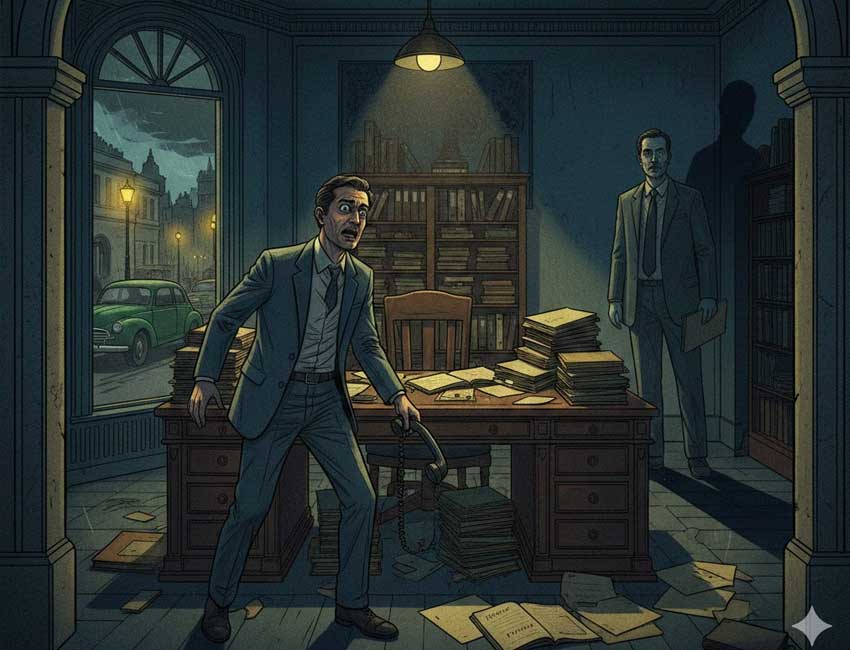
The line went dead. Das’s hand shook and the receiver dropped from it. Feverish, he staggered to his feet, muttering something to himself. Soon, he entered a state of frenzy, first pacing aimlessly in his office with his paperwork all over the place, and then banging his desk and weeping profusely.
After this, his complete unraveling began, which was a sorry tale. Bhola, watching from the doorway, saw the full spectacle. Later he recounted to Ghosh—”Sahib ran from his office with a torn paper in his mouth to the end of the corridor and then down the staircase into the parking lot, as if Yamraj himself was chasing him. So sad that it had to happen like this—crushed by his favorite Hindustan 10. But what could Laxman do? Sir was running like a madman and no driver would have been able to see him coming from such a tight corner.”
That was how Mihir Das ended—with shock and mystery.
Later that evening, Ghosh had Das’s home inventoried, and PP6542 marked TOP SECRET surfaced in his study. Ghosh was convinced that Das removed it from the office annex illegally. Inside were clippings, entries about Sanyal and his elimination, signed by one Tridip Sasmal! There was a picture of a younger Das and Sanyal in front of Hussain’s Khana! Were they friends?
And then, Niren found Das’s diary. Turning pages, he started reading from a piece.
Niren: “Sasmal knows Sanyal’s fate… must be shielded or else I am dead.”
Niren (to Ghosh): “But Inspector Tridip Sasmal of VG/PL/21 joined only in ’44. Das mixed it up!”
Ghosh was gazing at the picture.
Ghosh: “Sankhadeep Sanyal—a brilliant nationalist, erased by the British! Sometimes, even the distant silhouette of a man broadcasts his aura beyond his proximity. He was a diminutive but definitive intellectual, with an appeal far beyond his little frame, casting a shadow bigger than his physical contours. Das was jealous!”
The last entry in Das’s diary bore only one phrase: Sanyal’s ghost waits.
Ghosh: “God DOES work in strange ways.”
Next day, Ghosh signed a file and the ghost was rehabilitated.
What's Your Reaction?
