
Ayaz Rasool Nazki’s Dystopian Satire

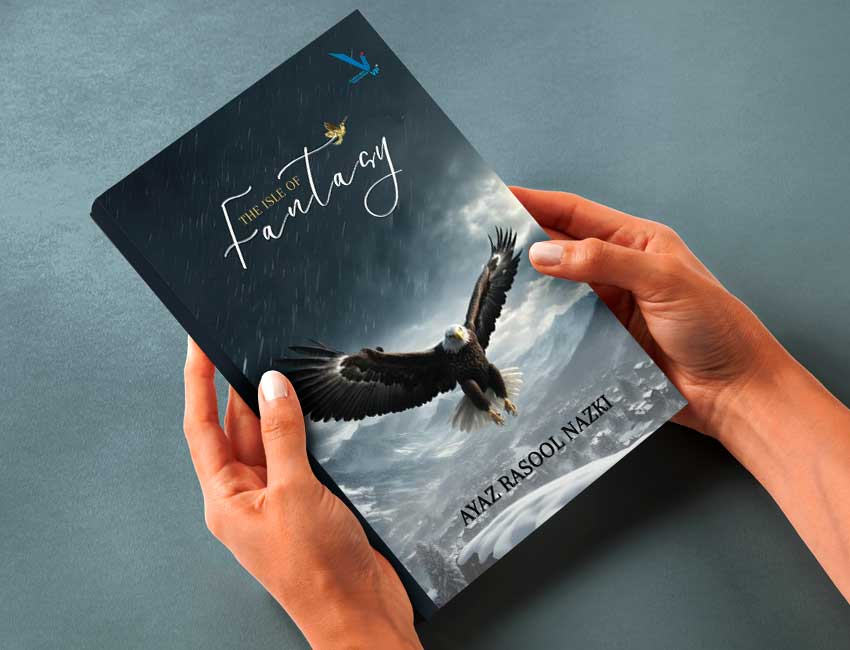

Explore Ayaz Rasool Nazki’s The Isle of Fantasy, a compelling animal allegory set in an abandoned palace. This dystopian satire brilliantly critiques power structures and reflects Kashmir’s socio-political dynamics through the lives of pigeons, cats, and mice.
Ayaz Rasool Nazki, an academician and a cultural administrator is based in Kashmir. The Isle Of Fantasy “is a tale of three species of pigeons, cats, and mice living in an abandoned palace on an island that has no ruler. Their lives are thrown into disarray as a new King arrives at the palace”. Animal allegory/fable in English literature uses animals and other creatures to represent human behaviours, social structures, and political ideas as in the ancient Greek text The Physiologus, Aesop’s Fables, Chaucer’s Nun’s Priest Tale, and George Orwell’s Animal Farm. This technique allows authors to reconnoitre complex themes and offer a mirror to society. In his recent novel, Nazki carries forward the legacy. The three species create a microcosmic world that explores the power structures, governance, and social dynamics of the present state of the country.
The Isle Of Fantasy is a dystopian satire that depicts the sad state of affairs of a society, as divergent from a utopian satire that talks up an ideal or flawless society. It is a work of fiction that serves as a caveat or cautionary tale about the dangers of certain political, and social trends. There are sixty-six chapters in the novel and it is a stark, strange, and mysterious world that leaves so many questions lurking in the mind. The novel has a linear, allegorical well-knit structure that charts the progression of a flock of pigeons as they fight back an oppressive regime. They imagine an animal utopia where they are free and will enjoy life much better than what they’ve known so far. The pigeons’ passage from subjugation to revolt captures the psychological conversion of controlled communities, registering a voice of protest.
Through the skirmish of the Pigeons, Nazki critiques totalitarian power structures and emphasizes the importance of combined action. While the pigeons’ insurgence serves as the climax, it also represents a profound commentary on the recuperation of lost agency, replicating the global experiences of marginalised societies. “The rebel commander and his comrades stood up and took leave. As they came out, the leader directed two of his colleagues to fly back immediately to their abode in the little valley and escort all the rebel forces to the flock. With the remaining comrades, he left for the flock square to begin the takeover of a free and independent Flock Land” (205). The confined isle has a striking resemblance with the valley of Kashmir where the past and the present are at war with each other. The idyllic valley has lost its peace because the ‘demons’ are constantly ravaging it.
The metamorphosis of Pixie from a cat to a human is multi-layered, underscoring themes of enforced identity alteration and self-discovery. Pixie’s fruition symbolises individual transformation and explores the sacrifices inherent in a reclaiming agency; in the process she loses association with her family and past life, mirroring the loss that time and again goes with personal and cultural transformation. The readers are reminded of the famous quote from Orwell’s Animal Farm “All animals are equal, but some animals are more equal than others”. Through the use of animal characters, the novel weaves three main narratives – a family of cats and a princess, a colony of rats and their nemesis, and the power struggles of pigeons and eagles – that intermingle and craft a rich tapestry of events. Nazki creates a symbolic framework within which readers can explore varied responses to control. The allegorical narrative relates to the political and social milieu of present-day Kashmir. The novelist deftly draws on local specificity to address larger human experiences of loss, resilience, and resistance. The language is simple and the novel can be read and enjoyed by children as well as adult readers. The Isle of Fantasy is engaging and consistently entertaining, with plot twists that keep readers glued.
The resonance of philosophical moorings at the end of the novel is quite evocative and the masterful weaving of the disparate threads of the political satire makes The Isle of Fantasy a collector’s item.
Book Details:
- Title: Nostalgic for a Place Never Seen
- Author: Ayaz Rasool Nazki
- Publisher: Vishwakarma Publications; First Edition (10 October 2024)
- Release Date: October 10, 2024
- Format: Paperback
- Pages: 214
- ISBN: 938962469X
- Price: Rs. 260
- Where to buy: https://www.amazon.in/ISLE-Fantasy-Ayaz-Rasool-Nazki
What's Your Reaction?
