
Air Pollution Kills 2 Million in India Annually

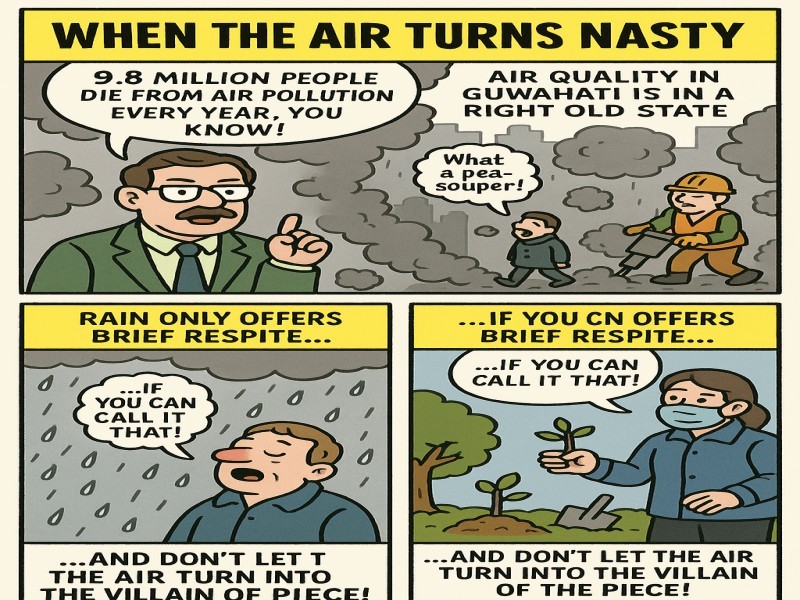

Air pollution in Guwahati has reached alarming levels, with over 9.8 million deaths globally linked to toxic air. In a witty, satirical take, British humour meets serious science as microbiologist Dr Sukumar Debnath discusses causes, consequences, and cures for our increasingly unbreathable air.
It’s not just the samosas that are being fried in Guwahati these days – the very air around us seems to be getting a daily deep-fry of its own, courtesy of the air pollution due to dust, diesel, and the devil-may-care demolition squads. If you’ve ever wondered what it might be like to inhale a brick or two with your morning cuppa, look no further than the present atmospheric conditions.
Enter Dr Sukumar Debnath, noted microbiologist, air-sleuth, and CEO of the Centre for Study on Environmental Microbiology, who’s been peering into petri dishes and particulate matter long enough to know that things are going pear-shaped. In a recent chinwag with a leading news paper in Guwahati , Dr Debnath didn’t mince his words: “Air pollution is a global problem and 9.8 million people die every year because of it.”
9.8 million! That’s more than the entire population of some big city popping their clogs annually because of a toxic cocktail in the air. India, not to be outdone, contributes a cool two million to that grim tally. Jolly good, isn’t it?
When asked about Guwahati’s condition, Dr Debnath described it as a bit of a dog’s breakfast – particularly where PM2.5 is concerned. For the uninitiated, PM2.5 is not a new model of Royal Enfield, but tiny airborne particles smaller than your patience in traffic, and far more dangerous. These particles, along with others like nitrogen dioxide, ozone and lead, are jumbled into the Air Quality Index (AQI) – the modern equivalent of a canary in a coal mine. If your AQI’s below 50, it’s a walk in the park. Between 201 and 500? It’s like breathing through a toast rack full of burnt engine oil.
Dr Debnath explained, “Vehicular exhausts mix with air pollutants and make a complex soup of half-cooked hydrocarbons.” Sounds like something you’d get at a dodgy takeaway after midnight, but trust me, no one’s licking their lips.
Rain, that obsession of ours, offers only a fleeting reprieve. “It helps wash down larger particles,” says the doc, “but let’s not pretend it’s the Holy Grail.” Guwahati might be blessed with the occasional downpour, but it’s not enough to keep the smog at bay. Rain’s just giving the city a quick rinse while the grime keeps coming back like a boomerang with a grudge.
Construction sites aren’t exactly helping either. Dr Debnath elaborated: “Demolition, tree felling, and soil disturbance stir up a dust storm worthy of a Western.” And in this show, there’s no handsome cowboy to save the day – just PM10 and PM2.5 making an uninvited entrance into your lungs.
So what’s to be done? Dr Debnath suggests a mix of common sense and clever science. Avoid high-pollution zones if your lungs are already throwing in the towel, report wildfires (and not just to your WhatsApp group), and for heaven’s sake, plant some trees. Not just any trees, mind – have a chat with a botanist first. Apparently, some foliage does a better job of gobbling up CO2 than others.
On the subject of tea – the very pride of Assam and salvation of every crisis – Dr Debnath sounded a bit glum. “Pollution affects plant physiology, makes pests more feisty, and messes with the rain. All bad news for tea,” he sighed. But all is not lost – science-based precision agriculture and new elite cultivars (a posh way of saying clever tea plants) might help weather the storm.

In the end, Dr Debnath’s message was clear: We need more monitoring, more science, and fewer people thinking pollution is just a posh word for “a bit dusty.”
So next time you step out and feel like you’ve walked into a low-budget apocalypse film, don’t just shrug and carry on. Strap on that mask, get planting, and for the love of Assam – don’t let our air turn into the villain of the piece.
After all, it’s not just the fish in the Brahmaputra that need clean water and air – we do too, love.
An Adoption of an article by R Dutta Choudhury published by Assam Tribune
What's Your Reaction?
