Tiger’s Nest Monastery : Where the Hikers Dare



A hike to the Tiger’s Nest Monastery Paro Taktsang, Bhutan yields to a rare mix of myriad pains and an urge, a call to merge oneself with spiritual ambience of Guru Padmasambhava, looming height of the steep cliff notwithstanding. Ipsita Barik recounts her tale of the gritty adventure.
Our trip to Bhutan was rooted in spirituality and a core connection to the natural beauty that can only be experienced in the heart of the mountains.
The six day trip was an amalgamation of scenic lush greenery, visits to monasteries rooted in tradition and gastronomic adventures to explore the wonderful traditional cuisine of Bhutan.
The day before we were set to return from Bhutan, we went on a trek of a lifetime. Neither of us are very outdoorsy people, both introverts who love nature but are plagued by a myriad of issues surrounding foot pain and the Tiger’s Nest hike is no joke.
The monastery hangs on a precarious cliff at 3,120 metres (10,240 ft), about 900 metres (3,000 ft) above the Paro valley, on the right side of the Paro Chhu river.
You don’t really go too high up in vehicles either, gaining about the entire distance by foot. There are no roads, just a trail carved into the mountain and ponies only go up about half the distance, till a cafe with a viewpoint.
Trek of the Trip
We were warned throughout the trip, cautioned about the difficulty, however, the day before suddenly filled us with an urge, a calling, that we needed to complete the trek, come what may.
We started the hike off with excitement, though it was quite challenging, especially due to the rains making certain portions of the path rather slippery. Equipped with a walking stick, we persevered through the first stretch, reaching the cafe and the viewpoint in 1.5 hours.
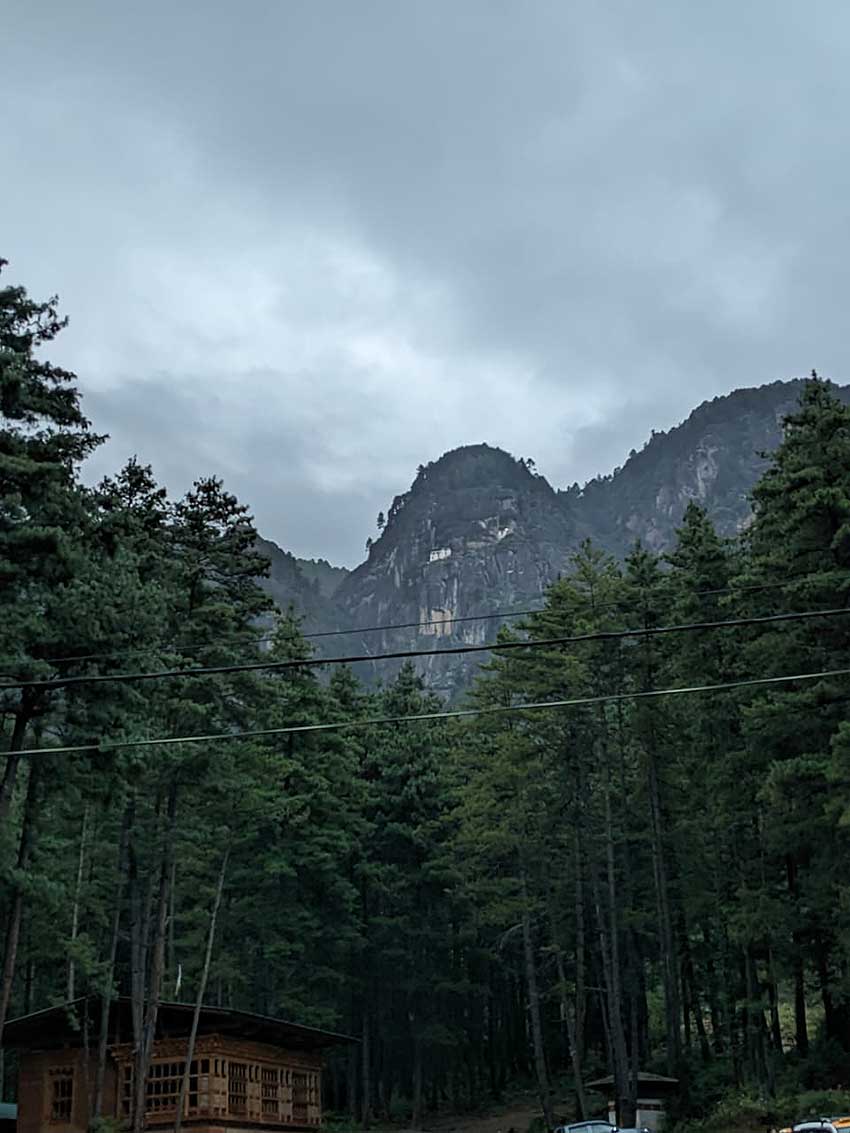
The view was spectacular from this point onwards, the vast, rocky mountain cliffs, lush green forests and looming high up above, nestled snugly between the rocks, Tatsang Monastery.
Here, suddenly a burst of rain impeded further journey for about an hour. Once the rain subsided and we got sufficient rest to heal some of the pain that was creeping into our tired calf muscles, we endeavoured on.
However, we quickly realised that the trek was nothing to be laughed at once our trail reached its ending point on a mountain parallel to our destination, and a set of a thousand steps, carved into the mountain cliffs, five hundred going down and five hundred going up to the monastery took its place.
The steps were daunting, coupled with the strain of gaining around 3000ft by foot, and every single step felt like a Herculean task, with no respite in sight due to the line of tourists following behind.
The Paro Tatsang Monastery
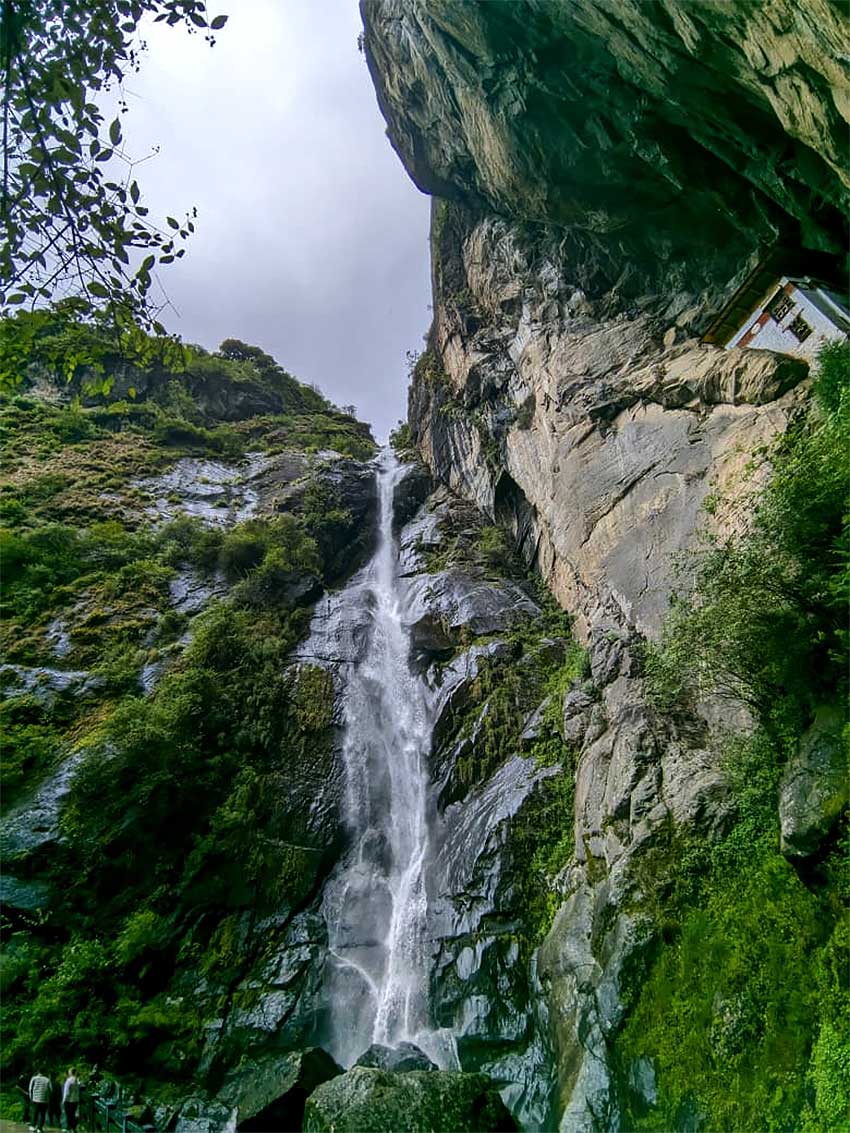
Then, as if our prayers were heard by the Gods, we reached the waterfall, the cool spray seemingly healing us from the inside, energizing our aching muscles and providing the last burst of energy to climb the rest of the steps up to the Monastery. The Monastery itself, Paro Tatsang, was stunning.
It was built in1692 by 4th Druk Desi Tenzin Rabgey around the Tatsang Senge Samdup cave, where Guru Padmasambhava, the founder of Vajrayana Buddhism, meditated and practised with his disciples.
Lore of Padmasambhava
According to locals, it is believed that Padmasambhava (Guru Rinpoche) flew to this location from Singye Dzong on the back of a tigress, hence the name, Tiger’s Nest Monastery.
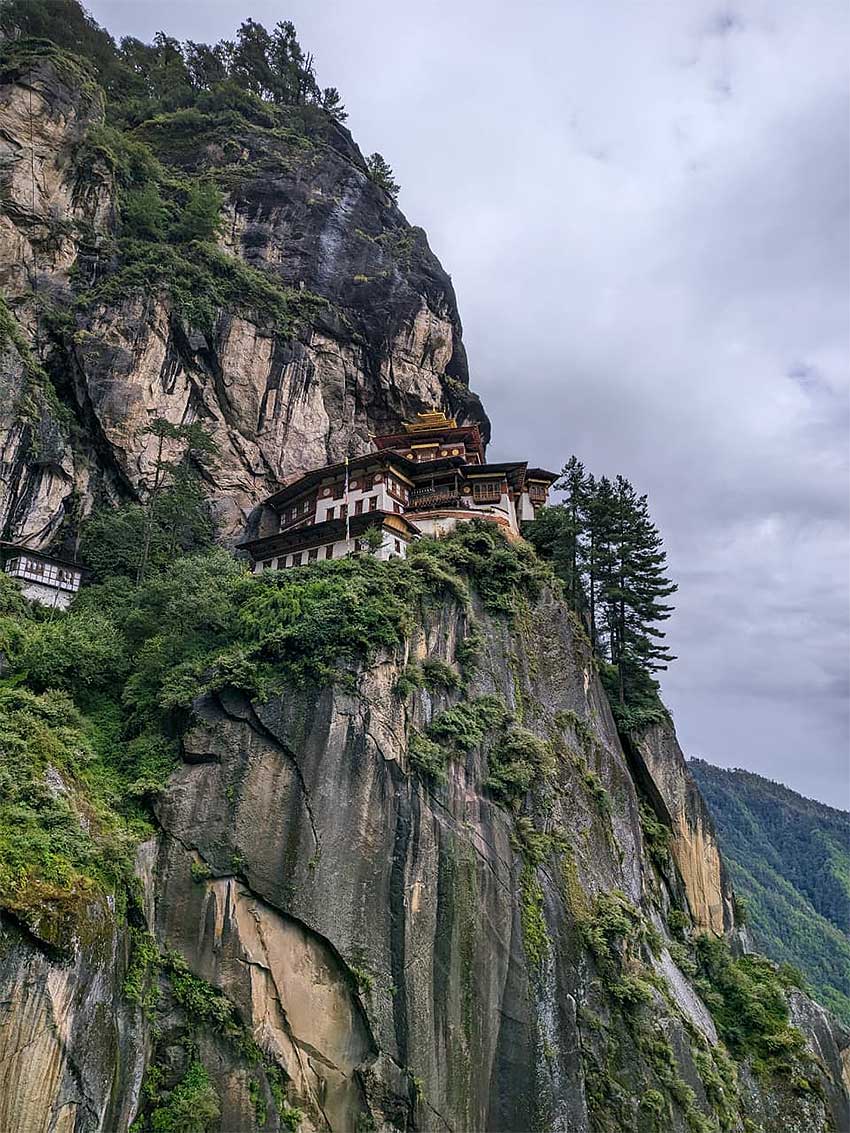
Composed of nine inner temples, the Monastery complex was a place of unbelievable calm and healing energy that radiated from the chants of the Buddhist monks to the prayers of both tourists and devotees alike.
That in fact, inspired a sense of awe and serenity in you, a humility regarding the insurmountable obstacles that littered the path to the monastery and the indomitable human spirit that is able to overcome it all, and an acute understanding of how miniscule we are in the face of the gargantuan mountains.
The journey will test you, strip away all your layers of vanity, pretences and superfluous needs and necessities and lay you bare at the feet of your innermost self, holding up a mirror to what it is that you truly seek, what it is that you truly are.
Laying our souls bare at the feet of Guru Rinpoche and seeking his blessings, we embarked on the return journey.
The descent
Now I didn’t realise it at the time, but the return journey was what would really test my mettle. By this point a deep burn had already set into my calf muscles, and while the steps back down were a breeze, the ones back up to the second mountain seemed like a Sisyphean task, one that was about to doom me.
Honestly, I do not know where I got the strength to take each step, maybe it was a blessing from the Gods above, but somehow, after stopping to catch my breath every fifty steps, we made it back up to the top.
Then began the descent, a very difficult task, made even more so by the rain that made everything quite slippery. Running on sheer willpower and fear of being on a mountain trail after dark, we somehow made it back to the base camp, shoes muddied, calves throbbing, hands blistered, but souls enriched by serenity and peace and a subtle pride at just what we were able to overcome and accomplish.
What's Your Reaction?