A devoted foodie with keen interest in wild life, music,…
Rakhaldas Banerjee discovered Mohenjo-daro, a jewel of the Indus Valley Civilisation, but his legacy remains overshadowed by controversy and colonial politics.
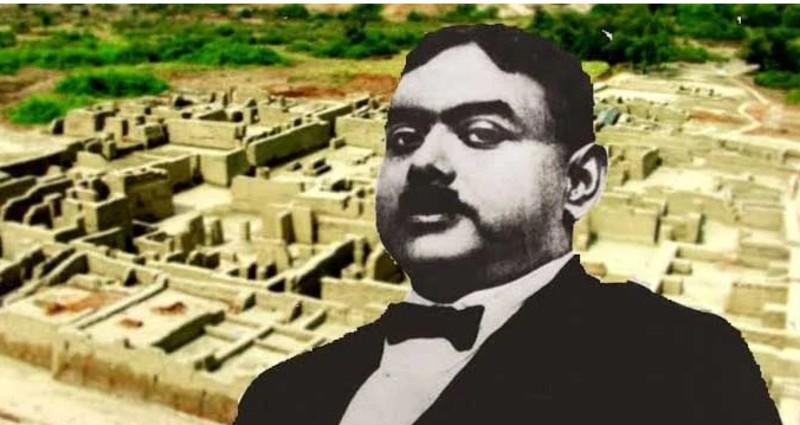
Recently we celebrated the birth anniversary of Rakhaldas Banerjee on 12th of April, I share this story as a salute to this great man. Who is Rakhladas Banerjee? Well go on read.
By all accounts, Rakhaldas Banerjee (12th April 1885 – 23rd May 1930) should have been a household name. After all, it’s not every day one stumbles upon a 5,000-year-old city lost beneath centuries of silt and secrecy. And yet, while his contemporaries enjoyed accolades and textbook immortality, Banerjee – brilliant, belligerent, and, let’s face it, a bit of a maverick – has been largely left out in the cold, historically speaking.
In the early 1900s, while the British Raj busied itself with empire-building and evening tea, Banerjee – a spirited archaeologist with a fondness for fieldwork and feisty independence – made one of the greatest archaeological discoveries of the 20th century: Mohenjo-daro, the fabled “mound of the dead men” in present-day Pakistan. Once the jewel of the Bronze Age Indus Valley Civilisation, it was a sprawling, meticulously planned metropolis that made other ancient cities look like badly-thought-out garden sheds.
But alas, as is often the case with brilliant minds who refuse to toe the line, Banerjee’s name got rather lost in the shuffle – buried, one might say, deeper than the ruins he uncovered.
Unearthing a Lost World
Born in 1885 into an affluent Bengali family, Banerjee’s early life in Baharampur was surrounded by medieval monuments and the echoes of forgotten dynasties. His passion for the past was evident even as a young lad. Unlike most students who’d borrow a book from the library and call it a day, Banerjee thought nothing of hopping states to inspect ancient inscriptions with his own eyes. One could say he had more enthusiasm than sense – but it worked.
He joined the Archaeological Survey of India (ASI) in 1910 and quickly rose through the ranks. By 1917, he was a superintending archaeologist in Western India. It was during this tenure that he chanced upon the site of Mohenjo-daro in Sindh in 1919, and by 1922, his excavations began peeling back the layers of time.
Banerjee’s findings were astounding: seals, coins, microliths, Buddhist stupas – and most crucially, evidence of an advanced urban culture that dated back millennia. His discovery linked Mohenjo-daro with another major site, Harappa, helping to piece together the puzzle of the vast Indus Valley Civilisation.
But while the ruins were impressive, Banerjee’s relationships with his colonial superiors were anything but.
Trouble in the Trenches
He had what one might politely call a “robust sense of independence”. Less politely, he was known for being prickly, irreverent, and quite incapable of currying favour. His tendency to bypass the usual bureaucratic rigmarole – like nabbing museum artefacts without official permission or buying paintings without financial clearance – didn’t exactly endear him to the British establishment.
John Marshall, the then Director-General of the ASI, was particularly unimpressed. While Banerjee was off uncovering an ancient civilisation, Marshall was busy stamping paperwork – and, as some historians argue, quietly edging Banerjee out of the narrative. The official reports from Banerjee’s Mohenjo-daro excavations were never published. Instead, Marshall’s own name became synonymous with the discovery.
As Professor PK Mishra later told the press Times of India, “The world knows Marshall discovered the civilisation’s ruins and it is taught in institutions. Banerjee is an insignificant footnote.” Quite the stitch-up.
By 1924, Banerjee’s funds for the project had dried up, and he was transferred – some say voluntarily, others suggest under pressure – to eastern India. Charges of financial mismanagement were levelled against him. He’d apparently spent excavation grants on office furniture and had travel claims that raised more than a few eyebrows.
He continued working in Calcutta, restoring ancient monuments with the same flair and fervour, but the final years of his career were marred by scandal. In 1925, he was accused of stealing a sacred idol from a shrine in Madhya Pradesh. Though the case was eventually dismissed and the charges unproven, the damage to his reputation was done. John Marshall reportedly insisted on his resignation.
He left the ASI in 1927 and became a professor at Banaras Hindu University. But a taste for the high life – horse-drawn carriages, extravagant feasts, and a wide circle of friends – meant he struggled financially. He died just two years later, aged 45.
Legacy in the Shadows
While Banerjee’s discoveries fundamentally changed our understanding of the subcontinent’s ancient history, his name is often buried beneath the weight of institutional bias and colonial politics. In Bengal, he remains a respected figure – a cultural hero of sorts – but in mainstream historical discourse, he is, tragically, the unsung genius.
Historian Nayanjot Lahiri described him as someone who “lacked diplomacy and tact” and had a knack for rubbing people the wrong way. But isn’t that often the case with visionaries? They don’t always play nice, but they change the world nonetheless.
So here’s to Rakhaldas Banerjee – brilliant, brash, and badly treated by history. A man who found a lost civilisation but lost his place in ours. Time we gave credit where it’s due and dusted off his name from the annals of neglect. After all, every mound has its buried treasures – Banerjee, quite fittingly, is one of them.
A devoted foodie with keen interest in wild life, music, cinema and travel Somashis has evolved over time . Being an enthusiastic reader he has recently started making occasional contribution to write-ups.