
Griffon Vulture Fall Prey To Poison In Assam

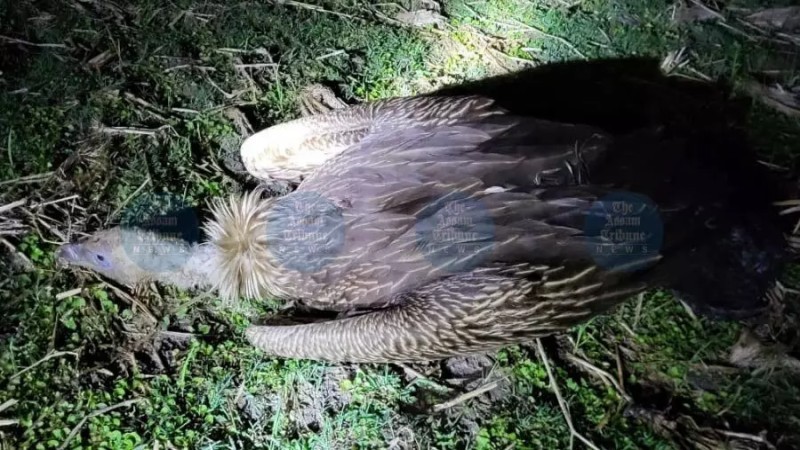

A tragic incident in Assam’s Dhubri district sees a Himalayan Griffon vulture found dead and several others collapsing mid-flight, likely due to diclofenac poisoning.
It was a bleak and heartbreaking scene that unfolded over the skies of Suripara Sapotgram in Assam’s Dhubri district. A Himalayan Griffon vulture—majestic, formidable, and once a sentinel of the skies—was found lifeless, while several others plummeted mid-flight, displaying visible signs of distress. The likely culprit? Diclofenac, that old and deadly foe of South Asia’s vulture population.
Eyewitnesses looked on in horror as the large birds, usually graceful gliders, appeared disoriented and feeble, tumbling down like rag dolls. One can scarcely imagine the pain of watching a creature designed to soar among Himalayan winds now unable to hold its wings against the pull of gravity. A single dead vulture was recovered from the fields, while others, struggling to stay aloft, lay collapsed and gasping—if not for breath, then perhaps for mercy.
It’s enough to wrench one’s heart.
Wildlife experts, not strangers to such tragedies, were quick to suspect diclofenac poisoning. Once commonly used to treat livestock, this non-steroidal anti-inflammatory drug has long been banned for veterinary use in India due to its devastating impact on vultures. A minuscule residue in a carcass is all it takes. For the vulture, it’s a death sentence—acute kidney failure that ends in an undignified fall from the skies.
One would think we’d learnt our lesson by now.
The Himalayan Griffon vulture (Gyps himalayensis), often overlooked in discussions of glamourous wildlife, is in fact a keystone species in the Himalayan ecosystem. Nature’s sanitation worker, the vulture performs the grim but vital task of clearing carcasses, thus preventing disease outbreaks. Their disappearance would be no less catastrophic than the toppling of a kingpin in a game of ecological dominoes.
Local activist and eyewitness Biswajit Barman captured the collective grief of the community:
“The scene in Sapotgram was heart-wrenching. Seeing these majestic creatures fall helplessly from the sky was both shocking and tragic. We need urgent awareness and stricter enforcement of bans on harmful drugs like diclofenac.”
But as always, it seems we’re shutting the stable door after the horse has bolted.
The forest department, to their credit, has urged villagers not to disturb the ailing birds and to report any further sightings. Post-mortems and sample collections are on the cards, and conservation groups have stepped in to amplify calls for using safer alternatives like meloxicam. But is it all too little, too late?
This isn’t the first such incident, and if history is any indicator, it won’t be the last unless there’s a dramatic shift in attitude. The skies over Assam have wept, and the earth beneath has borne the weight of yet another avoidable tragedy.

For now, the vultures lie still—silent messengers of human negligence. And we, once again, find ourselves clutching straws in the face of irreversible loss.
Perhaps next time we hear the word extinction, we’ll listen. Properly.
Or perhaps, like the vultures, we’ll simply fall.
News Sources : The Assam Tribune
What's Your Reaction?
