
Birendra Krishna Bhadra: Bengal’s Radio Drama Icon

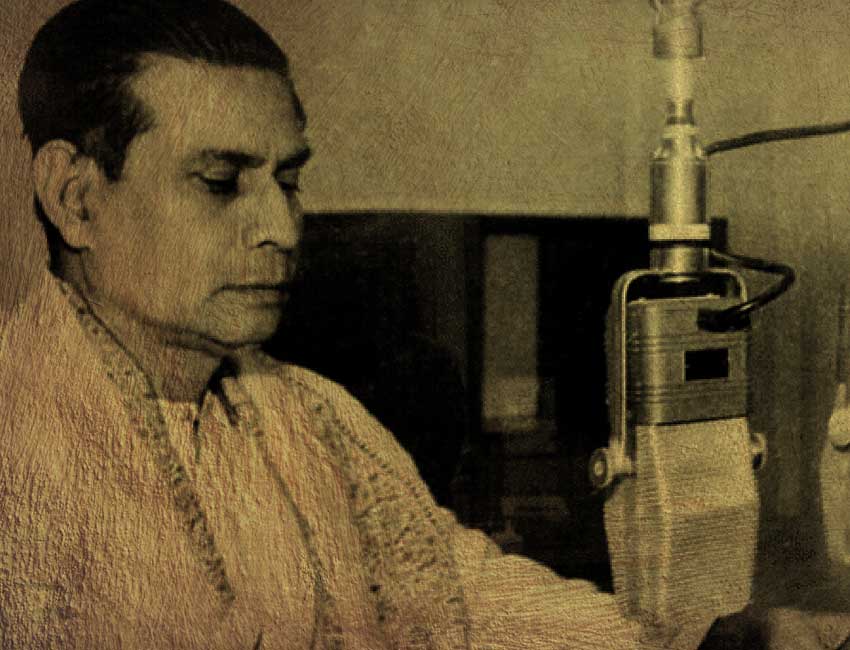

Durga Puja in Bengal actually starts from Mahalaya Day, with the sonorous voice of a radio drama immortal of AIR Calcutta, Birendra Krishna Bhadra, whose rendition of Chandi Paath has kept Bengalis united across the world for 93 years till date. We share this story on the occasion of his birth anniversary.
Year 1905. On July 16, Lord Curzon, then Viceroy of British India, announced the Partition of Bengal, to divide Bengalis into Hindus and Muslims.
Year 1905. On August 4 was born a voice that would unite Bengalis across the world though a single radio theatre programme, with his soaring voice rendition of the Chandi Mantra from the All India Radio (AIR)’s programme titled Mahishasuramardini. It has been 93 years now from the year it started in, but this programme has remained an obsessive-compulsive order for millions of Bengalis: that one day, Mahalaya, the beginning of Pitri Paksha, at 4.00 am, Bengal wakes up to hear that voice… and across the world crossing time zone gaps, Bengalis wake up nowadays to hear the same programme over YouTube…
“Ya Devi sarvabhuteshu shakti rupena sansthita
Namastasiayi namastasiayi namastasiayi namonamaha
“Ya Devi sarvabhuteshu vidya rupena sansthita
Namastasiayi namastasiayi namastasiayi namonamaha
“Ya Devi sarvabhuteshu bhranti rupena sansthita
Namastasiayi namastasiayi namastasiayi namonamaha
“Ya Devi sarvabhuteshu needra rupena sansthita
Namastasiayi namastasiayi namastasiayi namonamaha
But though that mantra comes towards the very end of the programme, the magic starts from just after the conch shell is blown and the first song ends: that fluid, sonorous voice comes through: “Ashwiner sharado pratey, beje utheyche aloka manji Anandamayee Mahamayar padoddhoni ashimo chonde beje uthey roopo lok o rasho lokey anay nabobhabomadhuri shanjivan… Aaj chitshakti rupini Vishwajananir agomoni mondirey mondirey dhyanoghoshota!”
That starts the Durga Puja sentiments for millions of Bengalis. Interestingly, Mahalaya is not the day when Durga Puja starts. It is the beginning Pitri Paksha, the fortnight when Bengalis take a dip in the Ganga and offer prayers to their ancestors. But though Devi Paksha, when the actual Durga Puja starts, is a full fortnight away, it is Birendra Krishna’s Chandi Paath that sweeps the cities and villages of Bengal and infuses the ecstasy for the coming Durga Puja… such was the towering presence of one man over the ether.
Such has been the power of this rendition that whichever non-Bengali friend I have shared this Chandi reading by with has remained mesmerised. Such has been the power of Birendra Krishna Bhadra’s mesmerising rendition in perfect, chaste (“un-Bengaliised”, if I may say so) Sanskrit pronunciation of Chandi Mantra, that I have seen him being taken to Durga Puja marquees across Calcutta for renditions of not the entire Mahishasuramardnini programme, but just that Chandi Paath portion of it. The organisers knew well that if the word spreads that Biren Bhadra is coming to a particular Durga Puja pandal on a specific day, in day time or in the evenings, the footfall would be chaotic, something Puja Committee wants!
Amazing Child
A short passage from Wikipedia: “Birendra Krishna Bhadra was a radio broadcaster, playwright, actor, narrator and theatre director from Calcutta (now Kolkata), India and a contemporary of legendary musician Pankaj Mallick and another legend of Bengal, the rebel-poet Kazi Nazrul Islam. He worked for the All India Radio, India’s National Radio broadcaster for several years during its early, starting 1930s, and during this period he produced and adapted several plays.”
Birendra Krishna Bhadra was born into the family of Roy Bahadur Kali Krishna Bhadra and his wife, Sarala Devi on August 4, 1905. The roots of the Bangali Brahman family were in what now is Bangladesh, which means that even his Bengali pronunciation would have been heavily accented with Bangal dialect, typical of East Bengal people. But he could overcome that natural bias because his father must have been after his little bums to get his Sanskrit pronunciation correct. For Kali Krishna, his father, was a linguist fluent in 14 languages. Though Kali Krishna worked as a translator in a Calcutta court, he also was a towering figure in Bengali literary circles of those times. Birendra Krishna completed his graduation in 1928 from the elite English medium Scottish Church College in Kolkata.
Birendra Krishna found a job with AIR and he promptly took to adapting several plays to the radio theatre format. From the 1930s till the menace of TV serials took over, AIR was doing pathbreaking work in radio dramas, then an extremely popular entertainment genre. Besides, the time was highly opportune. That was when the Bengali literary, theatre and film world was bustling with major talents. Apart from musician Pankaj Mullick, there was Dwijendralal Roy, Bimal Mitra, Bimal Roy, a budding Satyajit Ray and Ritwik Ghatak, Kazi Nazrul Islam, stalwart thespians Girish Chandra Ghosh, Chhabi Biswas… just name them….
Birendra Krishna made a radio drama, Sahajahan, from Dwijendra Lal Roy’s eponymous play, and it till date remains an immensely popular Bengali radio drama. The radio plays Chandragupta and Prafulla were also produced and directed by Birendra Krishna. He then wrote some plays including Mess No. 49, and directed a theatre production, Sahib Bibi Gulam, a stage adaptation of the celebrated novel by the famous author Bimal Mitra.
Besides, aside of Mahalaya, there were some other glimpses of Birendra Krishna that we get from old timers. One of them I remember I heard from Bhabesh Das, a former News Editor of DD Kolkata in his tome, Betar which was also the name of the house journal of AIR. He narrated that one day, there was a premier football match between arch rival East Bengal and Mohan Bagan. Unfortunately, sports commentators like Kamal Sarkar and others were not available that day. So this kurta-pyjama-clad Bangali Bhadralok was deputed to cover the match. He loidly protested that he hardly knew even the basic rules of football. He was packed off to the ground, behind told football is a simple game, but there was one cardinal rule. They players have to play with their feet and cannot touch the ball by hand. That is called a handball and a foul.
The Funny and the Sombre
Of went the gentleman, and at a crucial moment of the game, he found a player shoot the ball at the opponents’ goalpost, and the goalkeeper dived and saved a goal and clasped it in his hands. And at that moment, a visibly excited Birendra Krishna started shouting: Foul, foul… handball, handball! You see, the guy in AIR who had briefed him had forgotten to say that touching the ball with hands is a foul, excepting if the goalkeeper does that! (A Smilie, anyone?)
And though he is universally known for his Chandi Paath in Mahishasuromardini, people forget other accolades he had received. Nobel Laureate Rabindranath Tagore passed away in 1941. A pall pf gloom descended across the country, more so in Bangal. The passage of Tagore’s cortege from his home to the cremation ground had to be aired in AIR. But who could possibly carry that gloom through his voice? The bosses knew that only Birendra Krishna Bhadra could do it, if anyone. That narration had to be through the remarkable range of the modulations of his voice alone. This is one episode in his life most people today are not aware of, but it was a silent and sombre landmark in his career!
MahishasuraMardini: Epic Radio Drama
Whatever his other contributions, the legend of Birendra Krishna Bhadra stems directly from this radio theatre. But its history is complex. So let us paraphrase it in this manner. It started with a radio programme for Dhaka Radio, and the next year from the Calcutta Radio Station (later, AIR Kolkata) on 1930, which was written as Prabhatey Ashram Drisya in 1930 by renowned actor and radio programmer Hirendranath Basu. This name was changed to Prabhati Utsav, and then again to Prabhati Mangal in 1932, and so forth.
It was in 1937 that the programme Mahishasuramardini started on Mahalaya Day from AIR Kolkata. The programme was created by another legend, Bani Kumar, who based his script on Saptasati Chandi, which details the seven hundred shlokas on Durga. Music legend Raichand Boral initially set the score for the play.
Till the early 1960s, the programme was broadcast Live, with many changes from the previous years. Pankaj Mullick was one pf the three music directors for the programme, along with Boral and Harishchandra Bali. But eventually, Mullick became the sole in charge of music, along with Birendra Krishna Bhadra, says Bani Kumar in his book titled Mahishasuramardini. From then till mid-1960s, the names of the singers changed every year for the Live programming. Only two names were permanent: Pankaj Mullick and Birendra Krishna Bhadra.

Bani Kimar reminisces in his book that Birendra Krishna got so involved with the magnanimity of Devi Durga that he would get up at the crack of dawn, have a bath, wear his rich, mellow golden Garad Silk dress, which is worn only for various pujas, and then alone he would arrive for the programme. He used to say that this was not a just another performance, it was his offering. No wonder then that at one point in the narration, in which the sloka invokes Durga to awaken, and Bhadra says: “Jago…jago Maa,” that he literally breaks down.
A Powerful Legacy
The programme was played prerecorded from the late 1960s. Some years ago, I was watching a film, at the end of which there were angry radio listers storming out of their homes early on Mahalaya morning, shouting in anger and very apparent frustration, and the film even showed more than a few of the listeners throw their radio sets from their balconies down to the road below. It was an outrage of massive proportions, an outrage that the usually quiet and gentle Bangali gentry rarely gives in to.
What had happened is that a new director had joined AIR Calcutta in 1976. The audacious babu decided that this programme, running for so long, needed tweaking.
While watching the film, I recalled that morning, in the autumn of 1976. I had just completed my Class 10 board exams and early, as usual on Mahalaya morning, we were glued to the radio. But early that morning, when the programme started, there was confusion, and doors and windows were thrown open and neighbours asked each other: Shorbonash… eta ki hocche ta ki!” “Hey… what the hell is going on… this is a disaster”! They could not find Birendra Krishna Bhadra’s voice doing the Chandi Paath. There was complete disbelief. Utter chaos on the streets and neighbourhoods.
Apparently, the AIR Calcutta’s new don had renamed the programme as Durga Durgatiharini, but the most disastrous change that the official had made was that he changed Birendra Krishna Bhadra and brought in the fabled film actor Uttam Kumar to read the script. Uttam Kumar. The most loved Bengali icon of all times. But Uttam Kumar is not Birendra Krishna Bhadra, the listeners were adamant… tendramo peyechho? You think this is some circus clowning?
Birendra Krishna was deeply hurt, for apparently, he had not been informed of his unceremonious departure from the programme. But the furore that followed must have assuaged his heart’s pain. And more so when from the next year, the original recorded programme was resumed, with Birendra Krishna Bhadra and his mellifluous voice ushering in the Durga Puja festivities once again, and never has any other AIR boss dared to change anything in the programme.
Football icons, cricket icons, Mohammed Ali, Saurabh Ganguly, Sena, Pele, Martina, Steffi… Bjorn Borg… we have seen them all. They were all icons made as much by their talent as by the new age media. But a Radio Theatre icon from what seems to be the hoary past compared to the supertech media environments of 21st century? Can you imagine?
For though all radio drama anywhere was largely influenced by the proscenium theatre, it was completely handicapped. No stage. No props. No actors and actresses. Radio Drama is especially difficult because it had just two elements: voice, primarily, and background scores. So this is a good indicator of what that one voice must have kept all Bengalis united for 93 years!
My good friend and colleague Somashis Gupta, this morning, while discussing Birendra Krishna’s birth anniversary coming up tomorrow, August 4, sort of slipped in a research paper from under my WhatsApp door. The paper had appeared in the Global Media Journal Indian edition, December 2013. It was authored by Dr Manas Pratim Das, Programme Executive, AIR Kolkata.
Dr Das writes: “In A Brief History of Radio Drama in America, Don Kisner says, ‘Radio drama was born in 1927, when networks began adapting short stories, and even writing original scripts for broadcast. He is of the opinion that radio drama reached its peak in America in the 1940s and does not mince words while saying, ‘Radio drama is over 70 years old, and, for all serious purposes, has been dead for 50 of those years, being used only occasionally in the classroom as a novelty or curiosity.’
Well, scholars are scholars and we respect them. But Mahalaya 2024 is on September 17. We cordially invite Don Kisner to be sitting up in Calcutta that dawn and hear… and see… what Birendra Krishna Bhadra means!
What's Your Reaction?
