
Bengali Identity: How “Bengaliness” Evolved

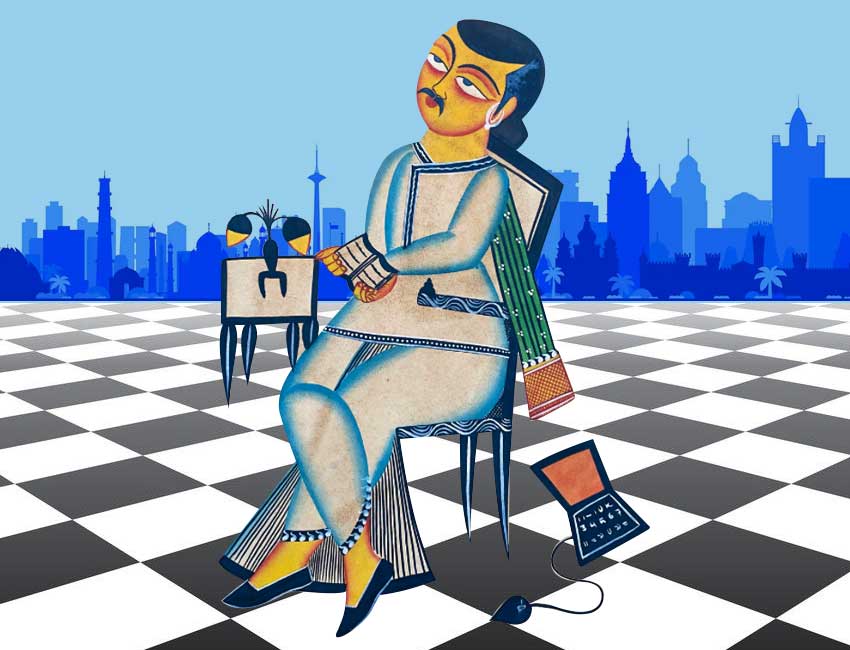

Bengali Identity has seen a rich evolution across India and Bangladesh, shaped by significant cultural shifts, political influences, and changing societal perceptions since the mid-18th century. Somjyoti Mridha‘s review, the final part of his three-part series, explores the cataclysmic changes in Bengal since the mid-18th century.
One enduring stereotype about Bengali identity is its narrow association with the intelligentsia, which simultaneously excludes every section of Bengali society apart from the educated upper-caste Bhadralok male.
Democratic left politics also kept emergence of identity politics at abeyance which became the mainstay of political discourse outside Bengal since the 1960s. Therefore, Bhadralok hegemony continued unchallenged in the Bengali public sphere until the political change in 2011.
Curiously, the public sphere in West Bengal is thoroughly dominated by the upper caste Bhadraloks having minimal engagement with the caste question either in the corridors of power or academia until very recently. The spectacular rise of Manoranjan Byapari both as a literary icon as well as a politician is a welcome aberration in the literary/cultural/political firmament of West Bengal.
The establishment of Bangla Dalit Sahitya Akademi in 2020 by the government of West Bengal provides a certain degree of recognition to sub-altern caste identities, their struggle and stories.
Bengali Identity and the Rise of Identity Politics
In fact, Bengal has suddenly woken up to the myriad possibilities of identity politics. Identity politics is not just limited to caste based assertion of subaltern identities; ethno-centric organization based on linguistic identity like Bangla Pokkho is also making inroads into the political landscape of West Bengal with its variant of ethno-centric political discourse.
Since the early 19th century, Bengali collective ethos followed a universalist paradigm under the influence of European Enlightenment Philosophy of the 18th century and hegemonic colonial discourses. They have suddenly discovered the particularities of their region, language and distinctness of their identity. There are various reasons for this new development.
Demographic advantage catapulted the Hindi belt to the forefront of national politics thereby relegating Bengal as a minor player in the corridors of power in New Delhi. Bengali identity also emerged as the mainstay of political discourse in the public domain since the ruling party is poised to contest both the left and the right for electoral victory.
Impact of NRC
The sudden explosion of discourses revolving Bengali identity also happened because of perceived threat from quasi-administrative/ political exercise like National Register of Citizens (NRC) in neighbouring Assam and the spectre of a nation-wide NRC proposed by the Central government.
The very real possibility of migrant labourers from Bengal being labelled as Bangladeshis or Rohingya Muslims in the National Capital Region or Bangalore may have also contributed to the popularity of ethno-centric politics in West Bengal.
While the Bengali society is primarily agrarian, it is impossible to ignore the centrality of Kolkata in Bengali culture. While Dhaka has emerged as a megalopolis with the formation of independent Bangladesh in 1971, it is Kolkata, the capital city of West Bengal which is considered as the centre of cultural modernity for the Bengalis.
Ascendency of Kolkata
Kolkata’s ascendency as the capital city of the Indian sub-continent during the 19th century has a lot to contribute to this perception. Kolkata’s self -perception as the second city of the British Empire coupled with the fact that it emerged as the locus of Bengal Renaissance during the 19th century made Kolkata—the epicentre of the Bengali cultural life.
While Kolkata’s fortunes rose with rise of British fortunes in the Indian sub-continent, it ebbed with their departure. The shift of capital to New Delhi in 1911 and the flight of capital during the 1960s have reduced Kolkata’s political and economic importance. Yet, its status as the epicentre of Bengali urbanity is still intact.
Possessing a property within the city precincts of Kolkata is still an aspirational goal for well-heeled Bengalis scattered across the sub-continent due to partition and lack of economic opportunities. The hegemony of Kolkata in the cultural life of the Bengalis has not remained unchallenged though. Dhaka has emerged as contender due to its political significance in Bangladesh.
Bengali Identity in a Divergent 21st Century
The well-heeled Sylheti community, demographically concentrated in Barak valley of Assam and Tripura, with a distinct cultural ethos of their own have challenged the cultural supremacy of Kolkata. The economic heft of migrant Bengalis in cities like Bangalore, Mumbai and Delhi poses serious challenge to the Kolkata hegemony. Bengaliness has evolved as a divergent discourse in the 21st century.

Bengaliness as a discursive and literary/cultural category has been in currency since the 19th century. The awareness of distinct Bengaliness vis-à-vis Indianness existed even during the heyday of Hindu nationalism when Bengal spearheaded Indian nationalist movement with Colonial Calcutta as the epicentre.
The trajectory of Bengaliness has changed since the publication of Bengaliana, A Dish of Curry and Rice and Other Indigestible Ingredients (1877) by Shoshee Chunder Dutt to the most recent, The Bengalis: A Portrait of a Community (2017) by Sudeep Chakravarti. In between lay a million attempts to configure the basis of Bengali identity in the form of fictional or non-fictional prose, historical treatises and sociological studies.
The Bengali self-image has been constructed through various cultural stereo-types ascribed to the community which reified cultural contours of Bengali identity in popular imagination both within and outside Bengal.
Locus of Bengali Identity
In the post-modern digital age, Bengalis have evolved from dominant image of the bespectacled, dhoti-punjabi clad gentleman with an umbrella engaged in adda over a hot cup of tea accompanied by oily fritters. The ubiquitous presence of fish in Bengali culinary culture has given way to Biriyani in the Awadhi format.
The image of a revolutionary Marxist as a representative Bengali has given way to the global yuppie savvy in corporate culture. Yet, the locus of Bengali identity is still based on cultural accomplishments of the 19th century Bengal.
Bengalis are yet to refashion their collective self in tandem with altered socio-political circumstances. Nostalgia for a non-existent ‘golden’ age when Bengalis were the ‘leaders’ of Indian society has thwarted our ability to grasp the changing socio-political conditions and technological advancements.
What's Your Reaction?
