Attacks on Hindu Minorities in Bangladesh



Escalating attacks on Hindu minorities and mob violence in Bangladesh have severely strained diplomatic ties, pushing Indo-Bangla relations into a deep freeze amid growing regional instability and unrest. Writes Prasanta Paul
The abrasive rebuttal of the Bangladesh government in response to the growing incidents of communal flare-up triggered by a fresh wave of mob frenzy and unrest following the killing of student leader Sharif Osman Hadi middle of December last year appears quite ominous for the Indo-Bangla bilateral relations.
The brutal lynching and burning of Dipu Chandra Das, a Hindu minority, over unproven blasphemy allegations in Mymensingh was just the beginning of an orgy of lynchings and violent mob attacks on the Hindu community. At least, 11 Hindus fell to mob violence in the 35-day period between December 2, 2025 and January 6, 2026; and people are apprehensive if more Hindu heads have quietly been drafted for brutal sacrifice in the guillotine in Bangladesh.

The video of Dipu being burnt atop a bamboo stick and a crowd shouting and bursting in joy in Mymensingh that went viral internationally, only speaks of medieval barbarism. With cops conceding later that there was no blasphemy charge as such that could subsequently be proved against Dipu and the Hadi killers were his own Bangladesh comrades, widespread international condemnation of the latest trend of unrestricted barbarism on the minorities in the Islamic country has steadily been growing.
Why? Because, leave alone Hindu Bengali settlers, even mosques and homes of Ahmadiyya minorities have also been attacked by the majority fantatics.
Fanatics, Unrest & Indo-Bangla ties
Fanatics because the mindless mob frenzy has also triggered a wave of anti-India propaganda and threat to invade India and oust the Narendra Modi government from power. The unrest has strained relations with India which is presently sheltering ousted prime minister Sheikh Hasina. India has also been accused by some Bangladeshi political figures of interference. The protests quickly gained widespread ground across several Bangladesh cities, leading to violent demonstrations in front of Indian diplomatic missions.
Even as India has been compelled to withhold for the time being visa issuance from Bangladesh, the latter sharply retaliated by imitating the same measure. Fortunately or unfortunately, the bilateral relations have again made its deserved entry into the cold storage, much in the fashion of the situation that developed in the wake of the ouster of former Prime Minister Sheikh Hasina in August 2024.
Be that as it may, what has shocked and surprised many is a stunning silence of leading Bangladesh literati who have, till the other day, been considered progressive. Because the arsonists went on a buring spree; they targeted and set fire to buildings, including the offices of major newspapers like Prothom Alo and The Daily Star and their ire also fell on ‘Chayanaut’, a premier and highly influential cultural institution in Bangladesh dedicated to the preservation and promotion of Bengali heritage, music, and traditions.
Destruction of Cultural Edifice
‘Chayanaut’ was established by cultural activists, including Sanjida Khatun and Waheedul Haq, to nurture Bengali culture with the study of Tagore and Kazi Nazrul Islam as central focuses. After invading the premises, the mob destroyed all the musical instruments, but desisted from setting the house afire.
Founded in Dhaka in 1961, Chhayanaut’s creation was a direct act of defiance against the Pakistani military regime’s ban on the performance and broadcast of Rabindranath Tagore’s music (Rabindra Sangeet). It has also emerged as a cultural resistance movement against the Pakistani government’s ban on Rabindranath Tagore’s music and works and become a powerful symbol of Bengali identity and nationalism.

Aashis Khan, grandson of Ustad Ali Akbar Khan, a virtuoso of Sarod, who managed to flee Bangladesh last week hiding his identity, condemned attacks on his Sangitangan (music academy) in Dhaka, calling it a “shameful” destruction of culture; while reflecting family dismay over threats to their musical heritage, he vowed to push for its preservation at any cost.
Armaan Khan, son of illustrated singer Ustad Rashid Khan, reacted strongly to the recent carnage in Bangladesh. After cancelling his scheduled concerts, he declared that Bangladesh was unsafe for artists as he severely condemned attacks on Hindu minorities and ‘Chayanaut’. Calling for humanity over religion, he exhorted artists to speak out against such atrocities.
“What is happening today with the Hindus in Bangladesh should not happen,” he said in Kolkata, “I never thought such a situation would happen in Bangladesh. All artists specially those with a significant fanbase, must take a stand now.”
Laskar & Jaish – Fish in Troubled Waters
What is also quite worrying is the Indian intelligence input that directly blamed outlawed Laskar-e-Toiba for turning Bangladesh into its latest terror base to step up subversive activities in India. Along with Laskar, Jaish-e-Mohammad too has become active; both Laskar and Jaish have teamed up to take on India as the ‘Operation Sindoor’ had struck deep into their respective terror bases in Pakistan.
Abdulla Shah Mazzar, considered right hand of notorious terrorist Masud Azaahar, had already conducted several trips to Bangladesh with a view to expand its terror network among the Rohingya settlers there. This apart, several dispatches of highly sophisticated arms assignments from China, according to sources, have reached selective pockets in Bangladesh via Nepal and West Bengal for launching sudden, across-the-border assaults on targeted sites in India. Jehadi training camps are also understood to have started operations at some places in Bangladesh soil.
All this brings us to a grave question: has the present generation in Bangladesh been properly exposed to the blood-stained history of the country’s path to liberation from the inhuman and brutal tyranny of the marauding Pakistani troops who had invaded erstwhile East Pakistan on March 25, 1971 in Dhaka and adjoining neighbourhood? And how India played the most critical and powerful role in liberating Bangladesh from the clutches of those Pakistani butchers?
Logic-defying Spurt in Anti-India Rants
In all probability, No; because the volume and the degree of anti-India rants among a majority of the Gen Z in Bangladesh defies all logic and understanding. Either they haven’t been properly briefed about the history of liberation or Mukti Yudh or they have been debarred from understanding true meaning of martyrdom, from grasping the permanence of heart-wrenching sacrifice of Mukti Yodhhas( Freedom fighters) and India soldiers.

An estimated 25 lakh people were killed & more than one lakh women were raped at gun point during the murderous crackdown. The Pak army mercilessly executed intellectuals, students and minorities. India which was extending crucial support to Mukti Bahini, the revolutionary front fighting the Pak invaders, finally decided to enter the war in December,1971.
Bangladesh War of Liberation
On the Western Front, Indian troops entered from West Bengal into Jessore, Khulna & Kustia; on the Eastern Front, troops moved into Coomilla, Brahmanberia and Chittagong while on the Northern Front, the Indian fighters began their assault from Assam and Meghalaya into Mymensingh and Sylhet. Then, finally, a co-ordinated central push towards Dhaka had been triggered.
After a 13-day military blitzkreig, Pakistan troops were compelled to surrender at the Race Course Ground, Dhaka on December 16,1971, making it one of the largest surrenders in the world war history as 93,000 Pak soldiers laid down arms following a truce.
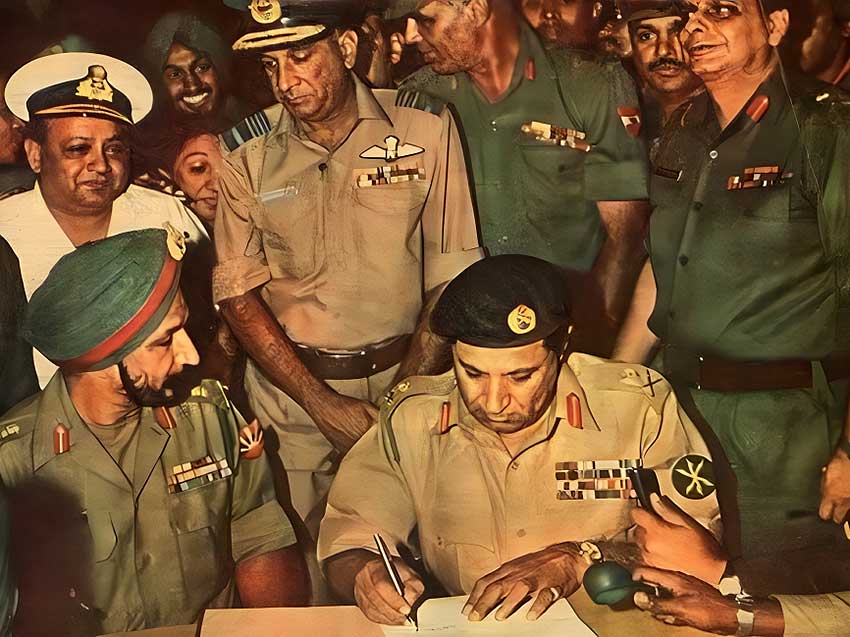
But there has been an untold account of sacrifice of Indian jawans which was kept a secret till the other day. A heart-rending tale permeated with a painful angst would bring tears to every patriot of India. While all the Pak prisoners of war(PoW) were released by India as per the truce, there was neither any talk nor any trace of their Indian counterparts who had been captured alive and been languishing in various prisons in Pakistan since then.
Unseen Cost of Sacrifice
Why the then Indian government failed to initiate their release even after such a spectacular victory over the Pak horror machine, is a well-guarded secret, a mystery which the families of those ill-fated soldiers were yet to fathom. Their desperate pleas for any information on the captive soldiers’ whereabouts fell on deaf ears.
It might augur well for India if the powers that be do a little bit of soul-searching and endeavour to deliver some justice to those hapless kins of the missing jawans, the unsung heroes, who must have counted their last, sordid days tearfully inside the dark prison premises for a last, parting look at their dear ones before being laid to rest in the most undignified manner.
Can we really vouchsafe that our country has not incurred any curse from these faceless, unknown, uncared for patriots due to a prolonged and abject government apathy towards their plight?
What's Your Reaction?