
History of 24th May- AMU, Telescribe & Kim

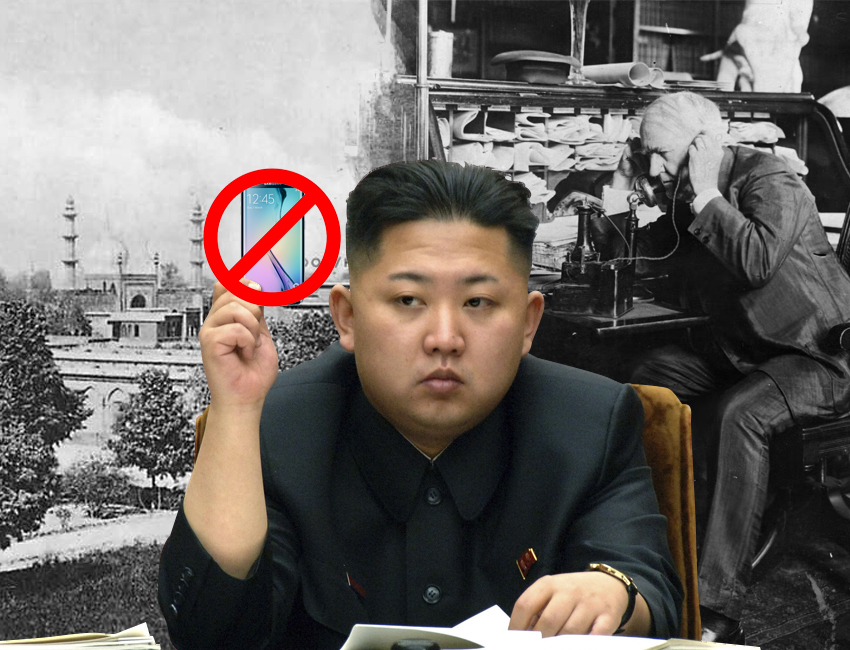

This episode of the series is about the History of 24th May and includes the beginning of the Muhammadan Anglo-Oriental School in 1875, the invention of Telescribe in the year 1915, and finally Kim’s decision to ban mobile phones in North Korea in 2004.
During the initial centuries of Islam, the educational system was predominantly informal. But in the 11th and 12th centuries, the ruling elites established formal institutions called madrasas. However, madrasas focused solely on religious teachings and did not incorporate modern-day education into their curriculum. But in India, this changed in the year 1875. That is what my first story is from the history of 24th May. But before that join me in wishing a very Happy Birthday to Bob Dylan. I shall share a full story on Bob Dylan and his influence in Indian Music this Saturday.
The beginning of Aligarh Muslim University.
Syed Ahmed Khan, a visionary and social reformer, realized an urgent need for modern education in the Muslim community. This realization came to him as the Muslims were lagging in various spheres of life during that time. Khan believed that education was the key to progress and that the Muslim community needed to embrace modern knowledge to thrive in the changing times.
As I see the history of 24th May, I see that it was this day in the year 1875 when a significant milestone was achieved by Khan when he established the Muhammadan Anglo-Oriental School in Aligarh. This institution evolved into what we know today as Aligarh Muslim University (AMU). This institute was a bridge to the educational gap and provide a platform for the intellectual development of Muslims.
The school aimed to combine traditional Islamic education with modern scientific and secular knowledge. It focused on providing a well-rounded education that would equip students with both religious and practical knowledge. This approach was aimed at enabling Muslims to adapt to the modern world without compromising their cultural and religious identity.
Over the years, the institution grew and expanded its curriculum, gradually transforming into Aligarh Muslim University in 1920. Under the leadership of eminent scholars and educators, AMU became a prominent center of learning, attracting students from different parts of India and even abroad.
A few years ago, I had the opportunity to visit the University, and what I witnessed there was truly captivating. The students are preached the profound essence of Islam, which emphasizes the concept of universal brotherhood. Simultaneously, they were also learning about the remarkable inventions of Thomas Edison. Speaking of Edison, it reminds me of an intriguing story from the history of 24th May which revolves around him.
Edison’s Telescribe
It is quite fascinating how WhatsApp has seamlessly integrated into our daily lives. From the infamous flood of good morning messages to official announcements, WhatsApp has established itself as a versatile platform. However, the roots of this remarkable development can be traced back to an event that occurred on the history of 24th May, in the year 1915. My second story.
The Wizard of Menlo Park – Thomas Edison is renowned for his invention of the Light Bulb. However, it is important to clarify that Edison did not invent the light bulb, as it had already existed for several years prior. Edison made significant improvements by creating a vacuum inside the bulb, identifying the suitable filament, and making a light bulb that could last for many hours. But this story is not about the light bulb but about the telescribe which he invented on the 24th of May 1915.
This invention revolutionized the way people communicated and documented information. The telescribe allowed the transmission and recording of written messages over long distances. It combined elements of telegraphy and stenography to create a new means of communication. At its core, the invention involved the use of a special writing instrument equipped with an electrically conductive tip. This instrument, similar to a stylus or pen, was connected to a series of intricate mechanical and electrical systems.
When a person wrote a message using the telescribe instrument, the conductive tip completed an electrical circuit that activated the transmission mechanism. The message was then sent over a telegraph line to a receiving telescribe unit located at the desired destination. The receiving unit reproduced the message in real-time, allowing the recipient to view and record the written content.
Although the telescribe represented a significant breakthrough in communication technology, it did not experience the same widespread adoption as some of Edison’s other inventions. Factors such as cost, complexity, and the emergence of alternative communication methods hindered its popularity. Nonetheless, the telescribe paved the way for subsequent advancements and served as a stepping stone toward the development of more advanced written communication technologies.
With that, I come to my third and concluding story from the history of 24th May.
Kim Jong Un’s legendary ban on mobile phones
The history of 24th May takes us to the year 2004. The leader of North Korea Kim Jong Un decided to ban all mobile phones in his country on this day. Can you believe it? It’s like the supreme leader wanted to turn his nation into a giant game of hide-and-seek.
Picture this: It’s 24th May 2004, and the technologically challenged leader wakes up from a deep slumber, clutches his smartphone-sized remote control, and suddenly exclaims, “Eureka! I have found the ultimate solution to maintain order and control… Let there be NO mobile phones!”
Oh, Kimmy, Kimmy, Kimmy! We know you love playing hard-to-reach, but this is taking it to a whole new level. Did you think this ban would make you the king of hide-and-seek? Or did you just want to create the world’s most epic game of “Guess What I’m Thinking”? We’re dying to know!
The reactions from the people must have been priceless! Can you imagine the look of shock and despair when the entire nation discovered they couldn’t snap a quick selfie or send their friends a GIF of their glorious haircut? The world’s most exclusive club of phone-less individuals was born, and it seems Kim was its honorable chairman.
But hey, let’s not forget the silver lining here. With no mobile phones, the people of North Korea had to resort to good old-fashioned communication methods. Carrier pigeons must have been working overtime, delivering the latest Kim Jong Un memos across the land. Morse code experts were dusting off their skills, tapping away secret messages in the dead of night.
Perhaps this was all part of his grand plan. Maybe he wanted to revive the art of conversation, forcing people to communicate face-to-face. It’s like saying, “Why type a message when you can just deliver it via interpretive dance?” We’ve got to admit, he is quite the innovator.
Oh, Kim Jong Un, you’ve truly given us a reason to chuckle. Your decision to ban mobile phones will go down in history as the ultimate plot twist, leaving us all in awe of your unexpected sense of humor. So here’s to you, Kim for bringing a little laughter into our lives. Long live the banter and may your reign be filled with whimsical decisions that keep us on our toes!
I am eagerly awaiting his next surprise move. Will it involve banning shoelaces or outlawing the use of hair gel? The suspense is killing me!
That’s all for the day. See you tomorrow.
What's Your Reaction?
