
Friendship That Shaped Sikkim

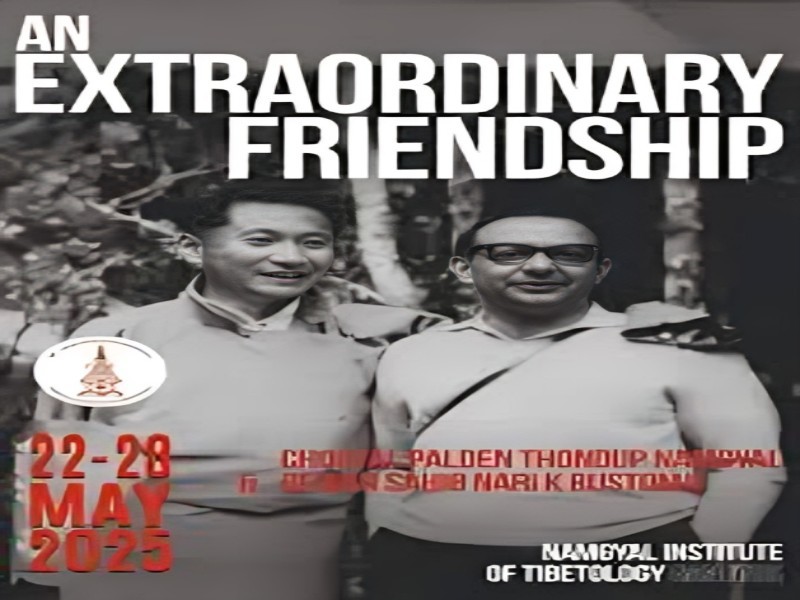

Explore the timeless bond between Chogyal Palden Thondup Namgyal and Dewan Sahib Nari K. Rustomji at An Extraordinary Friendship, a special exhibition from 22–28 May 2025 at the Namgyal Institute of Tibetology.
There’s something rather touching — one might say quietly stirring — about friendship that defy the humdrum of bureaucracy and the cacophony of politics. When the Namgyal Institute of Tibetology (NIT) in Gangtok throws open its doors on 22 May this year, what greets the public won’t merely be an exhibition, but a deeply emotional homage to a partnership that laid the bedrock for modern Sikkim — a tale not just of governance, but of heart.
Titled “An Extraordinary Friendship: Chogyal Palden Thondup Namgyal and Dewan Sahib Nari K. Rustomji,” the exhibition seeks to capture the ineffable bond between Sikkim’s Crown Prince and an Indian civil servant — two men from different worlds who, against the backdrop of post-colonial upheaval and Himalayan solitude, chose vision and camaraderie over division and distance.
Curated meticulously by Tenzin C. Tashi, senior researcher and editor at NIT, this special showcase features nearly 300 photographs, artefacts, documents, and archival films — many seeing the light of day for the first time. It’s a labour of love, really. But more importantly, it’s a reckoning — a long-overdue nod to a chapter in Sikkim’s past that shaped its future in more ways than one.
For the uninitiated, Rustomji was not just a man in a starched white collar, posted to an unassuming Himalayan kingdom. He was, technically speaking, India’s man — an ICS officer, seconded to Sikkim in 1954 at the behest of the Crown Prince. But the moment his boots hit Sikkimese soil, something changed. He wasn’t merely doing a job; he was answering a calling. Donning the traditional kho and learning the local tongue, Rustomji immersed himself in Sikkimese life with a gusto that would put many to shame.
And then there was Palden Thondup Namgyal — a Crown Prince with a modern mind and a deep-rooted respect for his culture. The two met, quite serendipitously, at the ICS training camp in Mussoorie in 1942. From shared lectures and walks in the misty hills to joint dreams for a remote kingdom nestled in the Himalayas, their friendship blossomed — a quiet force that would, in time, change the destiny of a land.
From the construction of government buildings that still stand with quiet dignity, to pivotal events like the Dalai Lama’s visit, the Buddha Jayanti celebrations, and the 1965 coronation — every chapter of Sikkim’s twentieth-century history bears the gentle imprint of their partnership. Even the darker moments, such as the 1967 Chinese aggression at Nathula, are not brushed under the carpet, but rather included as testament to their leadership in times of trial.
What makes this exhibition truly special, though, is not just its impressive archival sweep. It’s the humanity. It’s the handwritten notes, the warm photographs, the humble objects on loan from the Rustomji family home in Mumbai — things that speak, if one is willing to listen, of loyalty, mutual respect, and a rare blend of idealism and pragmatism.
It’s also a bit of a homecoming. For while the official Rustomji archives are preserved in Delhi’s Nehru Memorial Library, the personal side of his story — the side that reveals his affection for Sikkim and its people — now returns to the land he once helped steward.
And perhaps that’s what tugs most at the heartstrings. This wasn’t a transactional relationship. It wasn’t all formality and frowns. It was two men — one born to a throne, another to service — rolling up their sleeves, getting their hands dirty, and choosing, time and again, to walk the road less travelled. Together.

It’s a crying shame, really, that Dewan Rustomji’s legacy has remained largely unsung in Sikkim. But better late than never. This exhibition, in a quiet but poignant way, rights that wrong. It brings his story out of the shadows and lets it breathe in the mountain air once more.
As part of the 50 Years of Statehood celebrations, NIT’s tribute includes more than just memory — it includes continuity. Stalls by institutions founded by the late Chogyal, such as DHH, GFPF, STCS and even Temi Tea, will be part of the celebrations. Local favourite Rachna Books will be there too, championing literature that matters.
So if you’re in or around Gangtok this May, do pop in. It won’t be just another exhibition. It’ll be a window into a bygone era — when friendship was a force, not a footnote; when governance meant more than grandstanding; and when two men looked out upon a kingdom and thought not just of roads and hospitals, but of harmony, heritage, and hope.
A rare thing, that. And one well worth remembering.
What's Your Reaction?

This article is a tribute to Sikkim’s past – its an obeisance to to two great souls , the 12th King of Sikkim and the Dewan/Sidlon/Prime MInister , who both worked tirelessly for Sikkim and Sikkimese.
They are both long gone but never forgotten by ” real ” Sikkimese populace.
Thank you to the author of this article.